What is the LINK Token?
The LINK token is the native digital commodity of the Chainlink Network, used to pay for oracle services, compensate network service providers, and enhance the network’s cryptoeconomic security. The total token LINK supply is capped at one billion.
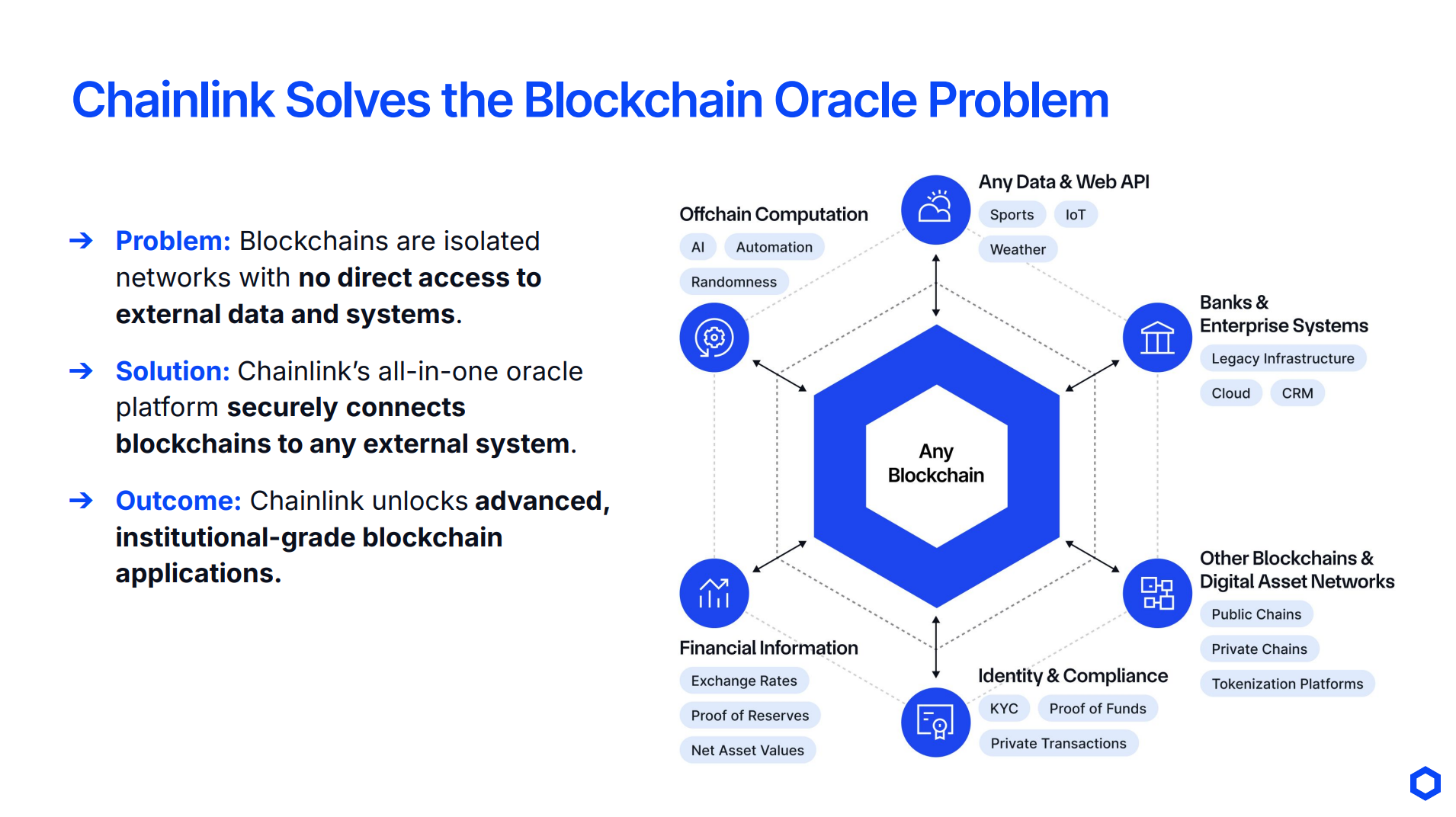
Blockchain networks operate as isolated environments, unable to natively access external data or communicate with existing systems. This limitation prevents smart contracts from interacting with real-world events, financial market data, and traditional enterprise infrastructure.
The Chainlink platform solves this challenge by providing the necessary data, interoperability, compliance, and privacy standards required for institutional blockchain use cases such as tokenized assets, decentralized finance (DeFi), and stablecoins. At the core of the Chainlink ecosystem is the LINK token.
The LINK token is the native digital commodity of the Chainlink Network, used to pay for oracle services, compensate service providers, and enhance network security. This article explores the mechanics and utility of the LINK token within the Chainlink ecosystem.
The Role of Chainlink in Onchain Finance
To understand the utility of the LINK token, it is necessary to examine how the Chainlink Network operates. Chainlink enables blockchain networks to access external data, other blockchains, and existing systems. Through Decentralized Oracle Networks (DONs), Chainlink combines decentralized data aggregation and defense-in-depth security measures to create consensus about real-world events and computations.
Chainlink is not a blockchain or a monolithic network, but operates as a collection of thousands of independent oracle networks running in parallel. These oracle networks observe, fetch, validate, and transmit information between offchain environments and blockchain networks. Through the Chainlink Runtime Environment (CRE), developers can orchestrate these diverse oracle functionalities into modular capabilities that execute across public and private blockchains. CRE serves as the orchestration layer of the Chainlink platform, allowing users to combine the Chainlink data standard, interoperability standard, compliance standard, and privacy standard into repeatable workflows.
The Role of the LINK Token
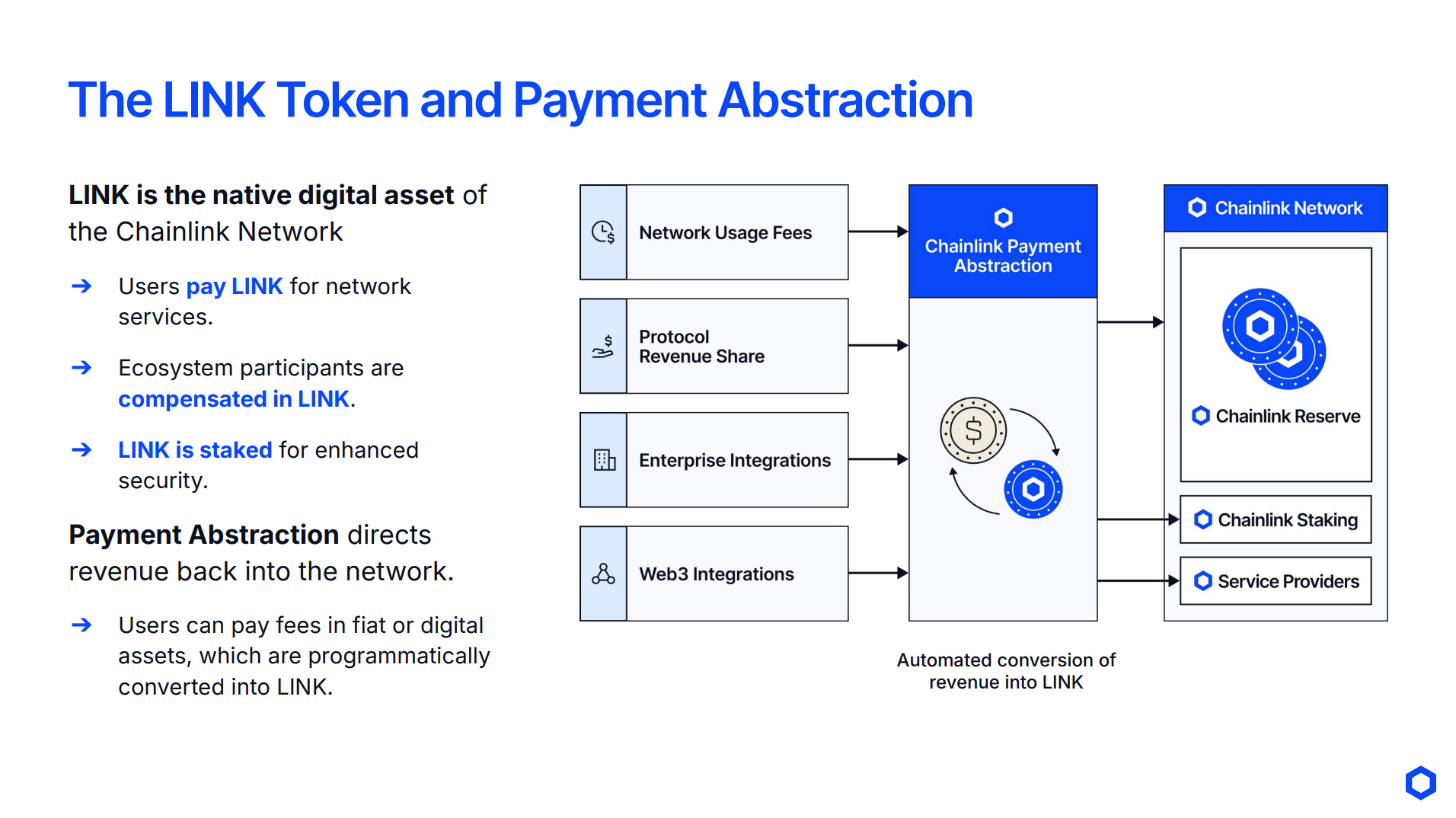
As the native digital commodity of the Chainlink Network, LINK is used by enterprises and individual developers to pay for oracle services. This is similar to how native blockchain gas coins are used to pay for transaction fees (e.g., ETH on Ethereum).
To ensure network reliability, LINK serves as the standard form of compensation paid to network service providers, such as node operators, for successfully facilitating oracle services. This creates an additional incentive for service providers to perform securely and reliably.. By ensuring that operators are reliably compensated for their computational resources and reliable onchain delivery, the LINK token helps maintain the infrastructure used by institutional-grade smart contracts.
To reduce payment friction and accelerate adoption, Payment Abstraction enables users to pay for Chainlink services in their preferred form of payment, including digitally native crypto assets and offchain fiat payment rails. These payments can then be programmatically converted into LINK tokens using a decentralized exchange. .
Payment Abstraction is used to help build the Chainlink Reserve, a strategic onchain reserve designed to support the long-term growth and sustainability of the network. The Chainlink Reserve is funded by offchain revenue from large enterprises adopting the Chainlink standard, as well as onchain revenue from service usage.
In addition to payments, Chainlink Staking uses the LINK token to support the network’s cryptoeconomic security. Staked LINK may be slashed if certain decentralized oracle networks fail to meet predefined performance requirements. This system ties economic commitments directly to service performance, reinforcing reliability as network adoption increases.
Originally issued on the Ethereum blockchain as an ERC-677 token, an extension of the widely used ERC-20 standard, the LINK token now circulates across numerous blockchain networks. Cross-chain transfers of LINK are secured by the Cross-Chain Interoperability Protocol (CCIP) using the Cross-Chain Token (CCT) standard. The total LINK token supply is capped at one billion.
Chainlink Economics and Monetization
As essential infrastructure for the onchain economy, the Chainlink Network must maintain a consistently high level of security and reliability, even during adverse conditions such as extreme market volatility or blockchain network congestion. To support this goal, the Chainlink Network is built on an economic model that rewards service providers for contributing to network security and reliability. Specifically, Chainlink Economics centers on three key pillars: revenue growth, cost reduction, and cryptoeconomic security.
1. Revenue Growth and Platform Monetization
The Chainlink platform features a wide array of payment and billing methods related to the integration, usage, and maintenance of Chainlink products and services. Monetization supports the network’s long-term economic sustainability and can include:
- Usage Fees: A model of payment where users pay for oracle services based on usage, including both subscription-based and per-call payments.
- Revenue Share: Applications and protocols share a portion of fees generated as a way to pay for the oracle services they consume.
- Enterprise Integrations: Traditional enterprises pay for the integration, usage, and maintenance of Chainlink products and services.
- Web3 Integrations: Blockchain ecosystems pay to integrate with the Chainlink Platform, most notably via the Scale program.
Demand for Chainlink has already created hundreds of millions of dollars in revenue, substantially from large enterprises that have paid offchain for access to the Chainlink platform.
2. Cost Reduction
Reductions in operating costs help make oracle services more efficient to produce and deliver, lowering the minimum threshold of fees required for sustainability. A notable example is the implementation of Offchain Reporting (OCR), which allows Chainlink oracle nodes to aggregate observations offchain before submitting a single, aggregated report onchain, saving on gas costs.
3. Cryptoeconomic Security
Cryptoeconomic security ties payments and staking-based commitments to service performance, aligning incentives and reinforcing reliability as adoption increases. This is achieved through Chainlink Staking, a cryptoeconomic security mechanism designed to enhance the security and reliability of oracle services.
Benefits and Real-World Use Cases
The Chainlink platform brings tangible benefits to both Defi protocols and traditional financial institutions. Chainlink today already secures approximately 70% of the DeFi economy and has enabled tens of trillions in transaction value.
Major DeFi protocols rely heavily on Chainlink services. Aave, the largest DeFi protocol with tens of billions in deposits, uses the Chainlink data standard to access reliable market data to help ensure protocol solvency. Aave also uses Chainlink Smart Value Recapture (SVR) to recapture non-toxic oracle MEV, establishing an additional protocol revenue stream. Lido upgraded to CCIP as the official cross-chain infrastructure for its wrapped staked ether across all chains, using the CCT standard to secure cross-chain transfers.
Traditional financial institutions are also adopting Chainlink for complex tokenized asset servicing. UBS worked with its tokenization unit, Chainlink, and DigiFT to complete an end-to-end tokenized fund workflow using the Chainlink Digital Transfer Agent technical standard. This live transaction successfully processed an onchain subscription and redemption request for a tokenized fund. Furthermore, financial institutions like ANZ and Fidelity International use Chainlink for cross-chain settlement workflows, proving that Chainlink can overcome the challenges of bringing verifiable identity data and automated transfer agent operations onchain.
Future Outlook
The future trajectory of the Chainlink ecosystem is closely tied to the expansion of the onchain economy and the broader adoption of institutional tokenization. As the blockchain industry evolves, the demand for highly reliable external data, secure cross-chain interoperability, privacy-preserving compute, and automated compliance will continue to grow. Chainlink Economics is designed to scale alongside this demand, establishing a durable feedback loop where increased usage funds better security at lower unit costs.
By establishing a virtuous cycle where network service providers are economically supported, Chainlink ensures the continuous provision of secure oracle infrastructure. As more value moves onchain through tokenized assets, stablecoins, and decentralized finance, the utility of the LINK token in securing these transactions and compensating decentralized infrastructure providers will remain fundamental to the operation of the global onchain financial system.


