Chainlink Introduces CCIP 2.0, Opening the Floodgates for the World’s Capital to Flow Onchain
.png)
CCIP 2.0 is now live and available to all institutions and digital asset issuers. This upgrade introduces key new features that reinforce CCIP’s position as the only interoperability standard designed to meet the security, compliance, and speed requirements of the world's largest financial institutions.
Blockchain’s next chapter is about bringing the entire global financial system onchain to transform how the world issues, moves, and manages value. And with MiCA in the EU, the GENIUS Act in the U.S., and joint agency work between the U.S. SEC and CFTC, the regulatory runway for digital and tokenized assets has never been clearer.
Asset issuers and tokenization platforms are now racing to bring stocks, ETFs, funds, commodities, and currencies onchain, while institutions accelerate their transition from experimental pilots to revenue-generating products and services.
More financial activity is happening onchain than ever before, yet institutional assets and workflows are still highly fragmented across public and private blockchains. Secure cross-chain connectivity is now essential for institutions looking to maximize distribution and unlock real utility for their assets across markets.
Institutions face three major barriers to operating across blockchains: cost, control, and security. Building cross-chain infrastructure in-house can take months of specialized engineering and cost six figures per chain. Furthermore, adopting infrastructure controlled by competitors creates strategic dependencies that can give a competitor asymmetrical advantages. Meanwhile, relying on legacy bridges exposes tokenized assets to the same vulnerabilities that have already resulted in billions of dollars in losses. Global markets need a neutral interoperability standard that institutions across jurisdictions can trust to collaborate on.
CCIP solves this by providing the first credibly neutral, institutional-grade cross-chain standard. Institutions only need to establish their security, compliance, and operational frameworks on CCIP once; they can then apply them across every chain they adopt. The result is scalable asset distribution without rebuilding infrastructure, advantaging competitors, or compromising the protections regulated capital requires.
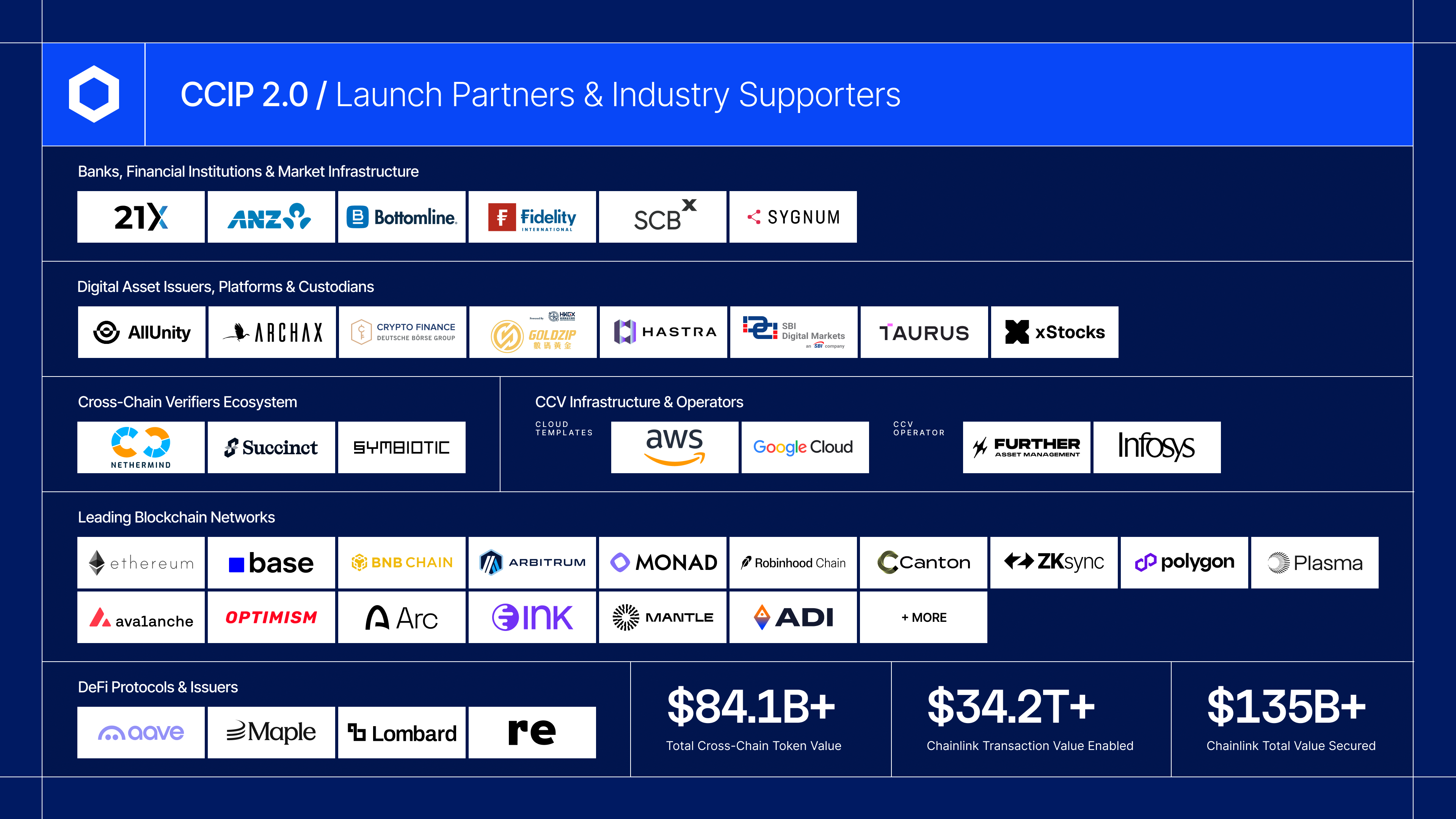
CCIP is already the most value-securing cross-chain solution in the industry, with over $84 billion in total cross-chain token value. In an industry flight to safety, $15+ billion in token value migrated to CCIP in the last 4 months alone, including BitGo’s $7.4+ billion WBTC, Coinbase’s $6.1B+ cbBTC, Kraken’s kBTC, the State of Wyoming’s official stable token FRNT, and many more. Among major financial institutions, launch partners and industry supporters include AllUnity, Amazon Web Services, ANZ Bank, Archax, Bottomline, Deutsche Börse Group’s Crypto Finance, Fidelity International, Further Asset Management, GoldZip by the Hong Kong Gold Exchange, Google Cloud, Hastra by Figure, Infosys, Nethermind, SBI Digital Markets, Sygnum, Taurus, TokenX by SCBX, and xStocks, who are integrating their digital assets and infrastructure with CCIP.
CCIP 2.0 begins a new era for the digital asset industry by laying the rails for hundreds of trillions of dollars in capital from existing financial systems to flow onchain. Key benefits with the CCIP 2.0 release include:
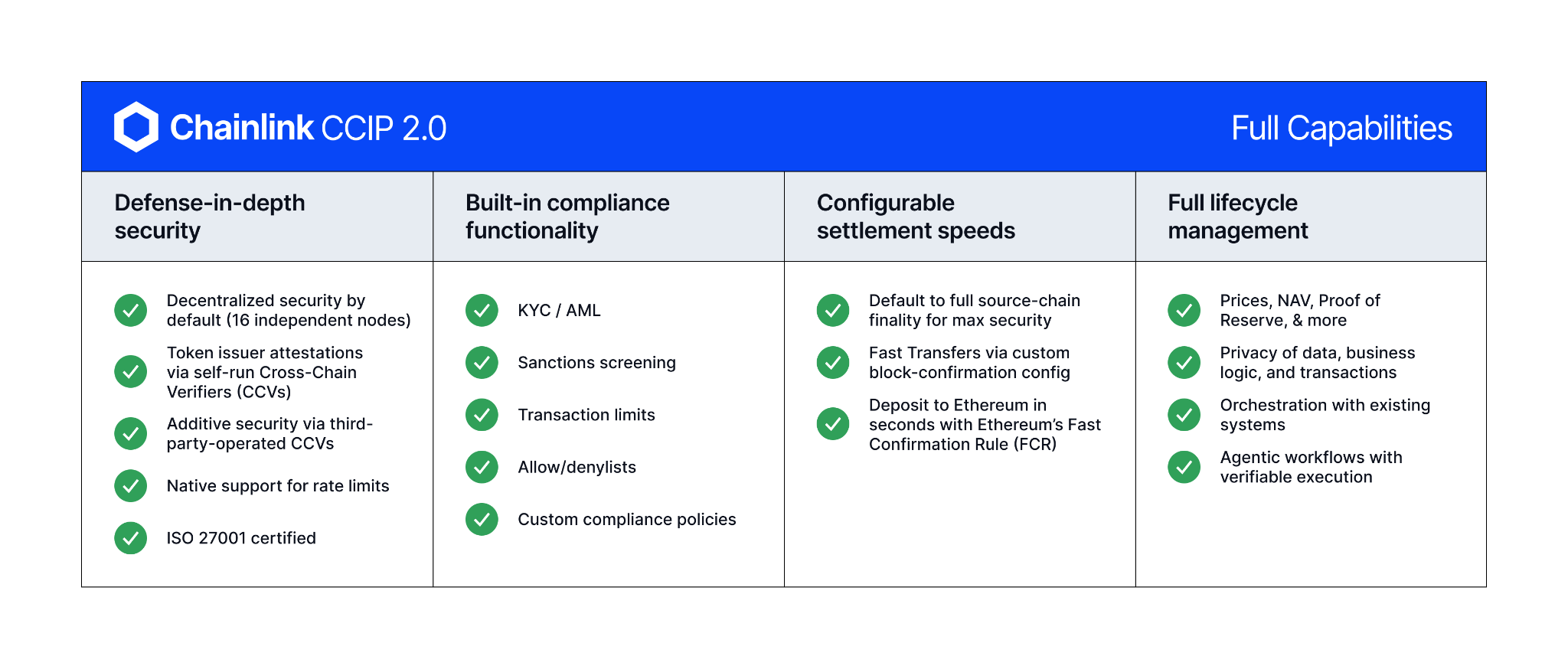
- User attestations: Participate directly in verifying cross-chain transactions by operating your own Cross-Chain Verifier (CCV). Your CCV independently verifies and cryptographically signs transactions, adding a verification step that must be completed before CCIP can execute them on the destination chain. CCVs can run on bare metal or your preferred cloud platform, with pre-built starter kits available for Amazon Web Services and Google Cloud.
- Additive security: Layer additional independent verification on top of CCIP’s ISO 27001 infrastructure using CCVs operated by you or third-party enterprise providers. Organizations such as Infosys are already building CCVs for clients that want additional verification without managing the infrastructure themselves.
- Built-in compliance functionality: Add governance policies, approval workflows, and other issuer-defined controls to enforce requirements such as KYC, AML, transaction limits, and more on every cross-chain transaction.
- Configurable finality speeds: Fine-tune how quickly transactions settle, from near-instant transfers to waiting for full source-chain finality for maximum security.
- Full lifecycle management: Power end-to-end digital asset transactions by combining CCIP with the broader Chainlink platform for trusted data, existing system integration, privacy, and agentic workflows.
Start building on CCIP today using the Chainlink docs or reach out to the Chainlink Labs team to get started.
How CCIP 2.0 Unlocks Institutional Capital Onchain
CCIP 2.0 provides the infrastructure institutions and asset issuers need to securely manage regulated capital across public and private blockchain environments. This enables seamless asset distribution across markets while preserving the custom policies, privacy requirements, and operational controls needed to unlock real utility onchain.
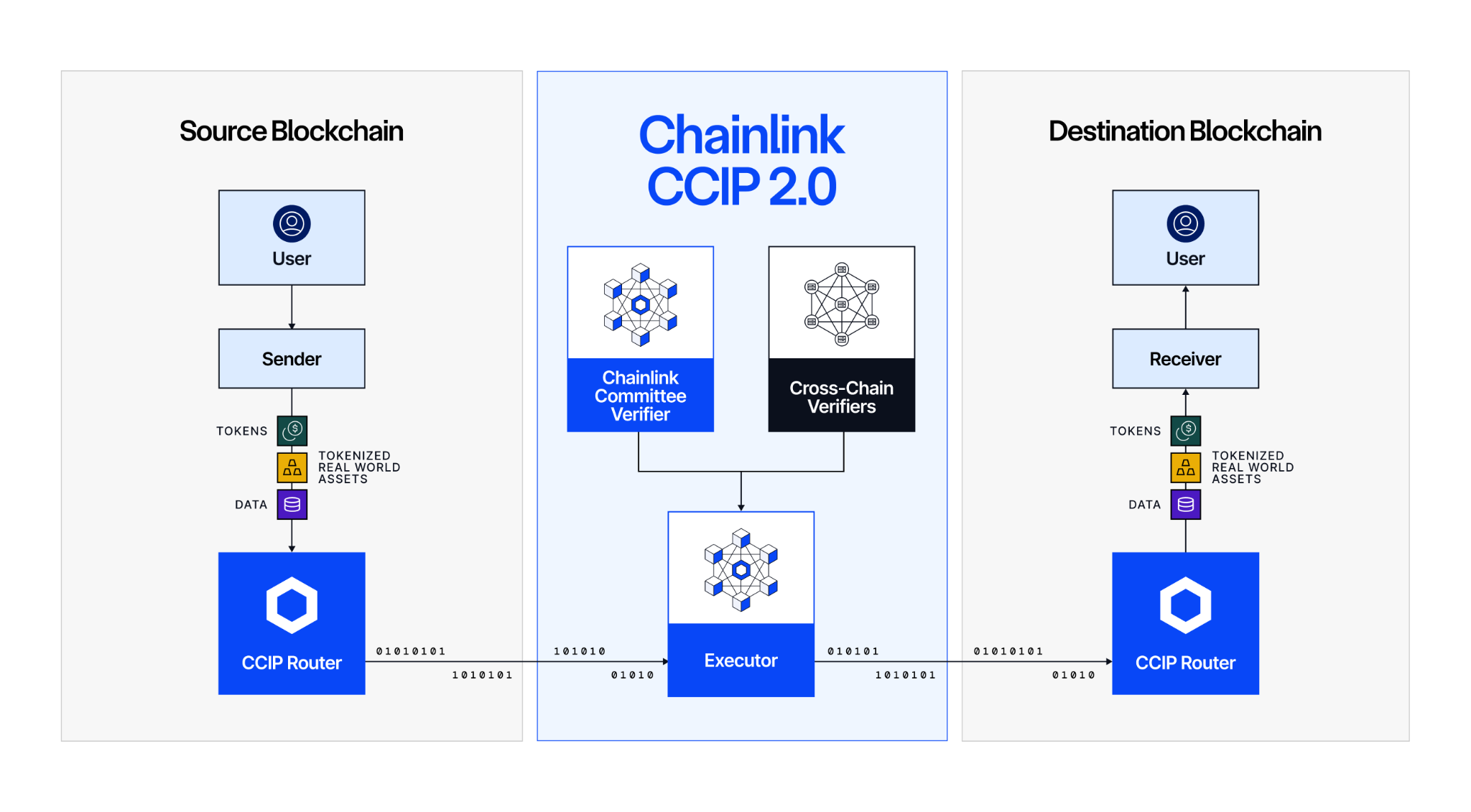
CCIP 2.0 supports three key capabilities for scaling institutional adoption of digital assets.
1) Establish Institutional Risk Controls
Institutions and asset issuers have different requirements for how their capital moves. A bank may have internal risk mandates for transaction validation; an institutional investor may want verifiable audit trails; and a DeFi protocol may seek its own verification layer when bridging assets.
CCIP 2.0 leverages the same decentralized oracle network infrastructure that has enabled tens of trillions in transaction value, and is certified to meet institutional-grade requirements. The default Chainlink Committee Verifier consists of 16 independent, security-reviewed node operators with extensive experience operating mission-critical infrastructure, who must come to consensus on every cross-chain transaction.
On top of this security foundation, CCIP 2.0 now offers more granular security controls for both token transfers and arbitrary messaging, including:
- Additive verification: On top of CCIP’s secure-by-default infrastructure, institutions and asset issuers can operate their own Cross-Chain Verifiers (CCVs) or select independent CCVs run by trusted third parties, adding another layer of verification to meet specific operational requirements. In this model, both the default Chainlink Committee Verifier and the independent CCV(s) must cryptographically sign a cross-chain transaction before it can be executed.
- Customizable enforcement: Users can define when and how their added security controls are applied (e.g., additional approval needed for any transaction above $1M).
- Open CCV Marketplace: Third-party verifiers can set custom verification fees on top of CCIP's base fee rate. This creates an open market for specialized verification services, giving issuers more choice while incentivizing providers to maintain high reliability.
With CCIP 2.0, established infrastructure companies can build and operate specialized CCVs for asset issuers, turning their expertise into revenue-generating services. Issuers gain additional verification without having to manage the underlying infrastructure and can select providers best suited to their requirements. As demand grows, the open CCV marketplace allows for more entrants and increasingly specialized services, expanding the security options available to every asset on CCIP.
Asset issuers like Lombard (leading Bitcoin yield platform) are adopting CCIP 2.0 to integrate custom CCV-enabled verification logic into their cross-chain tokens. Institutions, asset issuers, and developers have access to starter kits that make it easy to spin up CCVs on their existing cloud infrastructure, including Amazon Web Services and Google Cloud. Additionally, leading digital services companies, such as Further Asset Management, Infosys, Nethermind, and more, are developing and operating CCV infrastructure on behalf of customers.
Contact Chainlink Labs today to learn how to deploy and monetize your own CCV.
2) Transact in Seconds
Ethereum sits at the center of much of today’s cross-chain activity, making its confirmation time a major constraint on settlement speed. Working with Ethlabs, CCIP 2.0 unlocks a new class of cross-chain transactions by being one of the first protocols to support Ethereum’s Fast Confirmation Rule (FCR) when it launches. With Ethereum’s FCR supporting transaction confirmation in seconds, CCIP creates a fast execution path for payment flows involving Ethereum that previously could not operate effectively across chains.
But markets don't run at just one speed. A routine payment may need to clear within seconds, while a wholesale settlement may require full finality and additional sign-off. CCIP 2.0 gives issuers direct control over execution parameters, allowing lower-value, high-frequency transfers to use faster execution while higher-value transactions wait for full source chain finality. Issuers can define how much value they are comfortable moving faster-than-finality and charge additional fees to account for the associated risk. The result is a configurable settlement model with secure defaults, supporting high-frequency payment flows and higher-value institutional transactions.
- Secure-by-default configuration: The default configuration of CCIP is to wait for full source chain finality for maximum security, the duration of which is determined by each chain’s unique attributes.
- Custom confirmation thresholds: Issuers can define a custom block-confirmation config, enabling faster-than-finality transfers for both messages and token transfers.
Leading DeFi protocols, including Aave (largest lending platform), Re (largest tokenized reinsurance platform), Maple (the onchain asset manager), and more, have adopted CCIP 2.0 to unlock faster-than-finality transfers for their native cross-chain tokens.
3) Automate Compliance Enforcement
Most legacy bridges today cannot enforce KYC, AML, or sanctions screening on transfers. As a result, regulated issuers can't distribute tokenized assets broadly across onchain markets, while DeFi can't access the world’s deepest pools of capital.
CCIP 2.0 directly integrates with the Chainlink Automated Compliance Engine (ACE), providing a framework for embedding always-on policy controls and traceability into cross-chain transfers. This turns regulatory requirements from a manual operational burden into codified instructions that can be applied consistently to every transaction.
Institutions can enforce programmable identity and compliance controls on transactions involving their assets, such as:
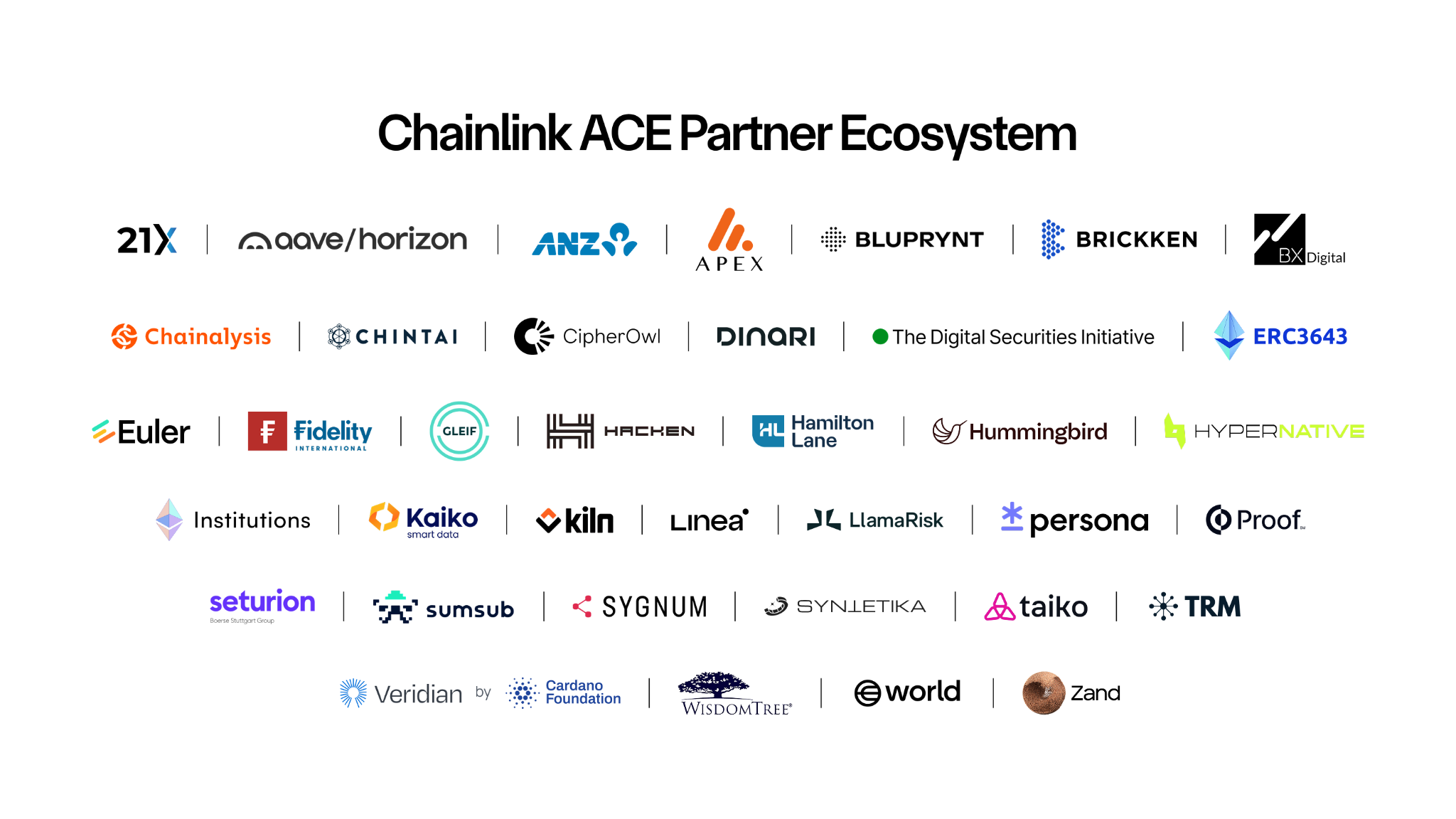
- Eligibility checks: Embed allowlist, denylist, and sanctions screening to ensure counterparties meet issuer-defined KYC, AML, and cross-jurisdictional requirements. Issuers can leverage the ACE partner ecosystem, featuring 20+ leading compliance providers, frameworks, and regulators, or simply integrate their own system to add policies seamlessly without rebuilding from scratch.
- Transaction and exposure limits: Apply value-based thresholds, rate limits, and other parameters to align with internal risk and collateral requirements.
- Issuer-owned controls: Support private or allowlisted token pools and issuer-defined policy checks so only authorized senders/receivers can move value across chains.
Why CCIP Is the Optimal Cross-Chain Deployment Strategy: Lower Costs, Faster Scaling, Credibly Neutral
CCIP 2.0 provides neutral, secure-by-default infrastructure built to eliminate the compounding costs and technical debt of building and operating in-house solutions. Building cross-chain infrastructure in-house often requires chain-specific expertise, more than half a year of development, and six figures in engineering work per supported blockchain.
Institutions will need to operate, secure, and deliver 99.99%+ global uptime for such mission-critical infrastructure, as well as stand up and continuously maintain secure connections across all supported blockchains. Each additional chain introduces further complexity, with every chain featuring its own RPC standards/endpoints, gas-fee market dynamics, finality models, hard-fork governance processes, and more. Institutions must also extend and synchronize their existing KYC/AML systems and broader compliance frameworks across all chains, ensuring that sanctions screening, transaction monitoring, and policy enforcement remain consistent as assets move between networks.
This model exposes institutions to significant risks, including cross-chain state mismatches, reorgs and chain halts, signing key exposure, and integration patches as each network evolves independently. The result is a permanently expanding operational, compliance, and security burden that must be monitored in real time across all chains simultaneously. Beyond the technical challenges, proprietary shared infrastructure often has limited adoption because competitors are unlikely to build on and transfer assets through a rival's infrastructure.
In contrast, CCIP provides institutions with an end-to-end, secure-by-default solution that is already connected to every major blockchain network, with the complexities and upgrade processes abstracted away, so clients can focus on their core business objectives.
As shared, globally accessible cross-chain rails, banks, and asset managers can adopt CCIP without ceding control to a competitor, while also benefiting from network effects that scale with adoption. CCIP instantly connects assets to a composable global network of leading DeFi protocols and financial institutions, enabling cross-chain liquidity and scalable distribution without needing to rebuild integrations for each market. Institutions only need to build their security, compliance, and operational frameworks once and can then apply them across all the public and private chains they expand to.
Leading financial institutions and market infrastructures are already leveraging CCIP for secure and reliable cross-chain interoperability, including:
- Swift partnered with Chainlink to enable financial institutions to connect to any public or private blockchain by leveraging CCIP along with their existing Swift infrastructure and ISO 20022 messaging standards.
- 24 of the world’s largest financial institutions and market infrastructures, including Swift, DTCC, Euroclear, UBS, and Wellington Management, leveraged CCIP to distribute validated corporate actions data across DTCC’s blockchain ecosystem and public/private blockchains.
- ANZ Bank and Fidelity International leveraged CCIP to power secure messaging and value transfer of e-HKD across jurisdictions and chains.
- SBI Digital Markets adopted CCIP as its exclusive cross-chain infrastructure to power interoperable and compliance-ready tokenized real-world asset transfers across its digital asset platform.
Learn more about the secure-by-default architecture powering global onchain finance: https://chain.link/blog/ccip-cross-chain-standard
Start Building In Minutes With CCIP 2.0
The infrastructure for the next $600 trillion in onchain finance is now in your hands. We’ve eliminated the complexity of cross-chain integrations so you can securely deploy capital and unlock global asset distribution in minutes.
CCIP 2.0 includes a ground-up redesign of the developer experience, enabling teams to ship faster while giving them more control over how they build, configure, and manage cross-chain transactions, assets, and execution times.
- A redesigned API, SDK, and CLI reduce integration friction and help teams get to production faster. Developers can integrate standard CCIP transfers and fast paths through a more unified interface.
- Greater configurability over transaction execution and token pool behavior.
View the complete list of chains now live with Chainlink CCIP 2.0, with more being added each week.
If you are a financial institution, tokenized asset issuer, or DeFi developer interested in integrating CCIP 2.0, check out the docs or reach out to the Chainlink Labs team.
—
Disclaimer: This post is for informational purposes only and contains statements about the future, including anticipated product features, development, and timelines for the rollout of these features. These statements are only predictions and reflect current beliefs and expectations with respect to future events; they are based on assumptions and are subject to risk, uncertainties, and changes at any time. There can be no assurance that actual results will not differ materially from those expressed in these statements, although we believe them to be based on reasonable assumptions. All statements are valid only as of the date first posted. These statements may not reflect future developments due to user feedback or later events, and we may not update this post in response. Chainlink does not hold or transfer any assets. Please review the Chainlink Terms of Service, which provides important information and disclosures.