Atomic Cross-Chain Transactions Explained
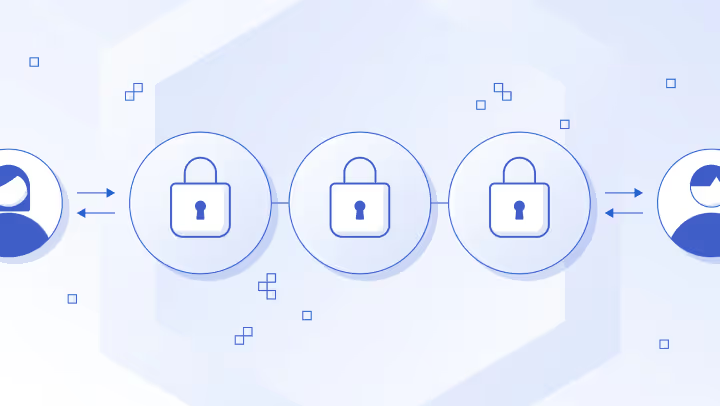
An atomic cross-chain transaction is a decentralized exchange mechanism where two parties trade assets across different blockchains without a third-party intermediary. The process relies on smart contracts to ensure atomicity, meaning the trade either completes successfully for both parties or fails entirely, preventing partial execution or loss of funds.
Blockchains operate as isolated ledgers with distinct consensus mechanisms, security models, and assets. While this isolation protects the network, it fragments liquidity and creates friction for users moving value between environments. Historically, interoperability required centralized intermediaries, introducing counterparty risk and single points of failure.
Atomic cross-chain transactions solve this by enabling trustless, peer-to-peer exchange across disparate networks. By using cryptographic guarantees rather than institutional trust, these transactions ensure value transfers either happen completely or not at all. As the ecosystem matures, atomic transactions are essential for developers building the next generation of decentralized finance (DeFi) and for institutions integrating capital markets onchain.
What Are Atomic Cross-Chain Transactions?
An atomic cross-chain transaction, often called an atomic swap, allows two parties to exchange assets on different blockchains without a trusted third party like a centralized exchange (CEX). The defining characteristic is "atomicity," a concept from database systems. Atomicity guarantees a transaction is an indivisible unit: all parts occur, or none do.
In a traditional cross-chain exchange via an intermediary, users face counterparty risk; they must trust the custodian not to lose or steal funds. Atomic cross-chain transactions remove this risk by using non-custodial smart contracts. If one party fails to fulfill their side of the trade within a timeframe, the protocol automatically refunds the other party. This facilitates a peer-to-peer economy where users keep control over their private keys and assets throughout the process.
The Technical Core: Hash Time-Locked Contracts (HTLCs)
The Hash Time-Locked Contract (HTLC) powers most atomic cross-chain transactions. An HTLC is a smart contract that uses cryptographic proofs and time constraints to enforce trade terms. It removes the need for mutual trust by mathematically guaranteeing funds remain inaccessible unless specific conditions are met.
An HTLC relies on two primary cryptographic pillars:
- Hashlocks: This acts as a digital padlock. It requires a cryptographic key (a "preimage") to unlock funds. The depositor creates a secret data string and hashes it. The counterparty can only claim funds deposited into the smart contract if they provide the original secret data matching the hash. This proves the payment conditions are satisfied.
- Timelocks: This functions as a deadline. It ensures funds don't remain locked indefinitely if the trade fails. If the counterparty doesn't reveal the preimage within a set block height or timestamp, the timelock expires, and the protocol refunds the original depositor.
Step-by-Step: How an Atomic Swap Executes
To understand the mechanics, consider a scenario where Alice wants to trade Bitcoin (BTC) for Bob’s Ether (ETH). The process follows a precise sequence to secure assets for both parties:
- Setup and Locking (Alice): Alice generates a random secret key (the preimage) and hashes it. She creates an HTLC on the Bitcoin network, deposits her BTC, and locks it with the hash. She shares the hash, but not the secret key, with Bob.
- Verification and Locking (Bob): Bob verifies Alice locked her funds on the Bitcoin blockchain. He creates a corresponding HTLC on the Ethereum network using the same hash. He deposits his ETH into this contract, locking it for Alice.
- Claiming (Alice): Once Alice sees Bob’s deposit on Ethereum, she claims the ETH by revealing the secret key to the Ethereum smart contract. This action publicly reveals the secret key on the Ethereum blockchain.
- Finalization (Bob): Bob observes the revealed secret key on the Ethereum ledger. He uses this key to unlock and claim the BTC deposited by Alice on the Bitcoin network. The swap finishes.
- Refunds (Fallback): If Bob never locks his funds, or if Alice never claims the ETH, the timelock expires, allowing the original depositors to withdraw their assets.
The Role of Chainlink and CCIP in Modern Interoperability
Traditional atomic swaps often restrict users to specific trading pairs and require manual management of cryptographic secrets. The Chainlink Interoperability Standard, powered by the Cross-Chain Interoperability Protocol (CCIP), expands basic asset swaps into programmable token transfers and arbitrary messaging.
CCIP provides a universal standard for developers to build secure cross-chain applications that transfer data and value across public and private blockchains. Unlike simple peer-to-peer atomic swaps, The Chainlink Runtime Environment (CRE) orchestrates complex workflows, such as "Burn and Mint" (where tokens are burned on the source chain and minted on the destination chain) and "Lock and Mint."
For financial institutions, this capability enables Delivery-vs-Payment (DvP) workflows where payment and asset delivery occur simultaneously across different chains. By using a Risk Management Network that monitors for anomalies, CCIP adds security beyond the basic cryptographic guarantees of a standalone HTLC. This standard allows organizations like Swift and ANZ to connect legacy financial systems to blockchain networks.
Types of Atomic Transactions: Onchain vs. Offchain
Atomic transactions fall into two categories based on settlement location, each offering distinct advantages regarding speed and cost.
Onchain atomic swaps occur directly between two different blockchains. The transaction records on both the source and destination ledgers. This method offers high security and transparency but depends on the underlying blockchains' limitations, such as slower confirmation times and higher transaction fees. For example, a direct swap between Bitcoin and Litecoin requires waiting for block confirmations on both networks.
Offchain atomic swaps use layer-2 payment channels, such as the Lightning Network. In this model, the initial transaction to open a payment channel records onchain, but the actual swap occurs offchain. This allows for near-instant settlement and low fees, making it useful for high-frequency trading or micropayments. However, offchain swaps often require more complex infrastructure and active node management compared to direct onchain settlements.
Benefits vs. Challenges
The adoption of atomic cross-chain transactions supports a more open financial system, but the technology involves trade-offs.
- Trust minimization: Users don't need to trust a centralized exchange or the counterparty. The code enforces the trade.
- Reduced counterparty risk: Because the transaction is atomic, one party can't lose funds because the other failed to pay.
- Non-custodial: Users maintain ownership of their private keys and assets until the exchange.
However, challenges remain:
- Latency: Onchain swaps depend on the block times of the participating blockchains. If one chain is slow, the trade delays.
- The "free option" problem: One party can abandon the trade if the market moves against them, effectively getting a free option to execute or cancel at the expense of the other party’s time and liquidity.
- Complexity: Managing preimages, hashlocks, and multiple wallets creates a steeper learning curve for users compared to centralized interfaces.
Real-World Applications and Future Outlook
As blockchain technology enters capital markets, the utility of atomic cross-chain transactions extends beyond retail trading. In DeFi, these transactions enable cross-chain liquidity aggregation, allowing protocols to source better prices for users across multiple networks. This reduces slippage and improves market efficiency, often utilizing the Chainlink Data Standard to provide reliable exchange rates during settlement.
On the institutional side, atomic settlement changes traditional financial workflows. Major financial infrastructures explore onchain Delivery-vs-Payment (DvP) models to settle tokenized assets. Kinexys by J.P. Morgan and Ondo Finance used Chainlink to complete an atomic cross-chain DvP transaction for tokenized treasury funds. This demonstrates how atomic principles can eliminate settlement risk and costly reconciliation in global finance.
The convergence of atomic principles with advanced interoperability standards like Chainlink CCIP helps phase out manual P2P swaps in favor of automated, smart contract-driven cross-chain flows. This evolution connects private bank chains and public DeFi protocols into a unified global onchain economy.
The Future of Atomic Settlement
Atomic cross-chain transactions replace centralized trust with cryptographic truth, enabling secure value exchange in a fragmented landscape. While Hash Time-Locked Contracts provided the initial proof of concept, the industry requires more scalable solutions.
The Chainlink oracle platform and The Chainlink Runtime Environment (CRE) accelerate this shift by providing the connectivity needed to bring capital markets onchain. Whether for DeFi users seeking trustless swaps or global institutions automating cross-border settlements, the principles of atomicity remain central to building a reliable internet of contracts.