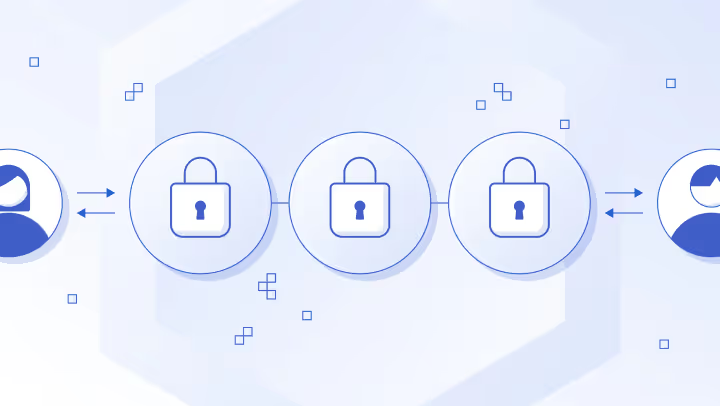
Cross-Chain Communication: Connecting Isolated Blockchain Networks
Cross-chain communication is the process of transmitting data, tokens, and instructions between isolated blockchain networks. This interoperability allows developers to build unified applications that use the unique advantages of multiple chains.
Blockchain networks operate as independent ledgers. A smart contract on Ethereum cannot natively read data from Solana or execute a transaction on Bitcoin. This isolation creates fragmented environments where liquidity, user identities, and application logic remain confined to single networks. As the Web3 space expands, developers and institutions require seamless connectivity between these distinct environments.
Cross-chain communication provides the infrastructure needed to bridge this gap. By enabling the secure transfer of data and value across different blockchains, interoperability protocols transform isolated networks into a unified, globally accessible environment. This connectivity is critical for building advanced decentralized finance applications, facilitating institutional tokenized asset transfers, and supporting complex smart contract operations across multiple environments simultaneously.
What Is Cross-Chain Communication?
Cross-chain communication refers to the technology and protocols that enable independent blockchain networks to share data, tokens, and state changes. In their default state, blockchains are highly secure but entirely isolated. They lack native mechanisms to verify events or read information outside their own environment. This inherent limitation is commonly known as the blockchain silo problem.
When a developer builds an application on a single blockchain, they are restricted to the liquidity, user base, and technical capabilities of that specific network. If a user wants to move assets from one chain to another, they traditionally have to rely on centralized exchanges or complex manual processes. Cross-chain communication solves this by creating secure pathways for different networks to interact directly.
Interoperability is essential for the growth of Web3 and the adoption of onchain technologies by existing systems. Financial institutions and enterprise organizations operate across multiple jurisdictions and technical environments. To interact with decentralized systems effectively, they need a reliable way to route transactions and data across various blockchains without building custom, point-to-point integrations for each one. Cross-chain communication allows developers to design applications that span multiple networks seamlessly. This capability ensures that users can access services and assets regardless of the underlying blockchain they choose to interact with.
How Cross-Chain Communication Works
Transmitting information between distinct blockchains requires an intermediary layer to facilitate the exchange. Because two separate blockchains cannot natively inspect each other, cross-chain communication relies on offchain infrastructure to observe an event on a source chain, validate it, and relay the corresponding instruction to a destination chain.
This process typically involves several different architectural approaches to handle cross-chain transfers and arbitrary message passing.
- Lock-and-mint bridges: This method involves locking a user asset in a smart contract on the source chain. Once the asset is locked, an equivalent amount of a wrapped asset is minted on the destination chain. When the user wants to return to the original network, the wrapped asset is burned, and the original asset is unlocked.
- Liquidity networks: Instead of wrapping assets, liquidity networks maintain pools of native tokens on multiple blockchains. When a user deposits a token on the source chain, the protocol releases the equivalent native token from its pool on the destination chain. This approach avoids the complexities of wrapped assets but requires deep liquidity on all supported networks.
- Arbitrary message passing: This is the most advanced form of cross-chain communication. Rather than simply moving tokens, arbitrary message passing allows smart contracts to send complex data payloads and functional calls across chains. A developer can trigger a function on a destination chain based on an event that occurred on a source chain. This enables true cross-chain smart contract execution, allowing applications to split their logic and state across multiple networks.
Benefits of Cross-Chain Interoperability
The primary advantage of cross-chain communication is the ability to unify fragmented networks. Without interoperability, liquidity remains trapped within individual networks. This fragmentation leads to inefficient capital allocation, higher slippage for decentralized exchanges, and limited liquidity for lending protocols. Cross-chain communication consolidates these isolated pools. This creates unified liquidity that improves capital efficiency across the entire decentralized finance (DeFi) space.
Enhanced user experience is another significant benefit. Navigating multiple blockchains often requires users to manage different wallets, pay varying gas fees in different native tokens, and understand complex bridging interfaces. Cross-chain infrastructure abstracts these complexities away. Users can interact with an application from their preferred network while the underlying protocol handles the cross-chain routing automatically.
For developers, interoperability enables the ability to build chain-agnostic applications. Instead of deploying the exact same smart contract code on a dozen different blockchains, developers can create a single, unified application that uses the specific strengths of various networks. A decentralized application might use a highly secure base layer for settlement while utilizing a high-throughput network for computation. Furthermore, institutions can use powerful orchestration layers like the Chainlink Runtime Environment (CRE), and the Chainlink interoperability standard, powered by the Cross-Chain Interoperability Protocol (CCIP), to connect their existing infrastructure to multiple blockchain networks through a single integration point, which drastically reduces development overhead and accelerates the adoption of tokenized assets.
Cross-Chain Use Cases and Examples
Robust cross-chain communication enables a wide variety of advanced applications that span multiple networks. Decentralized exchanges use this technology to allow users to swap native tokens across different blockchains without relying on centralized intermediaries. By routing trades through cross-chain protocols, these exchanges can source liquidity from multiple networks simultaneously. This reduces slippage and provides users with better execution prices.
The Future of Cross-Chain Connectivity
As the Web3 space matures, the demand for secure and reliable cross-chain infrastructure will only increase. Future developments will likely focus on enhancing security through decentralized validation networks and improving the developer experience with more intuitive abstraction layers. Ultimately, cross-chain communication blurs the lines between individual blockchains, creating a unified digital economy where data and value flow freely across all networks.