What Is a Crypto Dusting Attack?
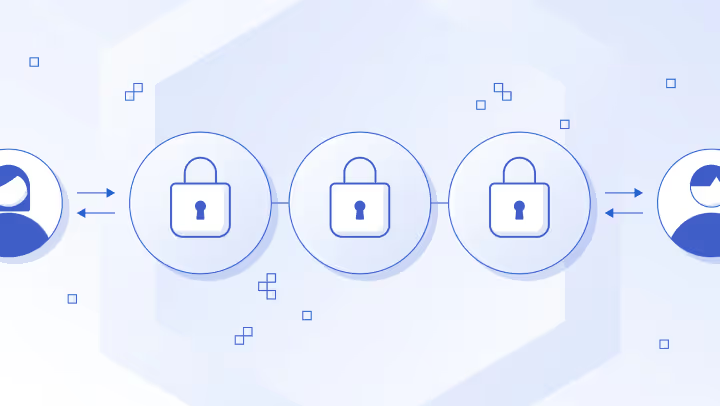
A crypto dusting attack is a malicious activity where attackers send tiny amounts of cryptocurrency to thousands of wallets. The goal is to track the flow of funds and deanonymize the wallet owners by analyzing how these small amounts are combined with other assets.
As the blockchain industry expands, users and institutions face complex security and privacy challenges. High-profile exploits often involve smart contract vulnerabilities or social engineering, but some threats are more subtle. A crypto dusting attack relies not on theft of funds but on the erosion of anonymity. Attackers distribute minute amounts of cryptocurrency to many addresses to map connections between wallets and real-world identities.
This tactic exploits the transparency inherent in public ledgers. Blockchain transactions are pseudonymous but fully traceable. A dusting attack seeks to bridge the gap between an onchain address and a specific identity. Understanding the mechanics of these attacks is essential for operational security, particularly when managing significant capital onchain.
Defining the Dusting Attack
In digital assets, "dust" is a tiny amount of cryptocurrency generally smaller than the cost of the network fee required to spend it. On the Bitcoin network, a few hundred satoshis might be considered dust because the transaction fee to move them would exceed their value. These residuals often accumulate naturally in wallets after multiple trades or transactions, remaining unspent because they are economically irrational to move.
A dusting attack weaponizes these negligible balances. Malicious actors broadcast transactions that distribute dust to thousands or even hundreds of thousands of wallet addresses simultaneously. Recipients often see a random, insignificant deposit in their transaction history. Unlike airdrops, which often serve as marketing tools or reward mechanisms for legitimate projects, the intent behind a dusting attack is rarely benevolent.
The primary objective is surveillance. The attacker does not intend to steal the dust back. Instead, they invest small amounts of capital to tag specific wallets. Once the dust lands in a wallet, it acts as a tracking marker. If the wallet owner inadvertently combines this dust with other funds during a future transaction, they trigger a chain of onchain evidence that the attacker can analyze to compromise the user's privacy.
How a Dusting Attack Works
Dusting attacks can rely on the Unspent Transaction Output (UTXO) model used by blockchains like Bitcoin. In a UTXO-based system, a user's wallet balance is not stored as a single number but as a collection of separate unspent outputs from previous transactions. When a user initiates a transaction, their wallet selects enough of these separate outputs to cover the total amount being sent and the network fees.
If a user ignores the dust and eventually attempts to send a transaction that requires aggregating multiple inputs, their wallet might automatically select the dust UTXO along with other legitimate funds to fulfill the transaction value. This process, called input consolidation, provides cryptographic proof that all the inputs involved belong to the same entity.
Consolidation allows the attacker to cluster previously unrelated addresses. By analyzing the transaction graph, the attacker can link the dusted address to other addresses owned by the same user. If even one of those linked addresses interacts with a centralized exchange that requires Know Your Customer verification or a merchant that collects shipping information, the attacker can reveal the real-world identity behind the entire cluster of wallets. While account-based models like Ethereum handle balances differently, the core principle of tracking fund movements to deduce ownership patterns remains a relevant threat vector.
Who Conducts Dusting Attacks and Why?
Perpetrators vary in motivation and sophistication. Cybercriminals often seek to compromise targets for phishing or extortion. Linking a high-value wallet to a specific individual allows attackers to launch targeted social engineering campaigns. If a hacker successfully links a whale wallet to a personal email address or phone number, they may attempt to extort the owner by threatening to reveal their financial history or by launching spear-phishing attacks to gain access to private keys.
Not all dusting activity is criminal. Blockchain analytics firms and academic researchers sometimes use similar techniques to study network behavior, map transaction flows, or test the limits of blockchain privacy. These entities may be contracted by government agencies or law enforcement to trace illicit funds. In these cases, the goal is forensic analysis rather than theft.
Some high-volume dusting events are simply spam. Projects may distribute tiny amounts of a token with a promotional message attached to the transaction metadata to advertise a new service or protocol. While less malicious than identity theft, this "spam dust" still clutters the network and can contain phishing links. Regardless of the source, the tracking mechanism remains a privacy concern for the recipient.
Identifying and Handling Crypto Dust
Identifying a dusting attack requires vigilance. Users might see a sudden influx of extremely small deposits from unknown sources. These transactions often stand out because they do not correspond to any initiated trade, withdrawal, or payment. In many modern wallet interfaces, these amounts are so small that they may not significantly impact the displayed portfolio value, making them easy to overlook without careful inspection of onchain data.
The most critical step is inaction. The attack is only successful if the dust is moved. As long as the dust remains unspent and isolated in the wallet, the attacker cannot link it to other funds. The tracking mechanism relies entirely on the consolidation of UTXOs. If the dust sits dormant, it serves no purpose to the observer.
Handling dust is often simpler for users on centralized exchanges. Many major exchanges offer a feature to convert small balances or dust into the exchange's native token or another asset. This is generally safe because the funds are held in the exchange's omnibus wallets rather than a personal onchain wallet. The consolidation happens internally within the exchange's books and does not reveal the user's personal onchain cluster to the public network.
Prevention Strategies for Wallet Privacy
Maintaining privacy on a public ledger requires proactive wallet management. Hierarchical Deterministic (HD) wallets are an effective defense. HD wallets automatically generate a new public address for every transaction while managing them all from a single seed phrase. This practice naturally fragments a user's holdings across many addresses, making it more difficult for outside observers to build a complete profile of the user's wealth.
Advanced users can use coin control. Wallets that support coin control features allow the user to manually select which UTXOs to spend in a given transaction. If a user identifies a dust deposit, they can flag that specific UTXO as "do not spend" within the wallet software. This prevents the wallet from ever automatically selecting the dust during input consolidation, effectively neutralizing the tracking attempt.
Network-level privacy tools provide an additional layer of defense. Using Virtual Private Networks or The Onion Router when broadcasting transactions helps mask the user's IP address. While this does not prevent onchain analysis of UTXOs, it decouples the transaction activity from the user's physical location and Internet service provider. This complicates the work of anyone attempting to combine onchain data with offchain metadata to reveal an identity.
Maintaining Onchain Hygiene
As the digital asset economy matures, privacy is a shared responsibility between protocol designers and end-users. Dusting attacks highlight the transparency of public ledgers, reminding participants that every transaction leaves a trace. Understanding how these attacks function and applying strategies like coin control and proper wallet segmentation allows institutions and individuals to reduce their digital footprint. Navigating the onchain economy securely requires robust custody solutions and continuous awareness of how data is aggregated in an open network environment.