Digital Asset Custody: Securing the Onchain Economy
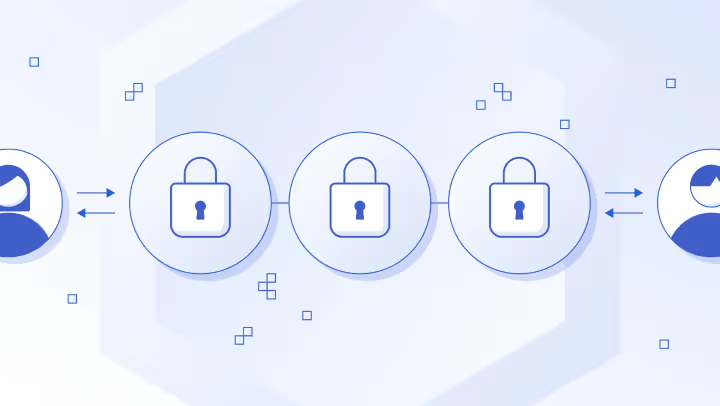
Digital asset custody is the process of securing cryptographic keys that control access to onchain assets. It ensures the safe storage, management, and transfer of digital assets through advanced security protocols and operational frameworks.
Global finance is transitioning to blockchain networks, requiring secure infrastructure to protect value. At the center of this transition is digital asset custody. Unlike traditional finance where custodians hold physical certificates or entries in centralized databases, digital asset custody revolves entirely around securing the cryptographic keys that prove ownership of onchain assets.
Whether managing cryptocurrencies, stablecoins, or tokenized real-world assets, institutional stakeholders must navigate a unique set of security, operational, and regulatory requirements. A reliable custody solution aims to ensure that assets are protected from theft, loss, and unauthorized access. Decentralized infrastructure provides the transparency, privacy, and connectivity required to secure these assets.
What Is Digital Asset Custody?
Digital asset custody is the specialized process of securing, managing, and transferring digital assets on blockchain networks. It differs fundamentally from traditional financial custody. In existing systems, a custodian physically holds assets or maintains authoritative ledgers detailing who owns what. The custodian acts as the ultimate source of truth.
In the blockchain environment, the ledger is distributed and decentralized. The assets themselves never leave the blockchain. Instead, ownership is established and transferred using cryptographic keys. Digital asset custody is fundamentally the practice of safeguarding private keys.
Every onchain address consists of a public key and a private key. The public key acts like a bank account number, allowing anyone to send assets to that specific address. The private key acts as the password or cryptographic signature required to authorize transactions and move assets out of that address. If a private key is lost, the assets associated with the public key become permanently inaccessible. If a private key is stolen, the attacker gains full control over the funds. Therefore, modern custody solutions focus on creating impenetrable environments for private key generation, storage, and usage. This requires specialized hardware, strict operational controls, and advanced cryptographic techniques to ensure that authorized parties can access their assets while keeping malicious actors out.
Types of Digital Asset Custody Models
Organizations and individuals can choose from several digital asset custody models depending on their specific security needs and operational capabilities. The two primary categories are self-custody and third-party custody.
Self-custody involves users managing their own private keys through unhosted wallets. This model provides complete control over assets without relying on an external entity. However, it places the entire burden of security and key recovery on the user. Third-party custody involves delegating key management to a specialized service provider, such as a centralized exchange or a qualified custodian. Qualified custodians are highly regulated entities that meet strict compliance standards to hold funds on behalf of institutional clients.
Securing private keys across these models relies on advanced underlying technologies:
- Hardware Security Modules (HSMs): These are dedicated physical computing devices that safeguard and manage digital keys. HSMs generate keys in an isolated, tamper-proof environment, ensuring that the private key never touches an internet-connected device.
- Multisig: Short for multi-signature, this technology requires multiple private keys to authorize a single transaction. For example, a multisig wallet might require three out of five designated keys to approve a transfer. This eliminates the single point of failure inherent in relying on one key.
- Multi-Party Computation (MPC): MPC takes security a step further by breaking a single private key into multiple distinct shares. These shares are distributed across different servers or devices. When a transaction needs approval, the devices compute the cryptographic signature together without ever reconstructing the full private key in one place.
Primary Risks in Digital Asset Custody
Managing cryptographic keys introduces unique vulnerabilities that require strict risk management strategies. The primary risks in digital asset custody span security, operational, financial, and regulatory domains.
Security risks are the most immediate threat to digital assets. Because blockchain transactions are irreversible, a successful cyberattack or phishing exploit can result in the permanent loss of funds. Custodians must also protect against internal bad actors who might exploit their access credentials to siphon assets. Additionally, the permanent loss of private keys due to hardware failure or poor backup procedures is a major security concern that can render assets permanently unrecoverable.
Operational and financial risks arise from how a custodian manages its business and client funds. A critical risk is the commingling of funds, where a custodian mixes client assets with its own corporate assets. If the custodian faces insolvency or bankruptcy, commingled funds can be frozen or used to pay off corporate creditors, leaving clients unable to access their assets. Single points of failure in technical architecture or operational workflows also pose severe risks, as a single compromised system or employee can lead to catastrophic losses.
Regulatory risks stem from the rapidly changing legal environment surrounding blockchain technology. Custodians operate in a complex environment characterized by shifting compliance frameworks and jurisdictional uncertainty. The lack of established legal precedents in many regions means that institutions must continuously adapt their custody practices. To address this, institutions are increasingly looking toward the Chainlink compliance standard, which uses the Automated Compliance Engine (ACE) to enforce complex KYC/AML and jurisdictional policies directly onchain, drastically reducing manual compliance overhead.
Real-World Examples of Custody Failures
The history of blockchain technology includes several high-profile custody failures that illustrate the severe consequences of inadequate security and operational controls. These incidents highlight the necessity of secure digital asset custody infrastructure for institutional and retail participants alike.
One of the most notable historical examples is the collapse of Mt. Gox. As an early centralized exchange, it held custody of hundreds of thousands of user assets. Due to prolonged security vulnerabilities and poor private key management, attackers systematically drained the exchange over several years. The resulting insolvency led to massive financial losses and a decade-long legal process for users attempting to recover their funds.
More recently, the failure of FTX in 2022 demonstrated the severe financial risks of commingling client funds with corporate assets. The exchange's lack of internal operational controls and transparent ledger practices resulted in billions of dollars in lost customer deposits. This collapse emphasized the critical need for verifiable, onchain Proof of Reserve to ensure client deposits are fully backed 1:1.
The Future of Digital Asset Custody
As the onchain economy grows, the methods for securing digital assets must evolve beyond basic key management. Institutions require infrastructure that not only protects private keys but also ensures regulatory compliance and operational transparency.
By adopting advanced cryptographic techniques and integrating decentralized standards, custodians can build the verifiable trust necessary to support the next generation of global finance. The Chainlink Runtime Environment (CRE) powers these advanced capabilities, helping institutions execute complex compliance and data logic directly across multiple blockchain networks.