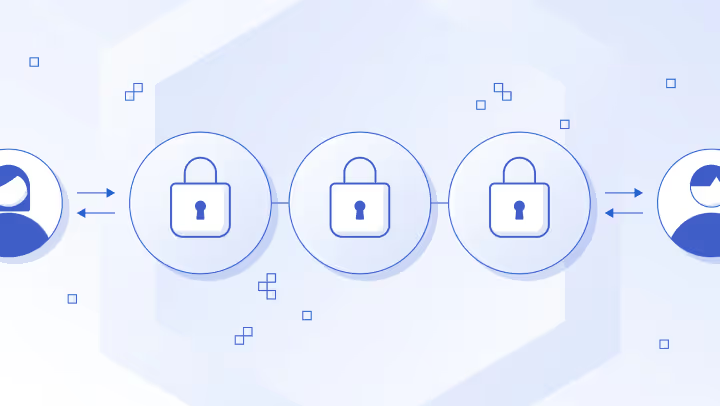
Digital Identity Platforms: DIDs, VCs, and Blockchain
A digital identity platform is a framework that enables individuals and organizations to generate, manage, and verify digital identities. By using blockchain technology, these platforms provide Self-Sovereign Identity (SSI), allowing users to control their own data while enabling tamper-proof verification for services like finance, healthcare, and governance.
Identity is fragmented. The average user manages dozens of usernames and passwords across siloed databases, leaving personal data vulnerable to breaches, misuse, and monetization without consent. As the web transitions toward Web3, the demand for a user-centric, portable, and secure identity layer has never been higher.
Blockchain-based digital identity platforms offer a solution: Self-Sovereign Identity (SSI). By moving control from centralized intermediaries to the individual, these platforms are redesigning how trust is established online. However, connecting this onchain identity infrastructure to real-world data requires secure, privacy-preserving connectivity—a role fulfilled by the Chainlink platform.
This article explores the architecture of decentralized identity, the role of smart contracts, and how The Chainlink Runtime Environment (CRE) orchestrates the critical data, compliance, and privacy standards needed to power the next generation of verification.
The Evolution of Digital Identity: From Centralized to Decentralized
To understand the value of blockchain-based identity, we must trace the evolution of digital identity management.
- Centralized Identity: In the early web, identity was administrative. A single authority (e.g., a website or email provider) issued credentials and owned the data. If the authority’s server was compromised, so was the user's identity.
- Federated Identity: This model introduced "Single Sign-On" (SSO), allowing users to use one ID (e.g., Google or Facebook) across multiple platforms. While convenient, it created massive data honey pots and gave a few tech giants disproportionate control over user access.
- Decentralized Identity (SSI): Blockchain technology enables a user-centric model where the individual owns their identifier and data. No single institution can revoke the user's identity, and verification occurs peer-to-peer using cryptographic proofs.
This shift allows for portable reputation. A user's history—such as creditworthiness or professional accreditations—travels with them across the digital economy rather than being locked within a single application.
Core Architecture: DIDs, Verifiable Credentials, and Wallets
Decentralized identity platforms rely on three primary primitives that work together to establish trust without a middleman.
- Decentralized Identifiers (DIDs): A DID is a globally unique identifier (a string of characters) generated and controlled by the user. Unlike a username owned by a corporation, a DID is anchored on a blockchain or distributed ledger. It serves as a permanent digital fingerprint that no external party can delete.
- Verifiable Credentials (VCs): VCs are the digital equivalents of physical credentials—such as a driver’s license, university degree, or bank statement. These are cryptographically signed by an Issuer (e.g., a university) and held by the Holder (the user).
- Identity Wallets: This is the application where users store their DIDs and VCs. When a user needs to prove something to a Verifier (e.g., a dApp), they select the relevant credential from their wallet and present it.
The Role of Smart Contracts and Oracles in Verification
While DIDs and VCs provide the format for identity, smart contracts enforce the logic. For example, a lending protocol might have a smart contract that dictates: "Release funds only if the user has a valid 'Credit Score > 700' credential." However, blockchains face the "oracle problem": they can't inherently access offchain data. A smart contract on Ethereum can't simply "see" a user's bank balance or verify a passport stored in a government database.
Chainlink solves this by acting as the secure platform between real-world identity data and blockchain networks. As the industry-standard oracle platform bringing the capital markets onchain, Chainlink provides the essential standards needed for this verification. The Chainlink Runtime Environment (CRE) serves as the orchestration layer, enabling developers to connect legacy identity systems to smart contracts.
- Connecting to Data Providers: Through Chainlink, developers can fetch data from existing Web2 identity providers (like OAuth or KYC APIs) and deliver the verification result onchain.
- Compliance Standards: For institutions, the Chainlink compliance standard powers the Automated Compliance Engine (ACE). ACE allows regulated entities to enforce KYC/AML policies directly within smart contracts, ensuring that only verified users can interact with permissioned pools or tokenized assets.
Benefits vs. Implementation Challenges
Adopting a decentralized identity platform offers significant advantages, though hurdles remain for widespread adoption.
Benefits:
- Security: Eliminates centralized password databases, reducing the attack surface for massive data breaches.
- Data Portability: Users can take their reputation and history (credit, social, professional) from one app to another, fostering a more competitive ecosystem.
- Compliance: Enables "permissioned DeFi," where protocols can automatically block sanctioned addresses or ensure users meet KYC/AML requirements via Chainlink ACE.
Challenges:
- User Experience: Managing private keys and recovery phrases is complex for non-technical users.
- Interoperability: While standards like DIDs exist, different blockchains and wallet providers must ensure their systems can talk to one another through Chainlink CCIP.
- Regulatory Uncertainty: Governments are still defining how decentralized identity fits within existing frameworks.
The Future of Identity
Digital identity platforms are transforming the internet from a space of rented access to one of owned identity. By combining the immutability of blockchain with the connectivity and privacy of the Chainlink platform, developers can build systems that are both secure and compliant.
Whether it is enabling undercollateralized loans in DeFi or allowing global banks to transact with verifiable onchain entities, the convergence of smart contracts and identity data is the foundation of the Web3 economy. The Chainlink platform can orchestrate these complex workflows, ensuring that digital identity is as reliable and usable as the physical credentials we use today.