Privacy-Preserving Identity and Compliance
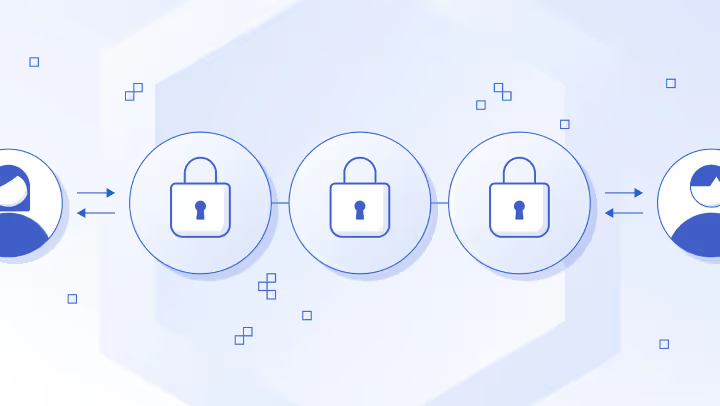
Privacy-preserving identity compliance refers to protocols that allow users to verify their identity or eligibility—such as being over 18, an accredited investor, or not on a sanctions list—onchain without revealing their personally identifiable information (PII) to the public. This resolves the conflict between blockchain transparency and data privacy regulations like GDPR.
Financial regulations are clear: institutions must know who they are doing business with. In traditional finance, this "Know Your Customer" (KYC) process involves handing over sensitive documents—passports, bank statements, and social security numbers—to a centralized entity.
Moving this process to a blockchain creates a fundamental conflict. Public ledgers are immutable and transparent; placing personally identifiable information (PII) on them violates data privacy laws like GDPR and creates massive security risks for users. Yet, for decentralized finance (DeFi) to scale to institutional capital, it must comply with Anti-Money Laundering (AML) and Counter-Terrorism Financing (CTF) standards.
Privacy-preserving identity compliance bridges this gap. It allows users to prove attributes about themselves—such as "I am an accredited investor"—without revealing the underlying evidence or their real-world identity to the public network. This creates a compliance layer that respects user privacy while satisfying regulatory requirements.
The Challenge: The Compliance-Privacy Paradox
Standard blockchain transactions are pseudonymous, identified only by alphanumeric wallet addresses. This anonymity prevents regulated institutions from participating in DeFi markets, as they cannot verify if a counterparty is a sanctioned entity.
Attempts to introduce compliance often break privacy:
- Onchain Whitelists: While effective for permissioning, a static list of "approved" addresses allows observers to track the behavior of those specific entities, potentially leaking trading strategies or net worth.
- Data Immutability: If PII is accidentally recorded on a blockchain, it cannot be deleted. This makes compliance with "Right to be Forgotten" laws (like GDPR) impossible.
- Centralized Honey Pots: Storing user data in centralized offchain databases to manage onchain permissions recreates the security vulnerabilities of Web2, where massive data breaches are common.
Core Technologies for Private Identity
To solve this, developers are moving from "data sharing" to "data verification" using advanced cryptography.
Zero-Knowledge Proofs (ZKPs)
Zero-knowledge proofs enable a user to prove a specific claim is true without revealing the data behind it. In identity, this allows for selective disclosure. A user can generate a cryptographic proof that they are a citizen of a specific country without revealing their name, exact address, or passport number. The blockchain verifies the proof, not the document.
Verifiable Credentials (VCs) and DIDs
Decentralized Identifiers (DIDs) and Verifiable Credentials (VCs) are open standards that allow users to hold their identity proofs in their own wallets, rather than on a central server. A standard KYC provider (the issuer) gives the user a digital credential. The user then presents this credential to a smart contract (the verifier) to gain access, often wrapping it in a ZK proof to ensure the issuer cannot track where the user is using their ID.
Trusted Execution Environments (TEEs)
TEEs allow for the secure processing of identity data offchain. An oracle node running a TEE can ingest sensitive ID documents, run a verification check against a sanctions list, and return a simple "pass/fail" boolean to the smart contract. The node operator never sees the raw data, maintaining privacy while linking offchain identity to onchain actions.
The Role of Chainlink (Compliance Standard)
Chainlink provides the essential infrastructure for bringing offchain identity states onchain without compromising privacy. The Chainlink Runtime Environment (CRE) orchestrates these services to create seamless compliance workflows.
Automated Compliance Engine (ACE)
The Chainlink Automated Compliance Engine (ACE) is part of the Chainlink Compliance Standard. It serves as a modular framework that connects onchain applications with trusted offchain identity providers. ACE allows institutions to enforce customizable policy rules—such as "only allow US-based accredited investors"—directly within the smart contract transaction flow, without the smart contract ever handling the PII.
Chainlink DECO
Chainlink DECO is a privacy-preserving oracle protocol that revolutionizes how identity data is sourced. It allows an oracle to verify data from an existing web session (using TLS) without seeing the data.
- Example: A user logs into their bank account. DECO generates a zero-knowledge proof that the user has a valid account and is over 18, based on the bank's own data. The oracle attests to this fact onchain, but the oracle never sees the user's login credentials or account details.
Cross-Chain Identity via CCIP
Identity fragmentation is a major user experience hurdle. The Chainlink Cross-Chain Interoperability Protocol (CCIP) allows for the propagation of compliance status across blockchains. If a user completes KYC on Ethereum, CCIP can securely transmit a message to a destination chain (like Arbitrum or a bank chain) confirming the user's eligibility, eliminating the need to re-verify identity for every network.
Key Use Cases
Privacy-preserving identity unlocks new markets that require both trust and confidentiality.
- Institutional DeFi: Banks can participate in "permissioned pools" on protocols like Aave. ACE ensures that all liquidity providers in the pool are KYC'd institutions, mitigating counterparty compliance risk, while keeping the specific identities of the traders private from the broader market.
- Undercollateralized Lending: Currently, DeFi lending requires over-collateralization because protocols don't know the borrower. By securely proving an offchain credit score or repayment history without revealing the exact score, users can access capital efficiency comparable to traditional finance.
- Sybil Resistance: DAOs and quadratic funding rounds need to ensure one-person-one-vote. Privacy-preserving identity allows users to prove they are unique humans without doxxing themselves to the community.
Implementation Challenges
- Standardization: The digital identity space is fragmented, with competing standards for VCs, soulbound tokens (SBTs), and attestations. Interoperability between these formats is critical.
- User Friction: Managing private keys and digital credentials adds complexity. The user experience must be simplified to match the ease of "Sign in with Google" while maintaining decentralization.
- Regulatory Uncertainty: While technology can preserve privacy, regulators must accept these cryptographic proofs as valid substitutes for traditional record-keeping. Continuous engagement between tech providers and policymakers is essential.