Secure Onchain Execution Environments (TEEs)
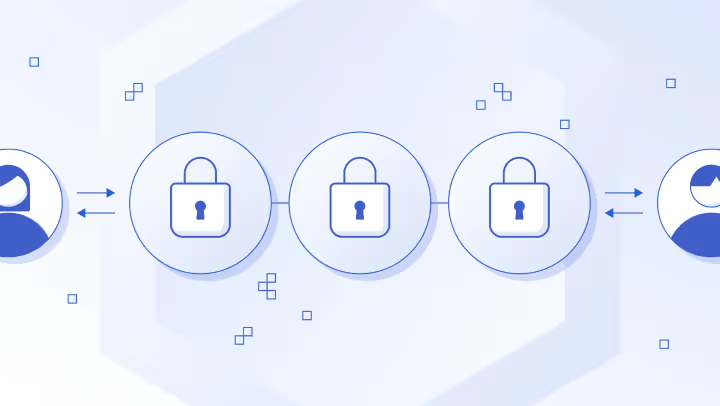
A secure onchain execution environment, typically implemented as a Trusted Execution Environment (TEE), is a hardware-isolated enclave that enables smart contracts to process sensitive data privately. It allows for confidential computing where data remains encrypted during execution, visible only to the code itself.
Public blockchains present a conflict between transparency and confidentiality. While the transparency of a public ledger ensures auditability, it prevents the adoption of institutional use cases that require strict data privacy—such as private order flow, sensitive identity management, and proprietary trading strategies.
A secure onchain execution environment solves this by creating a protected "black box" for computation. Technically realized through Trusted Execution Environments (TEEs), this technology allows code to run on verifiable hardware while keeping the underlying data encrypted. This architecture helps bring capital markets onchain, bridging the gap between public ledger integrity and the private requirements of modern business.
The Core Concept: What Is a Secure Execution Environment?
At its simplest, a secure onchain execution environment is a "vault" inside a computer’s processor. In technical terms, this is known as a Trusted Execution Environment (TEE) or a secure enclave.
In a standard blockchain node, the operating system and the node operator have visibility into every process running on the hardware. If a smart contract processes a private key or a sensitive bank balance, that data is exposed in memory. A TEE changes this architecture by isolating a portion of the hardware from the rest of the system.
Imagine a soundproof room with no windows inside a busy office. A worker (the processor) enters the room to perform a task. They can do their work securely, and no one outside—not even the building manager (the operating system)—can see or hear what is happening. They only see the worker enter with a locked briefcase (encrypted input) and leave with a result. This hardware-enforced isolation ensures that sensitive data is processed without ever being exposed to the host environment.
How It Works: Isolation and Remote Attestation
Secure execution environments rely on two pillars: memory encryption and remote attestation. These mechanisms ensure that the physical hardware is trustworthy without revealing the data it processes.
Memory Encryption When data is sent to a TEE, it is encrypted. It remains encrypted in the computer's RAM and is only decrypted once it reaches the silicon of the CPU die inside the secure enclave. If a malicious actor tries to physically inspect the memory or if the operating system is compromised, they will only see randomized ciphertext.
Remote Attestation For a blockchain to trust a single piece of hardware, the hardware must prove it is genuine. Remote attestation is a cryptographic process where the TEE generates a digital signature (often called a "quote") proving that:
- The hardware is a genuine, certified processor (e.g., Intel SGX or ARM TrustZone).
- The code running inside the enclave matches a specific, audit-verified version.
This quote is verified onchain, allowing the smart contract to confirm that the computation was performed honestly before accepting the result.
High-Value Use Cases: Why Blockchain Needs TEEs
The integration of secure execution environments enables sophisticated use cases that were previously impossible on public ledgers due to data leakage risks.
Anti-MEV and Dark Pools Maximal Extractable Value (MEV) attacks occur when validators reorder transactions to profit from user trades. TEEs allow for "dark pools" or encrypted mempools where transaction details are hidden from validators until they are ordered and executed. This prevents frontrunning and enables fair, institutional-grade trading venues on public networks.
Private AI and Data Inference Institutions often possess proprietary AI models they wish to monetize without revealing weights or training data. Conversely, users need to process sensitive medical or financial data without exposing it to the model owner. TEEs facilitate confidential AI inference, where the model and the user data interact inside the enclave—neither party sees the other's raw assets, but the computation yields a verifiable result.
Confidential DeFi Standard decentralized finance (DeFi) protocols expose positions and strategies. TEEs enable private lending and under-collateralized loans by allowing a smart contract to view a user's offchain credit score or bank balance inside an enclave. The protocol receives a simple "Yes/No" or risk score without the raw financial data ever being published onchain.
Comparative Analysis: TEE vs. ZK vs. MPC vs. FHE
Privacy is not a one-size-fits-all solution. While TEEs rely on hardware trust, other methods like Zero-Knowledge (ZK), Multi-Party Computation (MPC), and Fully Homomorphic Encryption (FHE) rely on pure cryptography. TEEs currently offer a distinct advantage in performance and programmability for complex workflows.
TEEs act as a practical "fast lane" for privacy. While ZK and FHE offer stronger theoretical guarantees (math vs. hardware), TEEs are currently the only viable solution for running complex, data-heavy applications (like AI or high-frequency trading) at the speed required by modern markets.
The Trust Model and Security Challenges
While secure execution environments are powerful, they are not without risks. Understanding the trust model is essential for developers and institutions.
Hardware Trust vs. Math Trust Unlike ZK proofs, which rely solely on mathematics, TEEs require trusting the hardware manufacturer. If the manufacturer's master key is compromised, the security guarantees could theoretically be broken. This is known as "hardware trust."
Side-Channel Attacks TEEs function as black boxes, but sophisticated attackers can sometimes infer what is happening inside by measuring "side channels"—indirect signals like power consumption, heat, or execution timing. Modern TEE implementations mitigate this through constant patching, code masking, and requiring code to be "constant-time" to hide execution patterns.
Decentralization as Mitigation To reduce reliance on a single hardware vendor, robust networks do not rely on a single TEE. Instead, they use a decentralized network of nodes running different hardware types. If one node is compromised, the consensus of the network ensures the integrity of the overall execution.
Leading Implementations: The Chainlink Privacy Standard
Chainlink has operationalized TEEs for the blockchain industry through the Chainlink privacy standard. This standard uses privacy oracles to conceal sensitive data and provide confidential computing, enabling privacy-preserving smart contracts on any blockchain while maintaining regulatory compliance.
Orchestration via Chainlink Runtime Environment (CRE) These privacy capabilities are orchestrated by the Chainlink Runtime Environment (CRE). The CRE acts as a unified abstraction layer that connects existing systems to blockchain networks. It allows developers to build workflows that combine:
- Confidential Compute: Processing sensitive data (like PII or proprietary algorithms) inside TEEs.
- DECO: A privacy-preserving oracle protocol that proves facts about web data (e.g., "User is over 18") without revealing the raw data.
- CCIP Private Transactions: Enabling cross-chain value transfer where transaction details are kept private from public observers.
Institutional Integration For institutions, this architecture is necessary for adoption. By combining TEEs with the Chainlink Compliance Standard (via the Automated Compliance Engine), banks and asset managers can perform necessary KYC/AML checks inside a secure environment. The CRE ensures that only the proof of compliance is posted onchain, preserving user privacy while satisfying regulatory requirements. This capability helps bring tokenized assets, such as private equity or debt, onto public blockchains.
Conclusion
Secure onchain execution environments are a necessary component for institutional blockchain adoption. By using the speed and isolation of TEEs, the industry can move beyond simple public transfers to complex, private commercial agreements.
Whether protecting proprietary AI models, preventing predatory trading strategies, or securing private institutional data, TEEs provide a pragmatic, high-performance path forward. As part of the broader Chainlink privacy standard and orchestrated by the Chainlink Runtime Environment, this technology enables developers to build privacy-preserving applications today, merging the trust of blockchain with the confidentiality of traditional finance.