What Is a Stablecoin Clearinghouse?
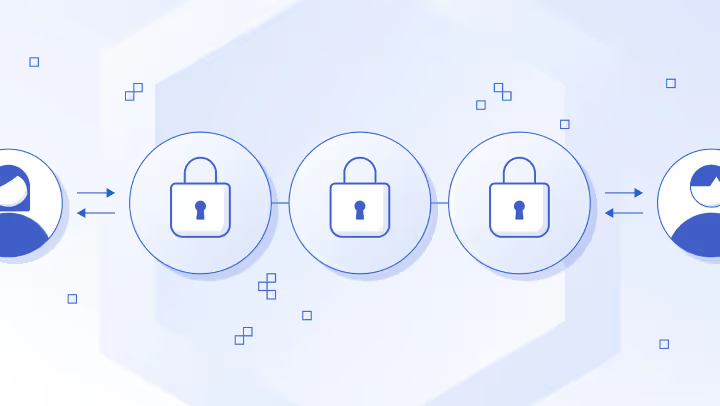
A stablecoin clearinghouse is a financial infrastructure that facilitates the clearing and settlement of stablecoin transactions between counterparties, ensuring atomic delivery and reducing settlement risk in digital asset markets.
As tokenized assets and onchain finance grow, the need for secure settlement infrastructure has become critical. A stablecoin clearinghouse serves as this core layer, bridging traditional financial mechanics with blockchain efficiency. In capital markets, clearinghouses traditionally manage counterparty risk and guarantee the completion of trades. It simplifies trades. Applying this model to digital assets allows financial institutions to settle transactions using stablecoins with increased speed and certainty. By facilitating delivery versus payment settlement onchain, a stablecoin clearinghouse mitigates the risks associated with bilateral trading. This infrastructure supports the broader adoption of tokenized assets by providing a standardized, secure environment for institutional participants. Understanding how these clearinghouses function is vital for business leaders and developers building the next generation of financial applications.
What Is a Stablecoin Clearinghouse?
A stablecoin clearinghouse is a specialized financial infrastructure designed to clear and settle transactions using stablecoins as the underlying settlement asset. In traditional finance, a clearinghouse acts as an intermediary between a buyer and a seller, ensuring that both parties fulfill their contractual obligations. When applied to stablecoins, this entity or protocol verifies transaction details, manages collateral, and guarantees the final transfer of digital assets.
There are generally two models for clearing stablecoin transactions. The first is a centralized institutional clearing model, where a trusted traditional financial entity operates the clearinghouse. This centralized model adapts legacy legal and operational frameworks to process stablecoin settlements, offering familiar compliance and risk management structures for institutional participants. They don't have to build from scratch. The second model involves decentralized onchain mechanisms. In this approach, smart contracts perform the clearing functions autonomously. These programmable contracts lock assets and execute the trade only when all conditions are met, eliminating the need for a traditional central counterparty.
Both models aim to solve the same fundamental problem of settlement risk in digital asset markets. By acting as the central node for trade reconciliation, a stablecoin clearinghouse ensures that stablecoins are reliably transferred in exchange for tokenized securities or other digital assets. This infrastructure is a necessary evolution for onchain finance, bringing the rigorous risk management of capital markets to the fast-paced environment of blockchain networks.
How It Works and Real-World Examples
The operational core of a stablecoin clearinghouse relies on atomic delivery versus payment settlement. Delivery versus payment ensures that the transfer of an asset occurs if and only if the corresponding payment is successfully transferred. In an onchain environment, this is achieved through smart contracts that coordinate the simultaneous exchange of a tokenized asset and a stablecoin.
When two counterparties agree to a trade, the stablecoin clearinghouse captures the trade details. The clearing mechanism then verifies that the buyer has sufficient stablecoins and the seller has the required assets. Once verified, the underlying smart contracts lock the assets. The settlement is executed atomically, meaning both legs of the transaction are processed in the same block. If either party fails to deliver, the entire transaction is canceled, ensuring neither party is left without their assets or payment. They won't lose their funds.
Real-world initiatives are already exploring these mechanics. Traditional financial entities have researched and tested network structures that support real-time digital payments and tokenized deposit settlements. Similarly, crypto-native platforms and decentralized finance (DeFi) protocols use onchain clearing mechanisms to process billions in daily trading volume. Workflows involving the tokenization of treasury funds rely on atomic cross-chain delivery versus payment transactions to ensure secure settlement. These platforms use smart contracts to pool liquidity and guarantee trade execution, proving that onchain clearing can operate at scale. As these models mature, the convergence of traditional clearing standards and onchain execution continues to accelerate, providing institutions with reliable pathways for digital asset settlement.
Benefits and Market Impact
Implementing a stablecoin clearinghouse introduces significant operational advantages to capital markets. A primary benefit is the ability to operate on a continuous, round-the-clock basis. Unlike traditional clearinghouses that are bound by banking hours and weekend closures, onchain clearing infrastructure operates continuously. This availability eliminates weekend risk and allows for immediate response to global market movements.
Faster settlement speeds are another major advantage. Traditional settlement cycles often take days to complete, tying up capital and increasing exposure to counterparty default. A stablecoin clearinghouse using blockchain networks can achieve near-instantaneous settlement finality. This rapid processing significantly reduces counterparty risk because the window between trade execution and settlement is compressed to mere seconds.
The broader market impact is noticeable. With faster and more secure settlement, financial institutions can improve their capital efficiency. Capital locked in transit can be deployed elsewhere, enabling new liquidity. This infrastructure dramatically improves cross-border payments by removing the need for a complex web of correspondent banks. When combined with tokenized asset trading, a stablecoin clearinghouse provides the foundation for a more interconnected and efficient global financial system, allowing institutions to trade and settle assets across borders without friction. The transparency inherent in blockchain-based clearing provides regulators and participants with a verifiable audit trail of all transactions.
Challenges
Establishing a stablecoin clearinghouse involves navigating complex challenges. Operational risks are a primary concern for institutional participants. The stability of the underlying stablecoin is paramount. If a stablecoin loses its peg to the referenced fiat currency, it introduces severe pricing discrepancies and settlement failures across the clearinghouse.
Liquidity fragmentation also presents a significant hurdle. As multiple blockchains and stablecoin issuers emerge, liquidity becomes siloed across different networks. A stablecoin clearinghouse must implement interoperability solutions to access fragmented liquidity pools and ensure smooth cross-chain settlement. Technological vulnerabilities, such as smart contract exploits or underlying network outages, require rigorous security auditing and advanced risk management protocols.
Regulatory frameworks are concurrently evolving to address these risks. Policymakers globally are drafting rules to govern stablecoin issuers and the clearinghouses that process them. These frameworks often demand strict reserve auditing requirements to ensure stablecoins are fully backed by high-quality liquid assets. Jurisdictional rules vary widely, requiring a stablecoin clearinghouse to maintain flexible compliance standards that can adapt to different regional mandates. Institutional adoption hinges on this regulatory clarity. As governments and financial watchdogs establish standard guidelines for digital asset clearing, clearinghouses must integrate transparent compliance mechanisms to operate legally and securely within the global financial system.
Role of Chainlink
For a stablecoin clearinghouse to function securely, it requires highly reliable data, cross-chain connectivity, and automated compliance. The Chainlink platform provides the infrastructure needed to overcome the challenges of onchain settlement. CRE powers the execution of complex clearing logic across these various networks. By serving as the universal orchestration layer, CRE allows developers to build and deploy advanced decentralized applications that require orchestrated data and interoperability without disrupting legacy infrastructure.
One of the most critical components for maintaining stablecoin stability is Chainlink Proof of Reserve. As part of the Chainlink data standard, Proof of Reserve provides cryptographic verification of the fiat collateral backing stablecoins. By continuously monitoring offchain reserves and publishing that data onchain, this infrastructure ensures that the stablecoins used for clearing are fully collateralized. This transparency mitigates the risk of peg deviation and builds institutional trust in the clearing process.
Fragmented liquidity across different blockchains complicates the clearing and settlement process. To address this, clearinghouses can use the Chainlink interoperability standard. This standard enables multi-chain stablecoin settlement by allowing smart contracts on one blockchain to securely communicate and transfer value to smart contracts on another. The Chainlink compliance standard ensures that transactions meet strict regulatory requirements across different jurisdictions. By integrating these standards through CRE, a stablecoin clearinghouse achieves the high-fidelity data, secure connectivity, and compliance necessary to power institutional-grade digital asset settlement.
The Future of Stablecoin Clearing
The transition toward onchain finance requires infrastructure capable of handling complex institutional workflows. A stablecoin clearinghouse serves as a vital bridge, bringing the reliability of traditional delivery versus payment settlement to the speed and efficiency of blockchain networks. By mitigating counterparty risk and enabling continuous, instantaneous settlement, this infrastructure provides new levels of capital efficiency for global markets. Overcoming the challenges of fragmented liquidity and regulatory compliance is necessary for widespread adoption. Through infrastructure like Proof of Reserve and the Chainlink interoperability standard orchestrated by CRE, Chainlink provides the secure data and interoperability required to build transparent, institutional-grade stablecoin clearinghouses. As the digital asset environment matures, standardized clearing mechanisms will be fundamental to scaling onchain finance.