Understanding Sidechains: Architecture, Benefits, and Use Cases
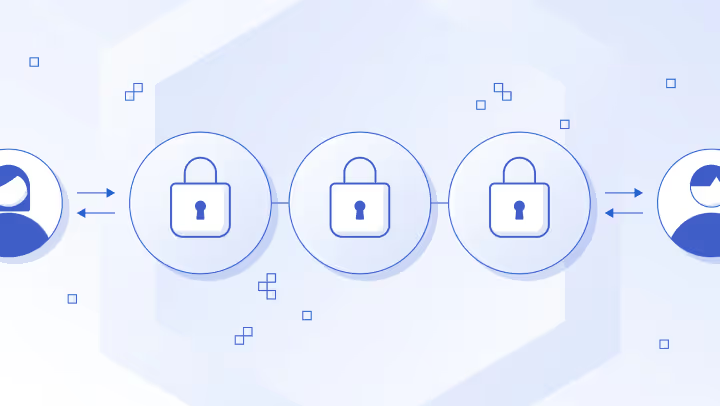
A sidechain is an independent blockchain connected to a primary mainnet via a two-way bridge. Sidechains improve scalability by offloading transaction processing from the mainnet while operating with their own distinct consensus mechanisms.
Blockchain networks face a persistent challenge in balancing decentralization, security, and scalability. As decentralized finance (DeFi), institutional tokenized assets, and enterprise applications grow, primary blockchains often experience congestion. This congestion leads to slower transaction speeds and higher gas fees. To address these limitations without compromising the underlying security of the base layer, developers use sidechains.
Sidechains operate as independent networks running parallel to a mainnet. They process transactions separately. This alleviates the computational burden on the primary chain. By facilitating efficient asset transfers and executing complex smart contracts in a specialized environment, sidechains expand the capabilities of blockchain technology. This architecture provides developers and institutions with the flexibility needed to build high-throughput applications capable of integrating with existing systems and scaling to meet global demand.
What Is a Sidechain?
A sidechain is a distinct, independent blockchain network connected to a primary blockchain, often referred to as the mainnet. The primary purpose of this architecture is to improve overall network scalability and offload transaction processing from the base layer. When a mainnet processes every transaction natively, it can quickly reach its throughput limits. Sidechains solve this by handling a large volume of transactions away from the mainnet, recording only the essential data or final states back to the primary network when necessary.
Unlike layer-2 rollups, which batch transactions and submit them directly to the mainnet for validation, sidechains operate autonomously. They possess their own block parameters, consensus algorithms, and validator nodes. This independence allows developers to optimize the network for specific use cases, such as high-frequency trading, gaming, or enterprise data management. For example, a sidechain can be configured for extremely fast block times and near-zero fees, prioritizing throughput over the strict decentralization requirements of a layer-1 network.
The connection between the mainnet and the sidechain is established through a cross-chain bridge. This bridge enables the transfer of digital assets and arbitrary data between the two networks. Users can lock their tokens on the mainnet and mint equivalent representations on the sidechain, allowing them to interact with decentralized applications (dApps) in a faster and more cost-effective environment. Once they complete their activities, users can burn the sidechain tokens and unlock their original assets on the mainnet. This parallel processing model is a component of modern blockchain scaling strategies.
How Do Sidechains Work?
Sidechains function through a combination of independent network architecture and cross-chain communication protocols. The core mechanism that connects a sidechain to a mainnet is known as a two-way peg. This peg acts as a bridge, ensuring that assets can move back and forth between the distinct blockchains while maintaining a consistent supply.
When a user wants to transfer assets from the mainnet to a sidechain, they send their tokens to a specific smart contract address on the mainnet. The smart contract locks these tokens, effectively removing them from circulation on the primary chain. Once the transaction is confirmed, a corresponding smart contract on the sidechain mints an equivalent amount of tokens and deposits them into the user's sidechain wallet. The user can then deploy these assets across various applications within the sidechain environment. To return the assets to the mainnet, the process is reversed. The sidechain tokens are burned or locked, and a cryptographic proof is sent to the mainnet smart contract, which unlocks the original tokens and returns them to the user.
Because sidechains operate independently, they rely on their own consensus mechanisms to validate transactions. A sidechain might use proof of stake, delegated proof of stake, or proof of authority, depending on its specific design goals. Validators on the sidechain are responsible for producing blocks, securing the network, and processing smart contract executions. The sidechain does not rely on the mainnet nodes for validation. This separation of consensus allows the parallel network to achieve higher transaction throughput and lower latency, as it does not need to synchronize with the slower block production times of the primary blockchain.
Types and Examples of Sidechains
Sidechains are generally categorized based on their compatibility with the Ethereum Virtual Machine (EVM). EVM-compatible sidechains are designed to support the same smart contract languages and developer tooling as the Ethereum mainnet. This compatibility allows developers to easily port their existing decentralized applications to the sidechain without rewriting the core code. Non-EVM sidechains use entirely different virtual machines, programming languages, and architectural designs, offering specialized environments tailored for specific performance metrics or security models.
Polygon PoS is a prominent example of an EVM-compatible sidechain. It operates alongside the Ethereum mainnet, using its own proof of stake consensus mechanism to deliver high-speed, low-cost transactions. Developers frequently deploy DeFi protocols and non-fungible token projects on Polygon PoS to provide users with a more accessible experience while retaining the ability to bridge assets back to Ethereum.
Rootstock is an example of a sidechain connected to the Bitcoin network. It brings smart contract functionality to Bitcoin by using a two-way peg with BTC. Rootstock operates with an EVM-compatible environment. This allows developers to build decentralized applications secured by a network of merged miners who simultaneously mine Bitcoin and validate Rootstock blocks.
Ronin is an application-specific sidechain built primarily to support blockchain gaming. By operating independently from the Ethereum mainnet, Ronin optimizes its block times and gas fees specifically for the high volume of microtransactions required by gaming economies. These examples demonstrate how sidechains can be customized to serve distinct market needs, ranging from broad DeFi environments to highly specialized enterprise or entertainment applications.
Benefits of Sidechains
The primary advantage of sidechain technology is improved scalability. By moving transaction processing away from a congested mainnet, sidechains can achieve significantly faster transaction throughput. This parallel processing ensures that high-demand applications do not overwhelm the base layer. Consequently, users experience faster settlement times, which is critical for financial applications, institutional trading, and interactive digital environments.
Lower gas fees represent another major benefit. Mainnets often experience fee spikes during periods of high network activity, pricing out retail users and making frequent transactions economically unviable. Because sidechains use their own consensus mechanisms and block parameters, they can maintain consistently low transaction costs. This cost efficiency enables use cases that require high-frequency interactions, such as micro-payments, decentralized social media platforms, and complex supply chain tracking systems.
Sidechains also offer flexibility for developers. Building on a mainnet forces applications to conform to the specific rules, block times, and security models of that base layer. A sidechain allows developers to customize the network architecture to fit their exact requirements. Enterprise applications can deploy permissioned sidechains that restrict node operation to known entities, satisfying strict regulatory and compliance requirements. Alternatively, projects can experiment with novel consensus algorithms or governance models without risking the stability of the primary blockchain. This ability to tailor the execution environment makes sidechains a versatile tool for scaling blockchain technology across diverse industries and institutional use cases.
Challenges and Risks
While sidechains provide substantial scalability benefits, they introduce distinct security trade-offs. The most significant challenge is that sidechains do not inherit the security of the mainnet. Because they operate with independent consensus mechanisms and validator sets, the security of a sidechain is entirely dependent on its own network participants. If a sidechain has a small number of validators or a low total value staked, it becomes more vulnerable to malicious attacks or network halts. Users interacting with a sidechain must trust its specific security model rather than relying on the decentralization of the primary blockchain.
Centralization risks are frequently associated with sidechain deployments. To achieve high transaction throughput and low latency, sidechains often limit the number of active validator nodes. This design choice concentrates block production and network governance among a smaller group of entities. While this improves performance, it reduces the overall decentralization of the network, potentially conflicting with the trust-minimized ethos of blockchain technology.
Cross-chain bridges, which facilitate the two-way peg between the mainnet and the sidechain, represent another critical vulnerability. These bridges rely on smart contracts to lock and mint assets across different networks. If the bridge architecture contains coding flaws or relies on centralized multisig wallets for validation, it can become a prime target for exploits. Historically, vulnerabilities within bridge protocols have led to significant losses of locked assets. Ensuring the secure transfer of value and data across network boundaries requires resilient interoperability standards and rigorous security audits to mitigate the risks associated with cross-chain communication.
The Role of Chainlink in Cross-Chain Connectivity
Secure communication between mainnets and sidechains is essential for the broader adoption of blockchain technology. The Chainlink platform provides the infrastructure required to facilitate secure, decentralized cross-chain communication, token transfers, and data delivery.
The Chainlink Runtime Environment (CRE) is an orchestration layer designed to connect any system, any data, and any chain. CRE simplifies blockchain complexity, allowing developers to integrate various Chainlink services and accelerate the deployment of complex multi-chain smart contracts.
For moving assets and data securely between a mainnet and a sidechain, developers use the Chainlink interoperability standard, powered by the Cross-Chain Interoperability Protocol (CCIP). CCIP enables smart contracts to send arbitrary data, transfer tokens, and execute commands across distinct blockchain networks with battle-tested security. This architecture mitigates the vulnerabilities traditionally associated with basic two-way pegs and centralized bridges. Furthermore, CCIP supports the Cross-Chain Token (CCT) standard, allowing assets to move fluidly across environments while maintaining a unified supply and consistent security parameters.
In addition to interoperability, sidechain-based applications require access to accurate external information. The Chainlink data standard, which encompasses Data Feeds, Data Streams, and SmartData, delivers reliable offchain data to smart contracts operating on sidechains. Whether providing high-frequency, low-latency market data for DeFi protocols or enriched financial data (like NAV and Proof of Reserve) for tokenized assets, these Chainlink decentralized oracle networks ensure sidechain applications function accurately.
For institutions using sidechains to meet strict regulatory and confidentiality requirements, the Chainlink privacy standard provides privacy-preserving smart contract capabilities. By orchestrating data, privacy, compliance, and interoperability standards through CRE, Chainlink helps developers build highly scalable, secure, and feature-rich applications across the entire multi-chain network.
The Future of Sidechain Technology
Sidechains represent a vital architectural component in the ongoing effort to scale blockchain networks. By providing independent execution environments, they enable faster transaction speeds, lower costs, and customizable parameters tailored to specific use cases. While challenges remain regarding independent security models and bridge vulnerabilities, advancements in cross-chain infrastructure continue to mitigate these risks. As the blockchain space expands to include institutional tokenized assets and complex enterprise applications, sidechains will play a role in managing network demand. Supported by orchestration and interoperability standards provided by the Chainlink platform, sidechains ensure that decentralized networks can scale efficiently while maintaining connectivity across the digital asset economy.