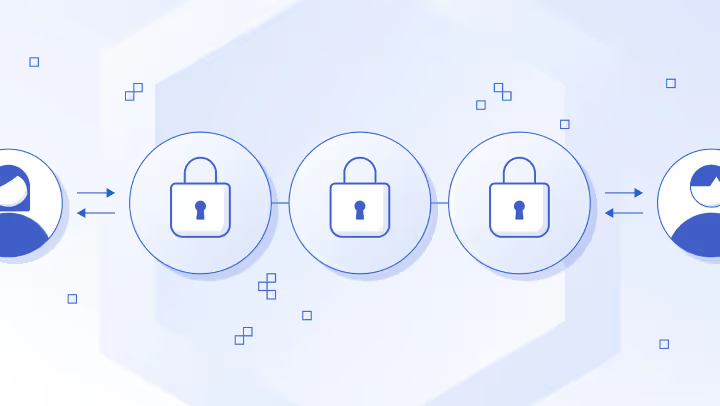
ZK Banking: The Future of Institutional Privacy and Scale
ZK banking uses zero-knowledge proofs to verify financial transactions and data validity without revealing underlying sensitive information, enabling compliant privacy on public blockchains.
As blockchain technology evolves from experiments to financial infrastructure, institutions face a conflict: the transparency that makes blockchains secure often contradicts the privacy required for banking. Public ledgers expose transaction details, creating risks for institutions bound by banking secrecy laws, GDPR, and competitive confidentiality.
ZK banking—applying zero-knowledge proofs (ZKPs) to financial operations—solves this problem. By allowing a party to prove a statement is true without revealing the data behind it, ZK banking introduces a model of "trust without transparency." This technology helps banks use the liquidity and connectivity of public blockchains while maintaining data privacy and regulatory compliance. From scalable layer-2 networks to privacy-preserving identity verification, ZK banking is the architectural key to bringing the next generation of capital markets onchain.
ZK Banking Decoded: The "Trust Without Revealing" Model
ZK banking relies on a cryptographic method known as a zero-knowledge proof. In traditional banking, trust comes from a central intermediary like a clearinghouse that sees all data. In a decentralized ZK system, trust is established mathematically between two parties: a Prover and a Verifier.
The Prover (e.g., a bank) demonstrates a claim—such as "this account has sufficient funds for the transfer"—without revealing the actual balance or account history. The Verifier (e.g., a smart contract or regulatory node) receives a cryptographic proof generated by the Prover. If the mathematics hold, the Verifier accepts the transaction.
The classic analogy is the "Ali Baba Cave." Imagine a ring-shaped cave with a magic door blocking the path. Peggy (the Prover) wants to prove to Victor (the Verifier) that she knows the secret password to open the door, but she doesn't want to tell him the password. By entering one side and successfully exiting the other upon Victor's random request, she proves she knows the secret without ever speaking it.
In banking, this "secret" is sensitive client data. This capability changes blockchain interactions, moving away from "security through obscurity" toward "security through cryptography." Privacy becomes an inherent property of the transaction rather than a permissions setting.
Solving the Privacy-Compliance Paradox
The main barrier preventing large-scale institutional adoption of public blockchains is the tension between privacy and compliance. Regulators require transparency to prevent money laundering (AML) and financing of terrorism (CFT), demanding that financial institutions perform Know Your Customer (KYC) checks. Conversely, privacy regulations like GDPR and commercial necessities demand that client data and trading strategies remain confidential. Standard public blockchains, which broadcast sender, receiver, and amount data, fail to meet these dual requirements.
ZK banking separates validity from visibility. Through zero-knowledge technology, an institution can generate a proof that a transaction complies with specific rules (e.g., "Sender is not on a sanctions list" or "Transaction amount is below $10,000") without revealing the identities involved or specific values.
This architecture creates a "compliant privacy" layer. Regulators or auditors holding a specific "viewing key" can access the necessary data for oversight, while the public ledger only sees the cryptographic proof of validity. This allows banks to operate on a unified global ledger—benefiting from shared liquidity and instant settlement—without compromising the confidentiality agreements they hold with their clients.
High-Impact Use Cases in Modern Finance
The application of ZK technology extends beyond asset transfers, enabling financial products that were previously impossible to deploy on public chains.
Private Lending and Undercollateralized Loans
Currently, decentralized finance (DeFi) lending is largely overcollateralized because protocols cannot assess offchain creditworthiness. ZK banking allows a borrower to prove they have a specific credit score or a valid proof of income from a traditional bank without uploading their bank statements onchain. A lender can verify the risk profile and issue a loan based on cryptographic assurance rather than public exposure.
Digital Identity (zkID)
Reusable identity is critical for onboarding users to Web3 services. Instead of uploading a passport photo to every new application, a user can generate a ZK proof stating, "I am a verified U.S. citizen over the age of 18," attested by a trusted issuer. The application validates the user’s eligibility without ever storing—or even seeing—their personal identifiable information (PII), drastically reducing data breach risks.
Wholesale CBDCs and Stablecoins
Central banks exploring Central Bank Digital Currencies (CBDCs) look to ZK proofs to balance systemic oversight with user privacy. ZK banking allows for wholesale interbank settlement where the central bank retains oversight of the monetary supply, but individual commercial banks can transact without exposing their positions to competitors.
Scaling Infrastructure: The Power of ZK-Rollups
While privacy is a major driver, scalability is the other pillar of ZK banking. Ethereum and other base-layer blockchains often face congestion, leading to high transaction fees and slower settlement times unsuitable for high-frequency financial markets. ZK-Rollups (Zero-Knowledge Rollups) address this by moving computation offchain while keeping data availability and security onchain.
A ZK-Rollup bundles (or "rolls up") thousands of transfers into a single transaction. The rollup operator generates a succinct validity proof (such as a zk-SNARK or zk-STARK) that attests to the correctness of all transactions in the bundle. This single proof is submitted to Ethereum mainnet. Because the mainnet only needs to verify the proof rather than process every individual payment, throughput increases, and gas costs are distributed across all users in the batch.
For banks, this provides a scalable environment that supports the volume of payment networks while inheriting the security guarantees of Ethereum. Crucially, ZK-Rollups offer faster finality than Optimistic Rollups. Because the mathematical proof guarantees validity instantly, funds can be withdrawn or settled immediately, removing the delay periods often required by other scaling solutions.
The Connectivity Layer: Chainlink’s Critical Role
Implementing ZK banking requires more than just scaling networks; it requires secure connectivity to existing financial data, interoperability between chains, and a unified way to orchestrate these workflows. The Chainlink Runtime Environment (CRE) is the orchestration layer enabling institutions to connect their legacy systems to any blockchain standard without disrupting existing infrastructure. Chainlink is the industry-standard oracle platform, bringing the capital markets onchain and powering the majority of decentralized finance (DeFi).
Privacy-Preserving Data Verification
The Chainlink privacy standard is essential for ZK banking, allowing a smart contract to verify data from a traditional web server (like a bank’s API showing a user's balance) without the data ever being revealed to the public or even to the oracle nodes themselves. This enables the Chainlink data standard to process sensitive financial data—such as credit scores or account balances—privately, allowing institutions to prove solvency or identity onchain while keeping the underlying data offchain.
Cross-Chain Interoperability
As banks launch their own private chains or use different ZK-Rollups, they need a secure method to transfer assets and data between them. The Chainlink interoperability standard, powered by Cross-Chain Interoperability Protocol (CCIP), provides the messaging layer for this ecosystem. CCIP enables the programmable transfer of tokenized assets between private bank chains and public DeFi ecosystems.
Verifiable Reserves
Trust in digital banking relies on solvency. Chainlink Proof of Reserve provides automated verification of onchain and offchain collateral. When integrated with ZK technologies, this allows stablecoin issuers or tokenized asset custodians to cryptographically prove that onchain assets are fully backed by reserves without exposing exact account numbers or custodial details. This improves transparency while maintaining commercial confidentiality.
Barriers to Mass Adoption
Despite the potential of ZK banking, hurdles remain before it becomes the standard for global finance. The most immediate challenge is computational intensity. Generating zero-knowledge proofs requires significant processing power and time, which can introduce latency. While hardware acceleration and algorithm optimizations are progressing, the cost of proof generation is still a factor for high-frequency use cases.
Complexity and talent scarcity also pose risks. ZK circuits are difficult to design and audit. A small error in the cryptographic circuit can lead to vulnerabilities that might allow an attacker to forge proofs or drain funds. The specialized languages used for ZK development (such as Circom or Cairo) have a steep learning curve, and there is currently a shortage of qualified developers and auditors capable of building and securing these systems at an institutional level.
Standardization is also lacking. With various teams building different types of proofs (SNARKs, STARKs, PLONKs) and disparate rollup architectures, fragmentation risks creating new silos. For ZK banking to succeed, the industry must converge on interoperable standards that allow proofs and assets to move smoothly across the financial ecosystem.
Conclusion
ZK banking is a necessary evolution in the convergence of traditional finance and blockchain technology. By allowing data validity to be verified without exposure, it satisfies the strict privacy and compliance requirements of global institutions while enabling the efficiency and liquidity of decentralized networks.
As banks and asset managers move toward tokenization, the combination of ZK-Rollups for scale and privacy-preserving tools like the Chainlink Privacy Standard will likely form the backbone of the future financial system. With the Chainlink Runtime Environment orchestrating these connections, the industry is moving closer to a global, onchain economy where trust is cryptographic, privacy is guaranteed, and value flows freely.