Introducing Chainlink Fulcrum: Connecting the World's Largest Financial Institutions to Onchain Financing
Tokenized assets are rapidly scaling across public and private blockchains, but fragmented liquidity, disconnected financing venues, and costly bespoke integrations have severely limited institutional adoption and left many assets stranded on their native platforms rather than put to work across markets.
The opportunity cost of idle assets is already evident in traditional markets; Citi estimates that approximately a quarter of institutional collateral sits idle due to settlement cutoffs and operational friction, resulting in roughly $346 million in forgone revenue annually for the average Tier 1 firm. To unlock institutional capital at scale, tokenized assets must be usable across markets without platform lock-in or bespoke integrations, giving institutions access to deeper liquidity, better financing terms, and more yield opportunities.
Today, we’re introducing Chainlink Fulcrum, a new end-to-end solution for institutional financing and collateral management across public and private blockchains.
Built for the needs of the world’s largest financial institutions, Chainlink Fulcrum is the first cross-chain repurchase agreement (repo) flow that separates the venue where a financing agreement is managed from the networks where cash and collateral settle. Through a single gateway, counterparties can choose eligible assets, set financing terms (e.g., prohibit collateral rehypothecation), and coordinate settlement across any supported chain, all without being locked into any one venue. It comes with 24/7 operational support, enabling institutions to identify changing exposures and respond in accordance with the agreement’s terms automatically, even when traditional markets are closed. This significantly enhances capital efficiency while reducing operational costs.
Chainlink Fulcrum is a global financing layer for the entire financial ecosystem. Banks and dealers can source and deploy liquidity around the clock. Prime brokers can extend financing to hedge funds against a broader range of tokenized collateral, enabling hedge funds to raise liquidity without selling their positions. Agent lenders and custodians can put their clients' tokenized securities to work in secured lending programs. Funds and insurers can deploy tokenized cash into secured, yield-bearing transactions, using collateral and terms that align with their mandates. Asset managers and issuers of tokenized funds and stablecoins can make their products more useful by making them eligible as collateral across venues, while corporate treasuries can earn yield on idle cash.
Fulcrum is in the process of being integrated with leading TradFi environments that are launching soon, as well as many existing venues, so participants can compare financing terms across them and route transactions to the venue of their choice, where the agreement is executed and governed. Chainlink Fulcrum does not custody assets, act as a counterparty, or operate a trading venue; financing agreements are executed among participants and governed on the venues integrated with it.
How It Works: A Single Workflow Extensible to Any Transaction
Repurchase agreements are a cornerstone of short-term funding in global capital markets. In a repo, one counterparty provides securities as collateral in exchange for cash and agrees to repurchase them at a predetermined price, typically within days. Banks, asset managers, and other financial institutions rely on repo to finance positions, manage liquidity, and deploy excess cash into secured, yield-bearing transactions. Extending these agreements to tokenized assets requires coordinating cash, collateral, and agreement terms across the public and private blockchains where each resides.
Chainlink Fulcrum brings the infrastructure required for cross-chain financing into a reusable, end-to-end workflow. Any set of counterparties can use it to establish a collateralized transaction, such as a bilateral loan or repo, across any supported public and private blockchains according to their agreed parameters, including the principal, financing rate, eligible collateral, and applicable haircuts. Currently supported chains include EVM and non-EVM networks supported by Chainlink’s CRE and CCIP.
Chainlink Fulcrum combines multiple aspects of the Chainlink platform into a unified solution, including:
- Chainlink Runtime Environment (CRE) orchestrates the workflow, coordinating the relevant data, systems, and contract calls across the transaction lifecycle. CRE connects agreement creation, collateral verification, and cash release into a single repeatable process.
- Cross-Chain Interoperability Protocol (CCIP) connects the public and private blockchains involved, enabling the cross-chain communication and asset transfers required to execute the financing transaction.
- Chainlink Data Streams supply market data used to value collateral, along with supplemental market data needed to enable transactions, such as real-time, mutually agreed-upon haircuts that discount the recognized value to account for risk.
- Compliance, privacy, AI, and other functionalities of the Chainlink platform built into the solution in the future, based on user demand, to unlock more advanced use cases.
Together, this allows a party’s cash release on one network to be conditional on collateral verification within an agreement managed on another network, effectively enabling cross-chain delivery-versus-delivery (DvD) across multiple blockchains.
The Next Evolution in Collateral Management: 24/7, Real-Time Settlement, Unified Golden Records
Today, disconnected collateral systems delay transfers, require costly reconciliation, and force institutions to hold liquidity buffers. Connecting assets and financing agreements across networks using blockchains, smart contracts, and oracle networks enables institutions to mobilize collateral faster and put more capital to work.
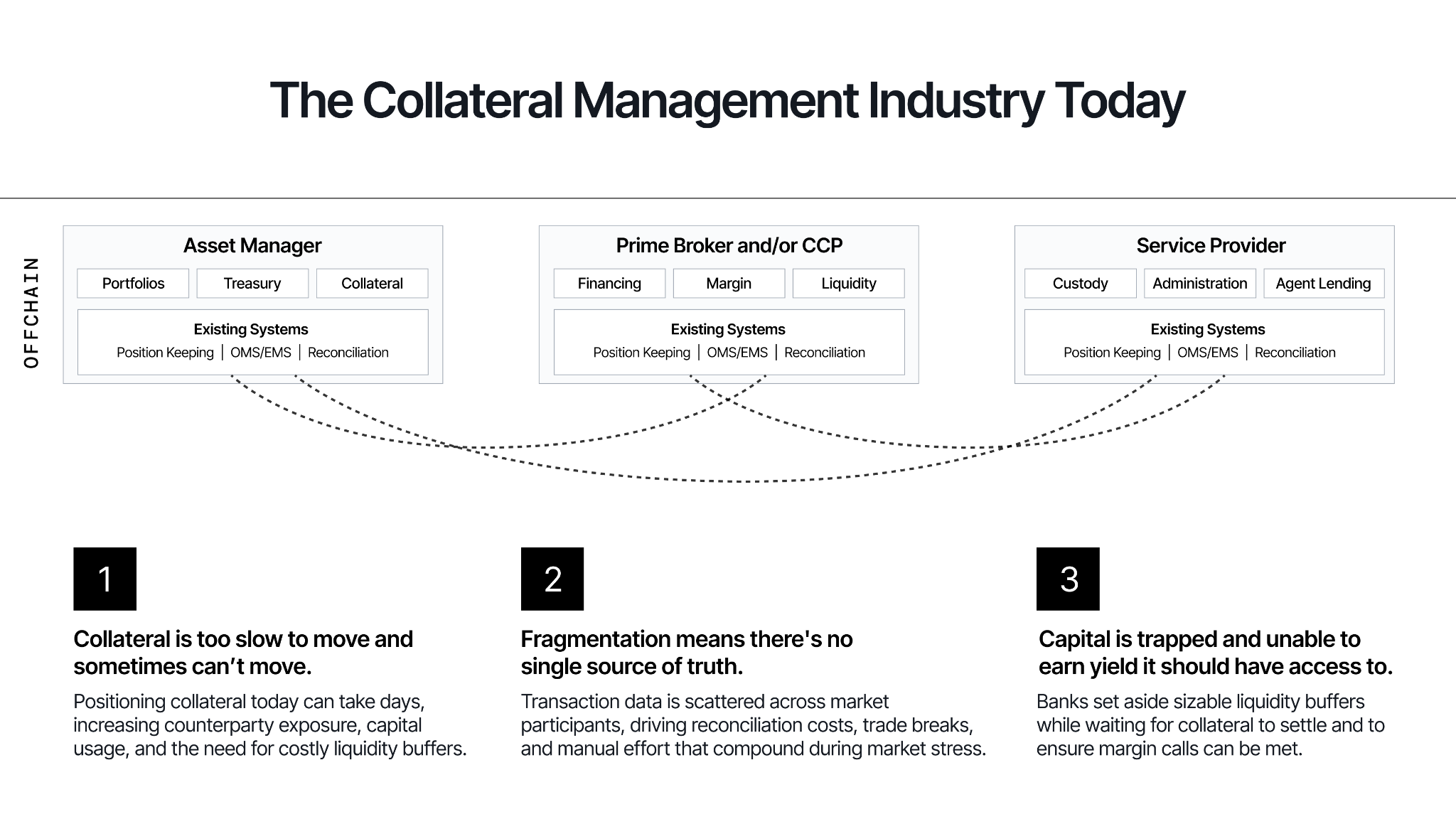
For tokenized assets to reach their potential, institutions need practical and efficient ways to finance them. A tokenized stock becomes more useful when its holder can use it as collateral to raise liquidity while retaining economic exposure to the underlying security. In turn, lenders gain opportunities to deploy tokenized cash against eligible collateral under agreed risk parameters.
By separating financing venues from settlement networks, Chainlink Fulcrum makes it easier for these counterparties to connect. An institution’s choice of blockchain no longer needs to dictate its choice of financing venue. This flexibility supports several key outcomes for businesses:
- More flexible funding: Faster collateral mobilization enables intraday repo and other financing, including on holidays and weekends. This unlocks higher trading limits for institutions, minimizes settlement delays, and reduces reliance on costly overdrafts or other wholesale funding sources.
- 24/7 risk management: Automated valuation enables institutions to monitor collateral coverage as prices change throughout the day. This near real-time capability helps reduce counterparty risk and supports margin management beyond traditional end-of-day processes by enabling participants to automatically trigger margin calls or liquidations when collateral falls below user-defined target ratios.
- Enhanced capital efficiency: Assets held on one network can support financing agreements managed on another. This expands the pool of usable collateral and helps institutions free up balance sheet capacity.
- Reduced operational complexity: A common integration framework connects existing systems with workflows across public and private blockchains. This reduces manual coordination and reconciliation and eliminates the need for separate custom connections.
Together, these capabilities provide a foundation for participants to manage financing positions across both traditional assets and digital assets. Available actions remain governed by each agreement, while the infrastructure supports ongoing coordination across networks and the establishment of unified golden records between counterparties.
Chainlink Fulcrum Demonstrates Cross-Chain Institutional Financing With DTCC at Sibos 2026
Powering the Financing Markets for a Tokenized World
Tokenization scales when institutions can put assets to work across financing markets. Chainlink Fulcrum provides reusable infrastructure for that expansion, with each additional venue and network added broadening financing opportunities available to institutional capital.
If your organization is interested in using Chainlink Fulcrum, talk to an expert to get started today.
—
Disclaimer: This post is for informational purposes only and contains statements about the future, including anticipated product features, development, and timelines for the rollout of these features. These statements are only predictions and reflect current beliefs and expectations with respect to future events; they are based on assumptions and are subject to risk, uncertainties, and changes at any time. There can be no assurance that actual results will not differ materially from those expressed in these statements, although we believe them to be based on reasonable assumptions. All statements are valid only as of the date first posted. These statements may not reflect future developments due to user feedback or later events, and we may not update this post in response. Please review the Chainlink Terms of Service, which provides important information and disclosures.


.jpg)