The Oracle Platform Powering Institutional Tokenization
Chainlink is the industry-standard oracle platform bringing capital markets onchain and powering the majority of decentralized finance (DeFi). Chainlink provides all the essential standards and services required to build and power institutional blockchain use cases at scale, and unlock the $16 trillion institutional tokenization opportunity by 2030.
Since inventing decentralized oracle networks in 2017, Chainlink has enabled tens of trillions of dollars in transaction value and actively secures over $130 billion in cross-chain token value and assets deposited across the DeFi economy. Beyond powering core markets across DeFi, such as lending, derivatives, and stablecoins, Chainlink is also being adopted as foundational infrastructure for tokenized assets by the world’s largest financial institutions and market infrastructures, such as Swift, DTCC, Euroclear, J.P. Morgan, Mastercard, Central Bank of Brazil, Wyoming Stable Token Commission, UBS, SBI, State Street, Fidelity International, WisdomTree, ANZ, Westpac, S&P Global, ICE, Amundi, and many others.
Chainlink is the only all-in-one platform that enables developers and institutions to combine all the critical data, interoperability, compute, compliance, privacy, and legacy-system connectivity requirements of their onchain applications into a single, reusable workflow. Chainlink uniquely enables institutions to solve all five fundamental problems of transacting onchain:
- The Data Problem: Tokenized assets need accurate information to be useful in transactions, including market pricing, net asset value, proof of reserves, reference data, corporate actions, and settlement instructions. Chainlink is the undisputed market leader in bringing data onchain securely and reliably.
- The Interoperability Problem: Financial institutions need to be able to seamlessly access and move tokenized assets across blockchain networks. Chainlink’s Cross-Chain Interoperability Protocol (CCIP) is the most secure way to move data and value across any public or private blockchain, opening up global markets for tokenized assets.
- The Compliance Problem: Regulated institutions require compliance and policy enforcement capabilities to be embedded within tokenized assets and smart contract applications, such as identity verification, risk screening, exploit protection, and asset-specific restrictions. The Automated Compliance Engine (ACE) extends existing infrastructure for identity and compliance to blockchains, enabling hundreds of trillions in regulated capital to move into the onchain format.
- The Privacy Problem: Regulated institutions require privacy for sensitive aspects of their onchain applications, such as client data, trading strategies, and business logic. Chainlink Confidential Compute brings privacy to every part of the transaction lifecycle, from data inputs and identity verification to transaction processing and cross-chain settlement.
- The Synchronization Problem: Tokenized assets must remain synchronized with legacy systems once issued, often across multiple chains. Chainlink is the only platform that enables institutions to securely interact across blockchain networks through their existing infrastructure and messaging standards. Furthermore, tokenized assets powered by Chainlink support Unified Golden Records—essential information embedded within the assets that stays with them as they move across chains.
Through August 2026, the Chainlink platform has securely enabled over $34 trillion in transaction value across 80+ blockchains. Chainlink has published over 20 billion total verified messages onchain and actively secures over $130 billion in cross-chain tokens and asset deposited into DeFi, with a Total Value Secured (TVS) market share of approximately 70% across all blockchains and over 80% on Ethereum. As a chain-agnostic platform with 2,700+ integrations across a variety of services, Chainlink accelerates the adoption of blockchain ecosystems and is used by tens of thousands of developers, including leading DeFi protocols, such as Aave, Maple Finance, Lido, and hundreds more.
LINK is the native token underpinning the Chainlink platform, used by organizations globally to pay for oracle services and by network service providers to enhance network security and earn rewards. To generate long-term economic sustainability, the Chainlink platform features a wide array of payment and billing models related to the integration, usage, and maintenance of Chainlink products and services.
Payment Abstraction reduces payment friction by enabling users to pay for Chainlink services in their preferred form of payment, including fiat or digital assets, which are programmatically converted into LINK. The Chainlink Reserve leverages Payment Abstraction to establish a strategic onchain LINK reserve funded by offchain revenue from enterprises and onchain revenue from service usage. Demand for Chainlink has already generated hundreds of millions of dollars in revenue, substantially from large enterprises that have paid offchain for access to the Chainlink platform.
This report is for informational purposes only and contains statements about the future, including anticipated product features, development, and timelines for the rollout of these features. These statements are only predictions and reflect current beliefs and expectations with respect to future events; they are based on assumptions and are subject to risk, uncertainties, and changes at any time. There can be no assurance that actual results will not differ materially from those expressed in these statements, although we believe them to be based on reasonable assumptions. All statements are valid only as of the date first posted. These statements may not reflect future developments due to user feedback or later events and we may not update this post in response. Please review the Chainlink Terms of Service, which provides further important information and disclosures.
Overview
What began in 2008 as a single blockchain with a singular focus on decentralized money in the form of Bitcoin has since grown into a complex landscape of hundreds of blockchains, thousands of digital assets, hundreds of millions of users, and an ever-expanding list of innovative applications and use cases.
While there has been a lot of discussion and experimentation over this period, it is now clearer than ever that tokenization and smart contracts are the killer use case of blockchain technology. Tokenization is the representation of anything of value as a digital token on a blockchain, while smart contracts program how tokenized assets are issued, serviced, transacted, and managed. Together, they form the foundation of a new global financial system—one that unifies global liquidity, settles in real-time 24/7/365, provides cryptographic guarantees, automates manual processes, and enables programmability.
The World Economic Forum estimates that tokenization could target up to $867 trillion in financial assets, representing nearly all global assets. Settlements and payments involving these assets amount to hundreds of trillions in value, much of which can be replatformed by smart contracts and blockchain ledgers.
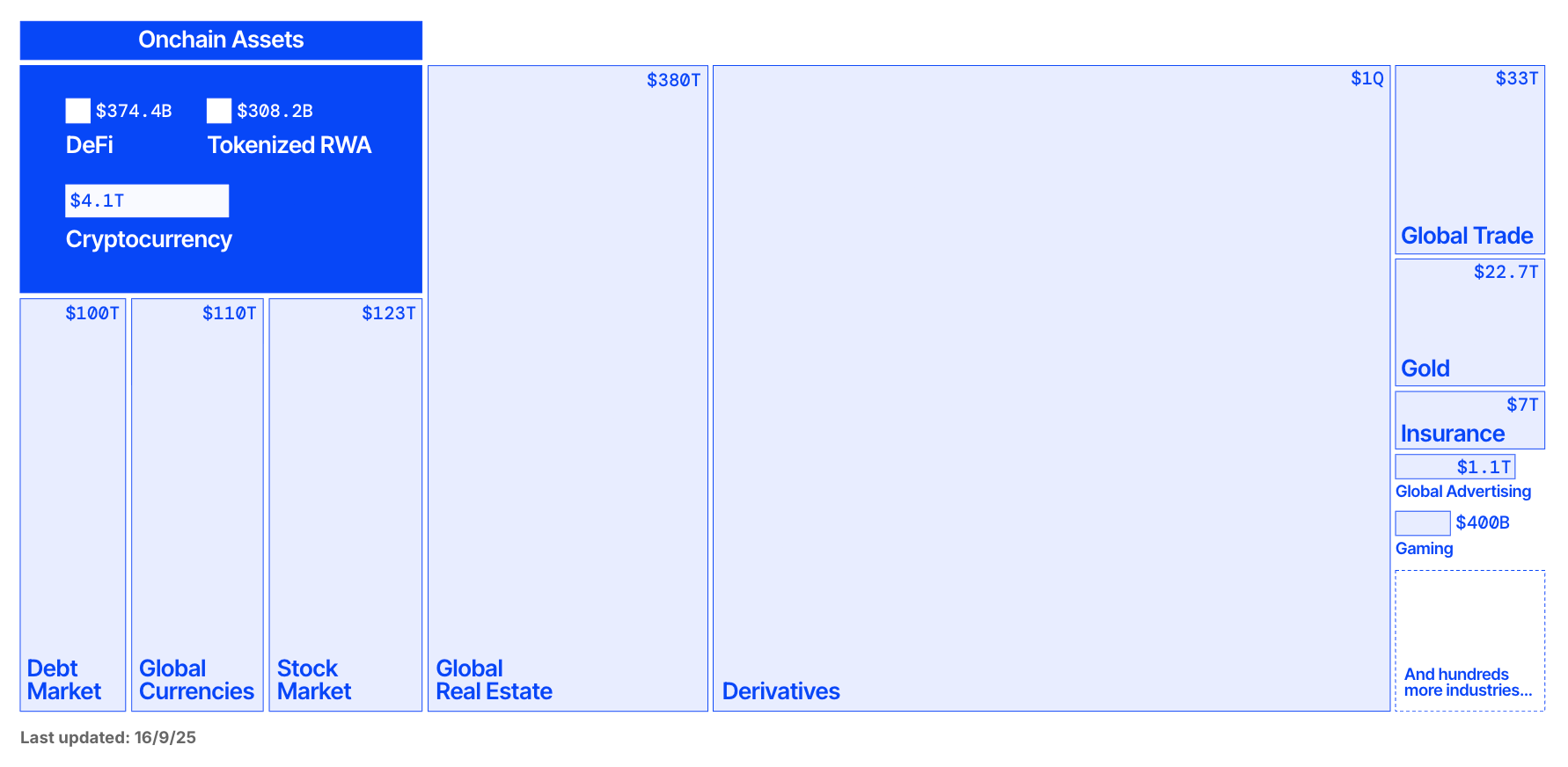
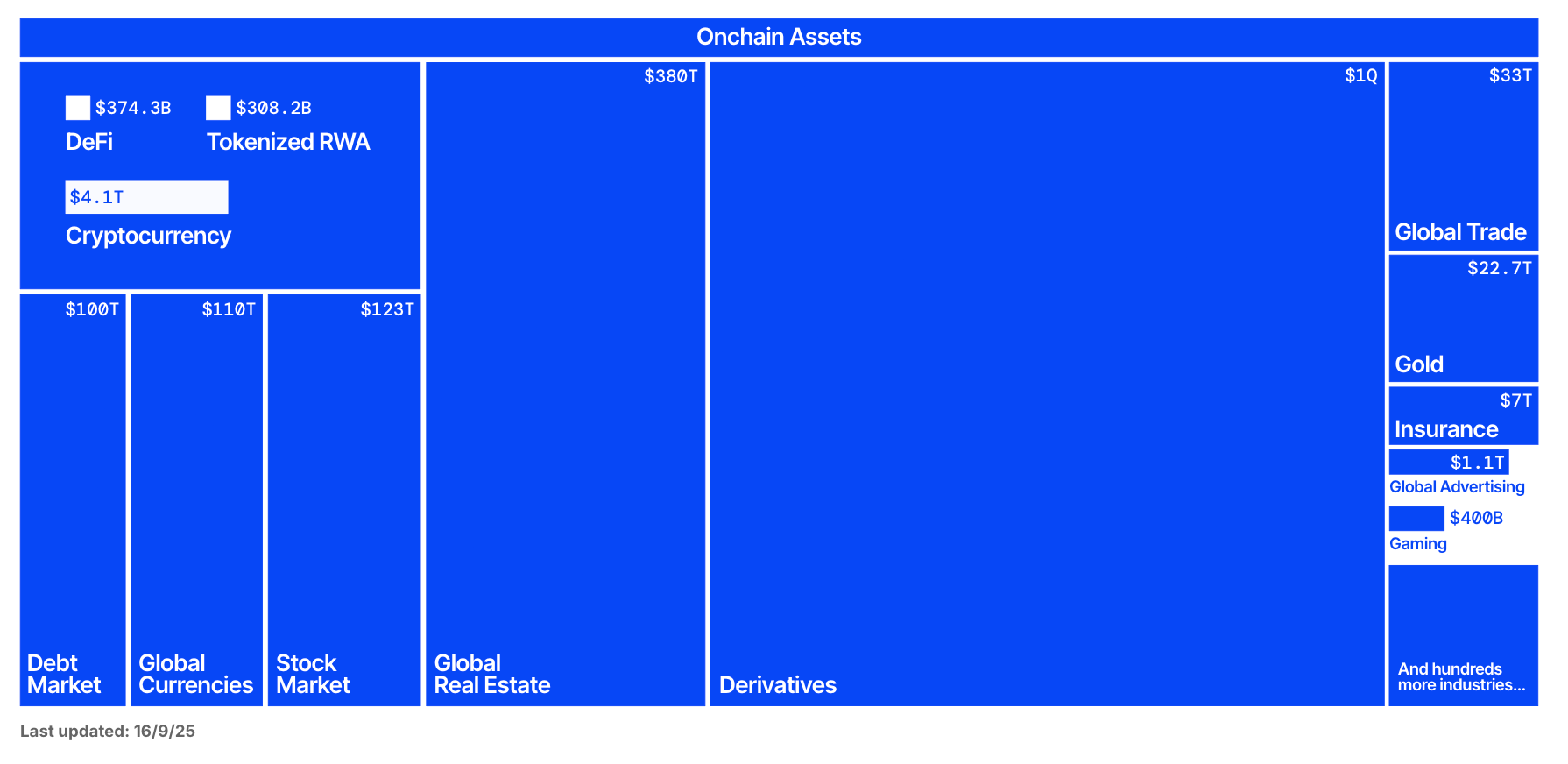
Stablecoins, or tokenized money, were the first wave of real-world asset tokenization, and continue to grow by remediating billions of dollars in payments-related costs annually. Alternative assets were next, particularly private credit markets, where liquidity, transparency, and settlement have been foundational issues for decades. Now, tokenized funds, equities, and public credit are gaining traction as the benefits of tokenization and smart contracts are applied more broadly to drive both new product innovations and decreased costs and latency.
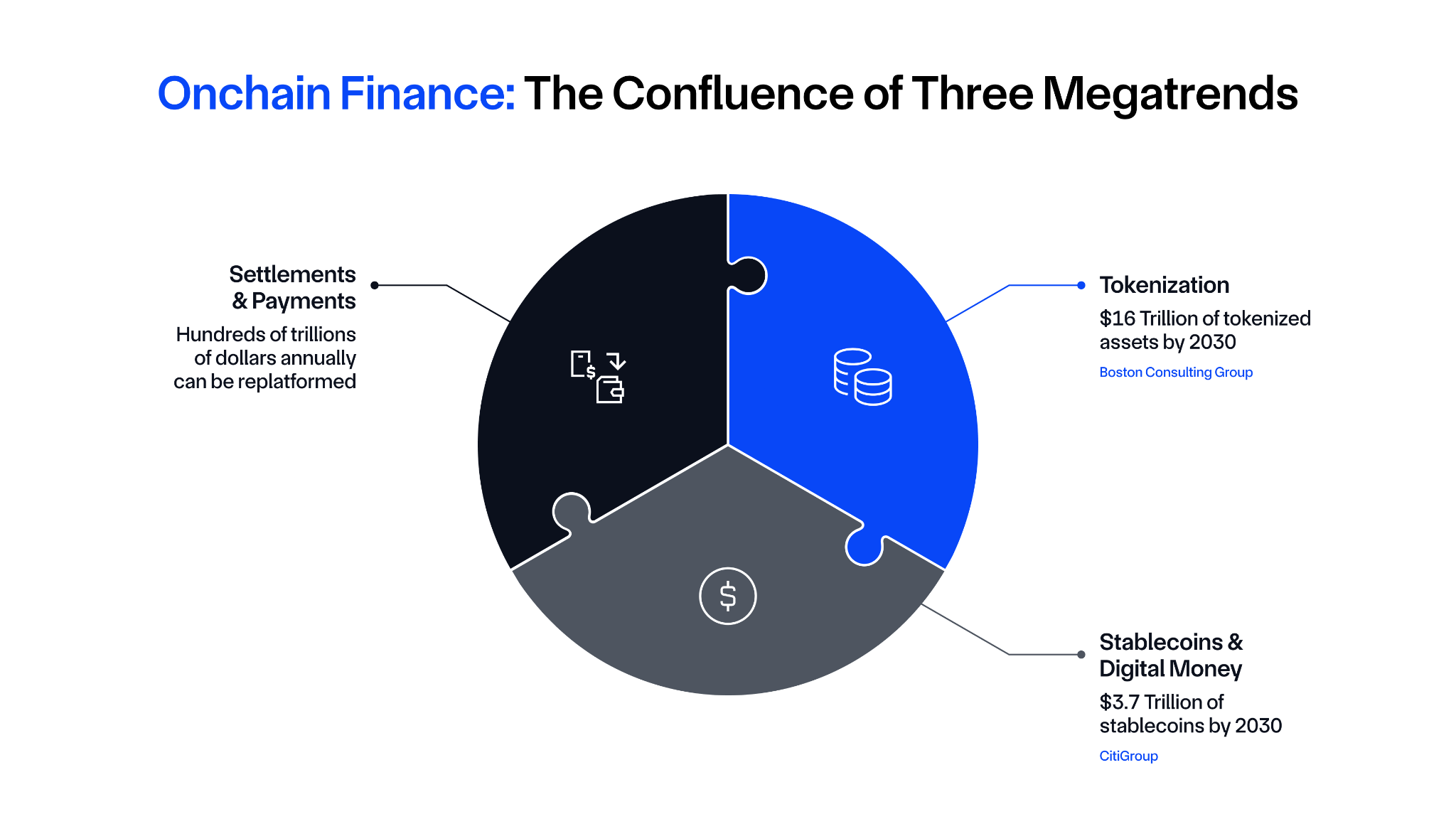
With the adoption of tokenized assets rapidly accelerating, there’s now a global system of existing infrastructure and technologies that need to connect with blockchain-based systems. There are also a number of key requirements that must be met in order for tokenized asset transactions to operate at scale in the real world. Most notably, tokenized assets need access to external data and computation, interoperability between blockchains, embedded compliance and privacy, and synchronization with offchain systems, all of which must be orchestrated together to support the full transaction lifecycle.
Building these more advanced smart contracts for tokenized assets is becoming increasingly complex for institutions and independent developers alike, specifically given the fragmentation across blockchains, legacy systems, and external resources. Solving everything in-house requires significant operational overhead, technical debt, and project management resourcing while employing a fragmented and growing list of point-to-point solutions adds even more complexity to the situation.
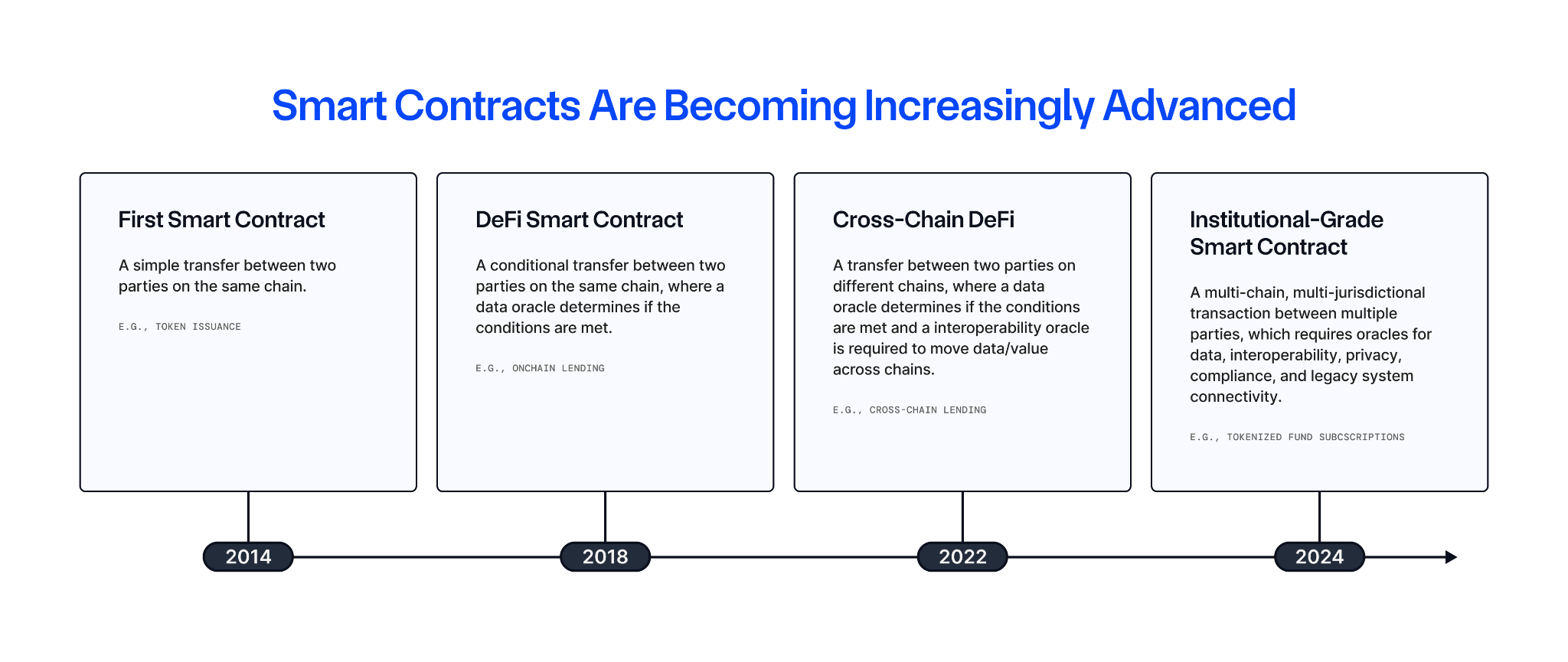
This predicament is similar to the early days of the Internet and online applications; that is, until the TCP/IP standard unified disparate intranets into a single global Internet and the Java Runtime Environment (JRE) abstracted the complexities of online application development. The blockchain industry now needs its own TCP/IP and JRE standard.
Enter Chainlink, the industry-standard oracle platform that unifies disparate blockchain networks and enables custom smart contracts across onchain and offchain systems. The Chainlink technology stack currently spans four key standards: data, interoperability, compliance, and privacy. Chainlink also provides an orchestration layer for combining different standards, blockchains, existing systems, and Chainlink services into a single, executable workflow.
Chainlink’s standards and services can be easily created and seamlessly composed into more advanced solutions using the Chainlink Runtime Environment (CRE), including being integrated with existing systems and standards. CRE is the industry’s only all-in-one orchestration layer for building and executing institutional-grade smart contracts—smart contracts that are easily connected to external data, cross-chain enabled, compliance-ready, privacy-preserving, and which can securely interoperate across thousands of public and private blockchains, existing identity and enterprise systems, and core financial infrastructure.
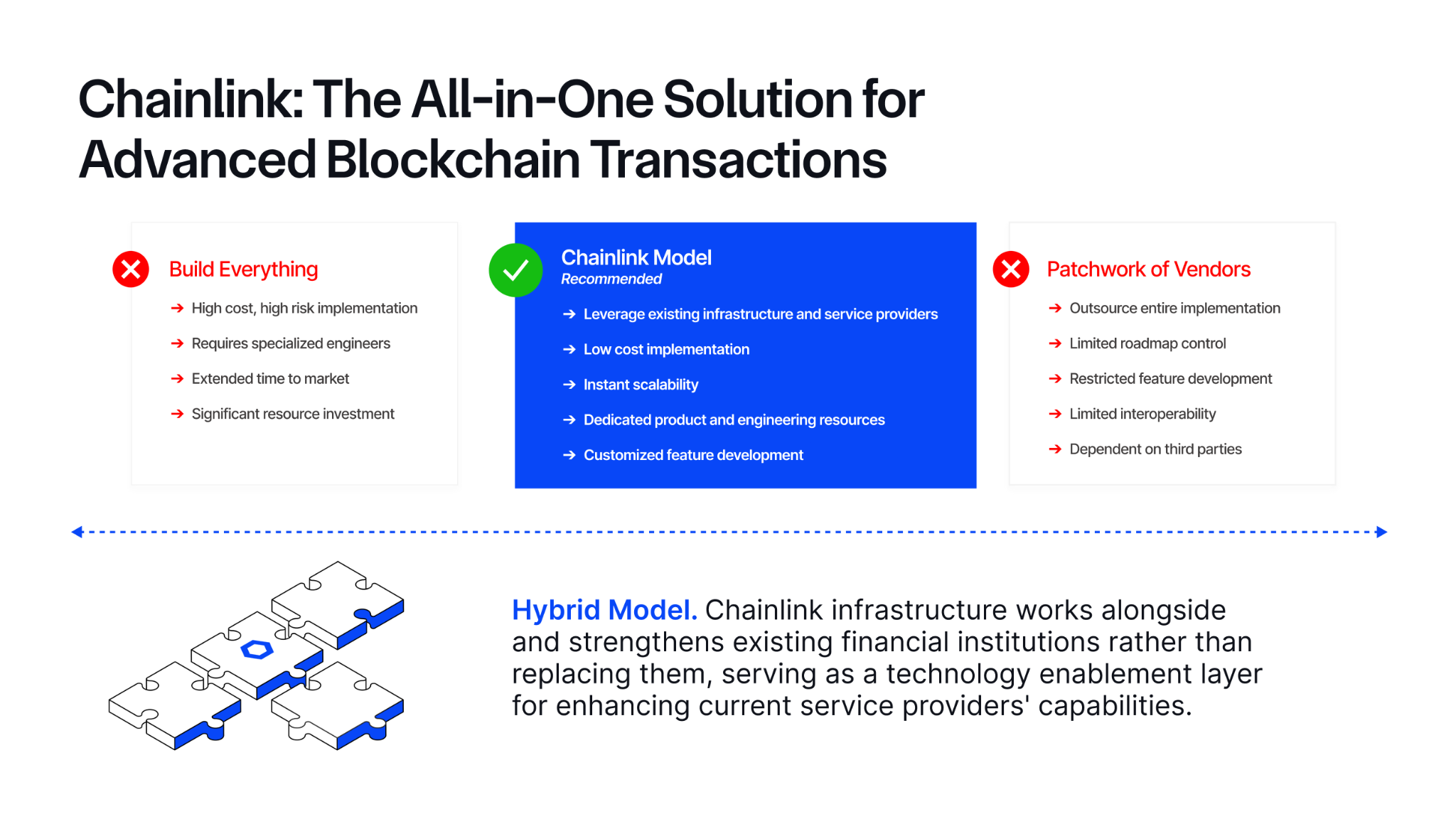
Instead of relying on point solutions that only address a fraction of an application’s needs and require a complex patchwork of different service providers, developers can leverage Chainlink to access all of the services they need for tokenized assets within a single, unified platform. With Chainlink, multi-party, multi-chain, multi-asset, multi-jurisdictional, and multi-system smart contracts are not only possible, but easy to build, execute, and future-proof against industry shifts. Chainlink enables institutions to create these institutional-grade smart contracts that mirror the sophistication and security seen in existing financial systems while also realizing enhanced efficiency and automation thanks to the power of smart contracts and oracle networks.
As most corporations and financial institutions prepare for asset tokenization en masse, the Chainlink platform is uniquely positioned to service this demand as the essential piece of infrastructure for building and powering institutional tokenized assets, markets, and services.
“We believe the next step going forward will be the tokenization of financial assets and that means every stock, every bond... will be on one general ledger.”
– Larry Fink, Chairman and CEO of BlackRock, 2024.
Chainlink Fundamentals
Understanding Chainlink requires understanding the fundamental ‘oracle problem’ it set out to solve before expanding into a wider platform of oracle standards, services, and solutions.
The Oracle Problem
Blockchains, while highly secure and deterministic, are inherently self-contained systems that cannot natively access external (offchain) data, other blockchains, or existing systems, leaving them isolated like computers without an Internet connection. This ‘oracle problem’ creates a barrier to smart contracts achieving their full potential, as many use cases—such as financial agreements, insurance, and supply chain automation—depend on having access to offchain data and existing systems.
Oracles serve as the bridge between blockchains and the outside world. They observe, fetch, validate, and transmit information between the two environments. They can also transform the information before it reaches its destination, including support for any arbitrary computation.
The challenge, however, is that centralized oracles introduce single points of failure, undermining the very benefits of decentralization that blockchains provide.
.png)
Decentralized Oracle Networks (DONs)
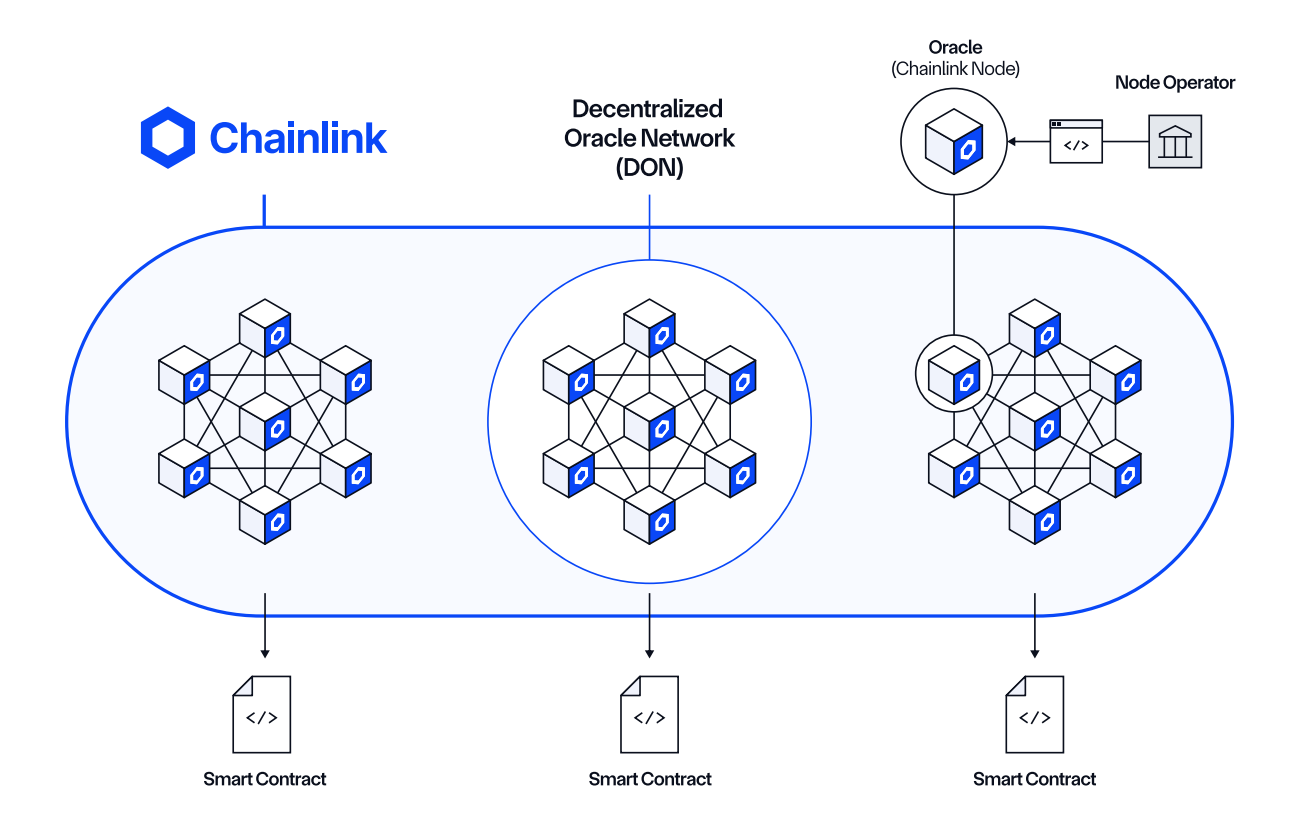
Chainlink solved the oracle problem through the invention of decentralized oracle networks (DONs), which combine multiple independent nodes, multiple data sources, cryptographic primitives, and advanced security measures to generate consensus about any event or computation. DONs also ensure reliable and tamper-resistant delivery of the output to predefined destinations (e.g., blockchains).
In solving the oracle problem, Chainlink enables smart contracts to securely interact with external data, smart contracts on other blockchains, and non-blockchain systems, paving the way for widespread adoption of advanced applications that seamlessly interoperate across onchain and offchain environments.
Importantly, Chainlink is not a single, monolithic network. Instead, it's a collection of independent DONs running in parallel, each performing predefined tasks. Each DON can be customized to fit the exact needs of users, including the number of nodes, data sources used, computations performed, security parameters configured, etc.
Offchain Reporting (OCR)
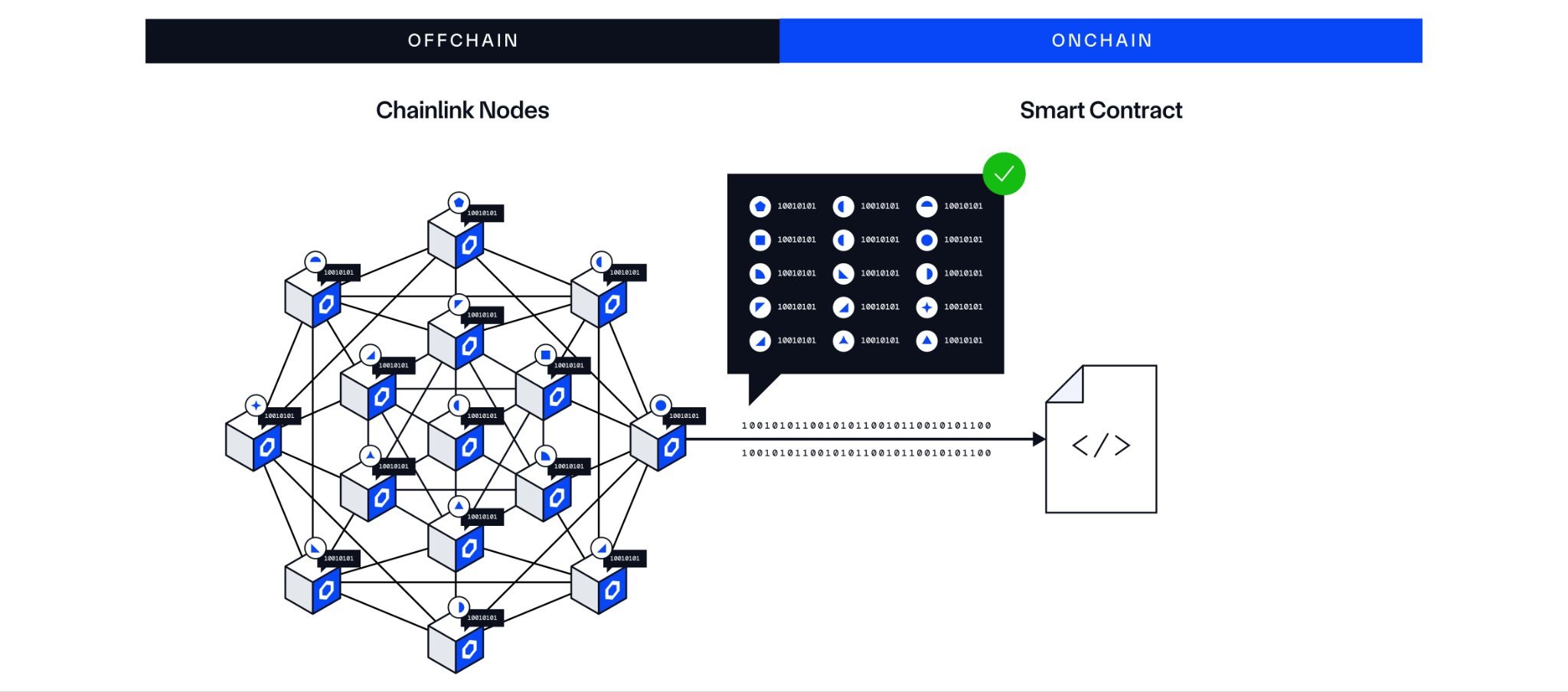
The cryptographic consensus protocol at the heart of Chainlink DONs. Through OCR, Chainlink DONs form consensus and provide attestations about information, whether individual data points, intersystem messages, or real-world events. OCR operates as an offchain, byzantine fault tolerant, cryptographically secure, decentralized, peer-to-peer protocol that improves network scalability and efficiency by allowing nodes to aggregate observations offchain before submitting a single, aggregated report onchain. Instead of every node sending separate onchain transactions, nodes communicate offchain over a secure peer-to-peer network, elect a leader, collectively generate a single report signed by a quorum, and transmit a single report onchain, significantly reducing network operating costs.
Chainlink Runtime Environment (CRE)
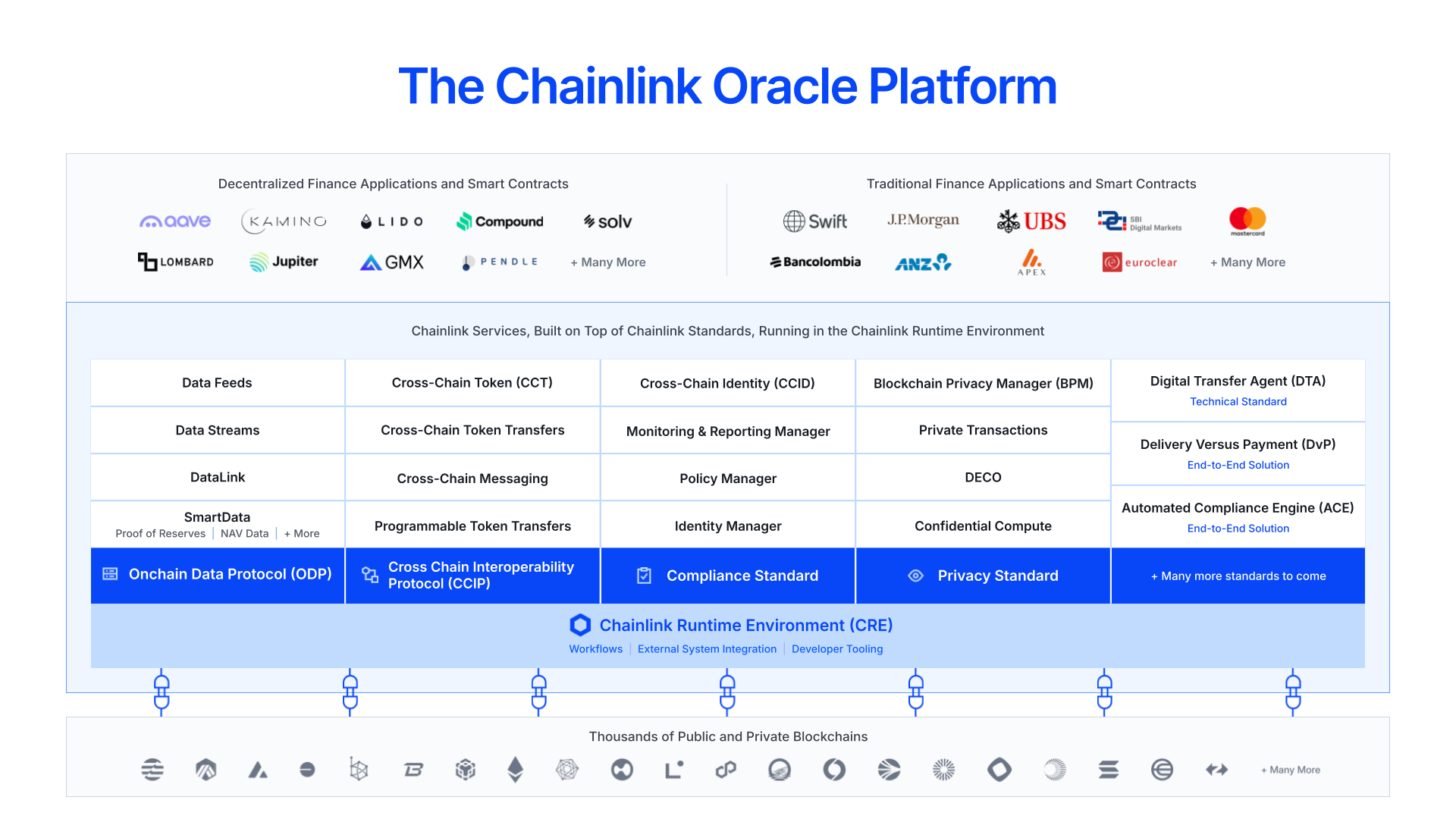
The orchestration layer of the Chainlink platform. CRE distills various Chainlink oracle functionalities (e.g., read from blockchain, fetch API, execute computation, perform consensus, write to blockchain) into modular capabilities that developers can combine together into repeatable, executable workflows. CRE can be integrated into existing business processes and enable both enterprises and individual developers to create complex, customizable workflows that span multiple blockchains, legacy systems, and Chainlink oracle services—supporting the full lifecycle of tokenized assets.
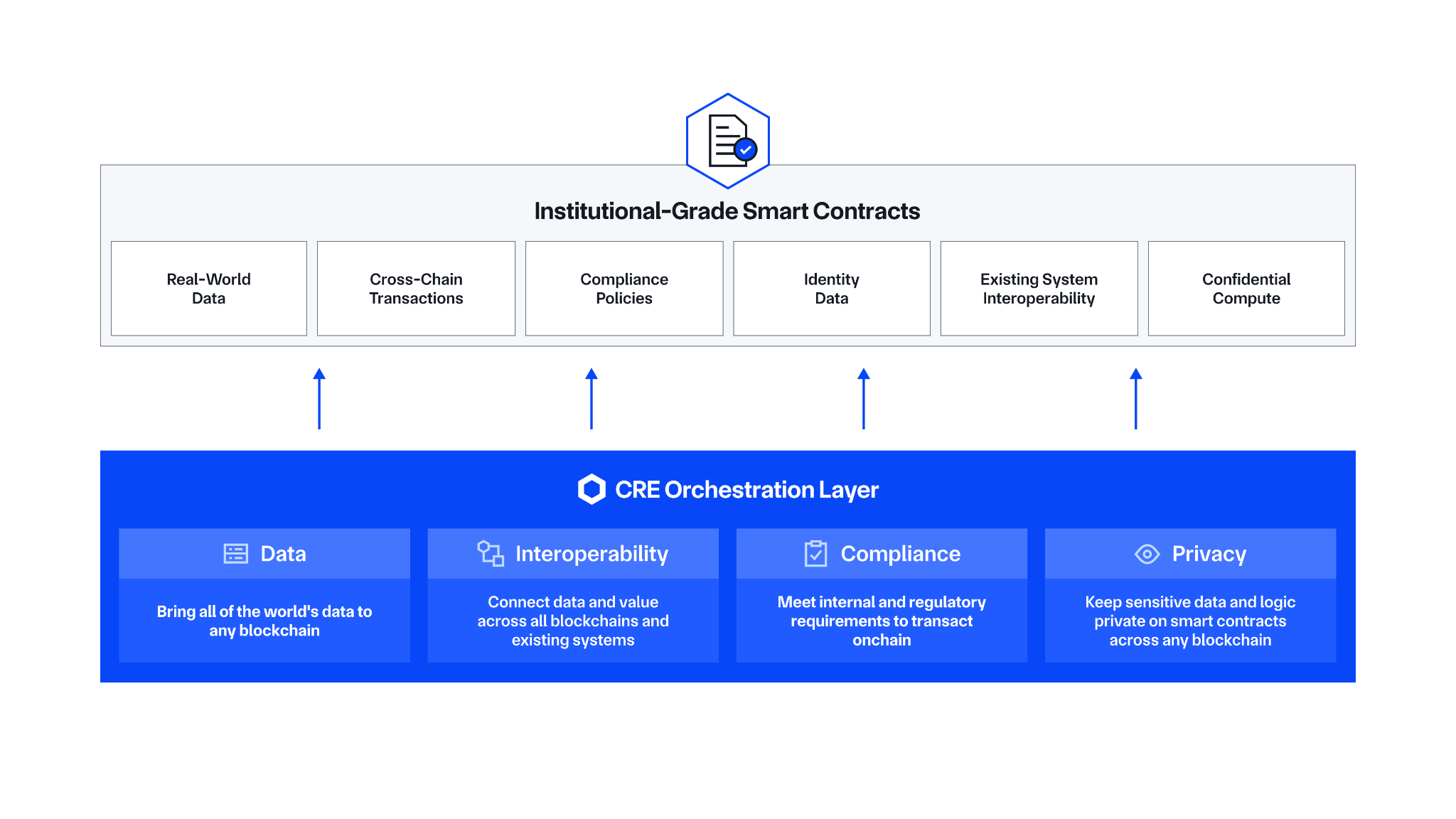
By unlocking seamless orchestration across onchain and offchain systems, CRE removes multi-chain development friction, synchronizes onchain smart contracts and offchain legacy systems, and accelerates time-to-market. This architecture is particularly suited for traditional finance, where institutions can combine issuance, settlement, servicing, monitoring, compliance, privacy, and legacy system integrations into a single workflow running in a single environment. Positioned at the intersection of Web3 and capital markets, CRE is enterprise-grade infrastructure necessary for scaling blockchain adoption across thousands of chains and use cases and integrating it seamlessly with existing financial markets.
The Chainlink Oracle Platform
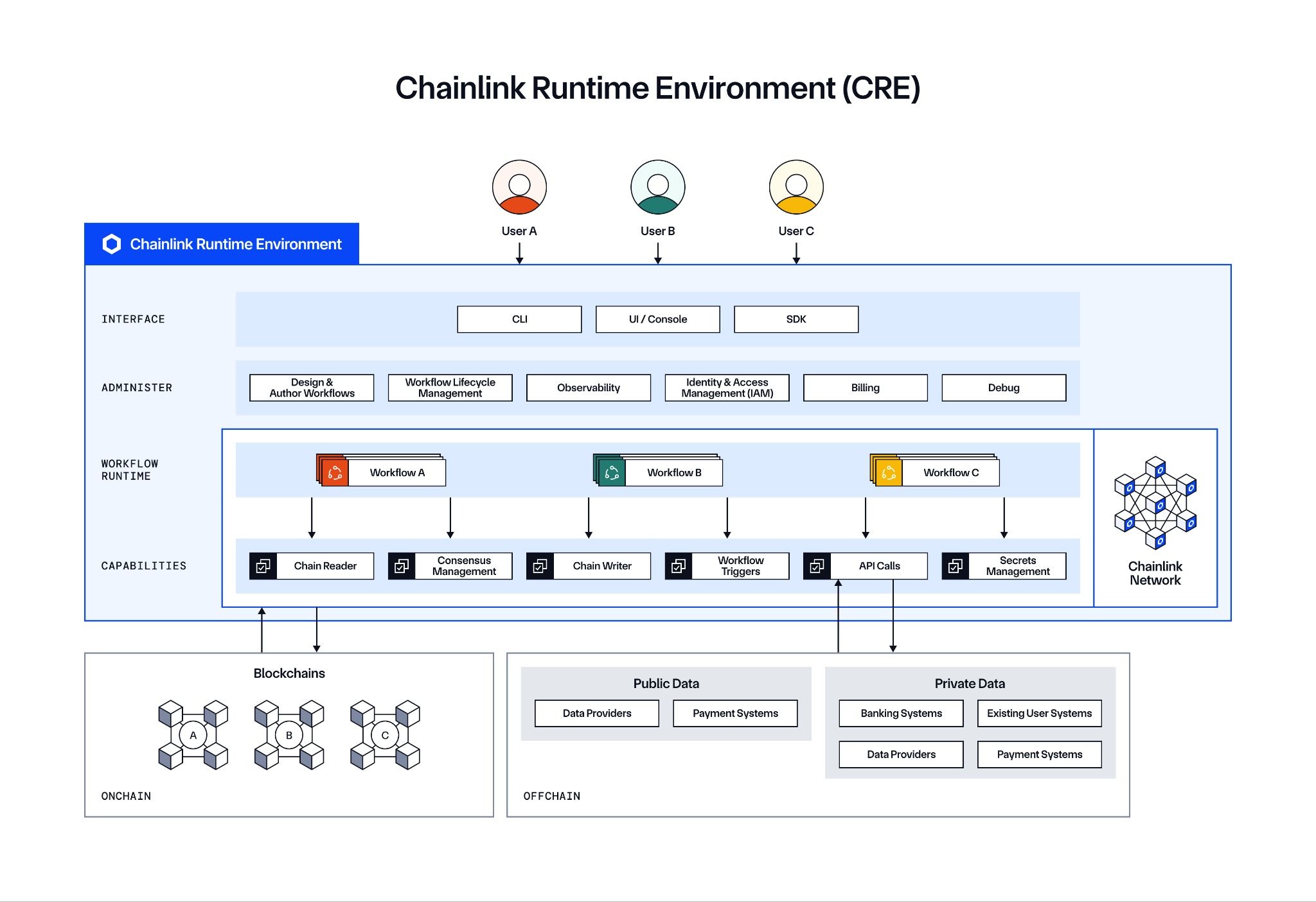
The entire collection of standards and oracle services across data, interoperability, compliance, and privacy, along with an orchestration layer for bringing them all together into advanced workflows. Chainlink’s all-in-one oracle platform represents essential infrastructure for institutional tokenization and Chainlink’s principal competitive advantage.
- Standards are protocol-level specifications defining how a Chainlink DON or set of DONs execute a broad type of oracle functionality to facilitate a specific use case. For example, CCIP is a standard for how a DON reads data on a source blockchain, verifies it, and writes it to a destination blockchain.
- Oracle services are pre-configured DONs built on top of Chainlink standards that perform predefined functions. For example, Data Feeds are preconfigured services designed specifically to push reference data to dedicated smart contracts at specific intervals.
- Orchestration layer is the collection of tools for composing and executing workflows using the aforementioned standards and services. The Chainlink Runtime Environment (CRE) is the orchestration layer for the Chainlink Network.
- End-to-end solutions compose multiple standards and/or services via CRE workflows into more sophisticated use cases, such as compliant cross-border transactions.
Chainlink is the only oracle platform to achieve ISO 27001 certification and a SOC 2 Type 1 attestation, providing institutions confidence that Chainlink meets institutional-grade infrastructure management and data security requirements. The ISO 27001 certification affirms that Chainlink has established a robust Information Security Management System (ISMS) encompassing the infrastructure, development, operations, administration, and security of CCIP, Price Feeds, and SmartData, as provided by Chainlink Labs, one of the primary contributing developers of Chainlink. ISO 27001 certification and completion of the SOC 2 Type 1 attestation validate Chainlink’s position as enterprise-grade infrastructure suitable for real-world, in-production use cases with financial institutions.
Standards, Services, and Solutions
Standards
Chainlink consists of four standards for designing and operating oracle services. Developers and institutions leverage these oracle services to address specific use case requirements of advanced blockchain applications or to support end-to-end solutions. These standards include:
- The Chainlink Data Standard is powered by the Onchain Data Protocol (ODP). ODP is an open, protocol-level specification for how a DON aggregates and verifies external data and publishes it onchain. It also encapsulates how applications securely access the data via a consistent set of interfaces across any blockchain—regardless of source, format, aggregation, delivery models, chains used, or use case. Chainlink’s data oracle solutions are unified under the ODP standard, giving institutions the foundation they need to seamlessly and securely bring core financial data onchain.
- The Chainlink Interoperability Standard is powered by the Cross-Chain Interoperability Protocol (CCIP). CCIP is an open, protocol-level specification for how a DON reads data on a source blockchain, verifies it, and writes it on a destination blockchain.
- The Chainlink Compliance Standard is powered by the Onchain Compliance Protocol (OCP). OCP is an open, protocol-level specification defining how to utilize DONs to define and store compliance data onchain and utilize identity data and policies in smart contracts. OCP allows existing identity systems (e.g., GLEIF’s vLEI, ERC-3643) to be integrated with onchain infrastructure via the Cross-Chain Identity (CCID) framework, with policies enforced onchain and offchain using the Policy Manager.
- The Chainlink Privacy Standard is a collection of privacy oracle services that conceal sensitive data and provide confidential computing. Through the Chainlink privacy standard, institutions can incorporate privacy into key parts of a transaction, such as its data, logic, computations, and external connections.
They can leverage the Chainlink Runtime Environment to combine all these standards and services into custom workflows that run across blockchains and legacy systems in a secure and reliable manner.
Data
Data Feeds
Oracle networks that provide smart contracts secure, decentralized, and tamper-resistant access to market and events data across various blockchains. Chainlink Data Feeds aggregate inputs from multiple data providers through a network of independent oracle node operators, producing highly reliable reference values. This design removes single points of failure, ensures transparency, and establishes Chainlink as the industry standard for data. Data Feeds are push-based oracles that directly transmit offchain data to blockchain networks on a specified interval via a reference smart contract, which can then be utilized by other blockchain applications.
.png)
Data Streams
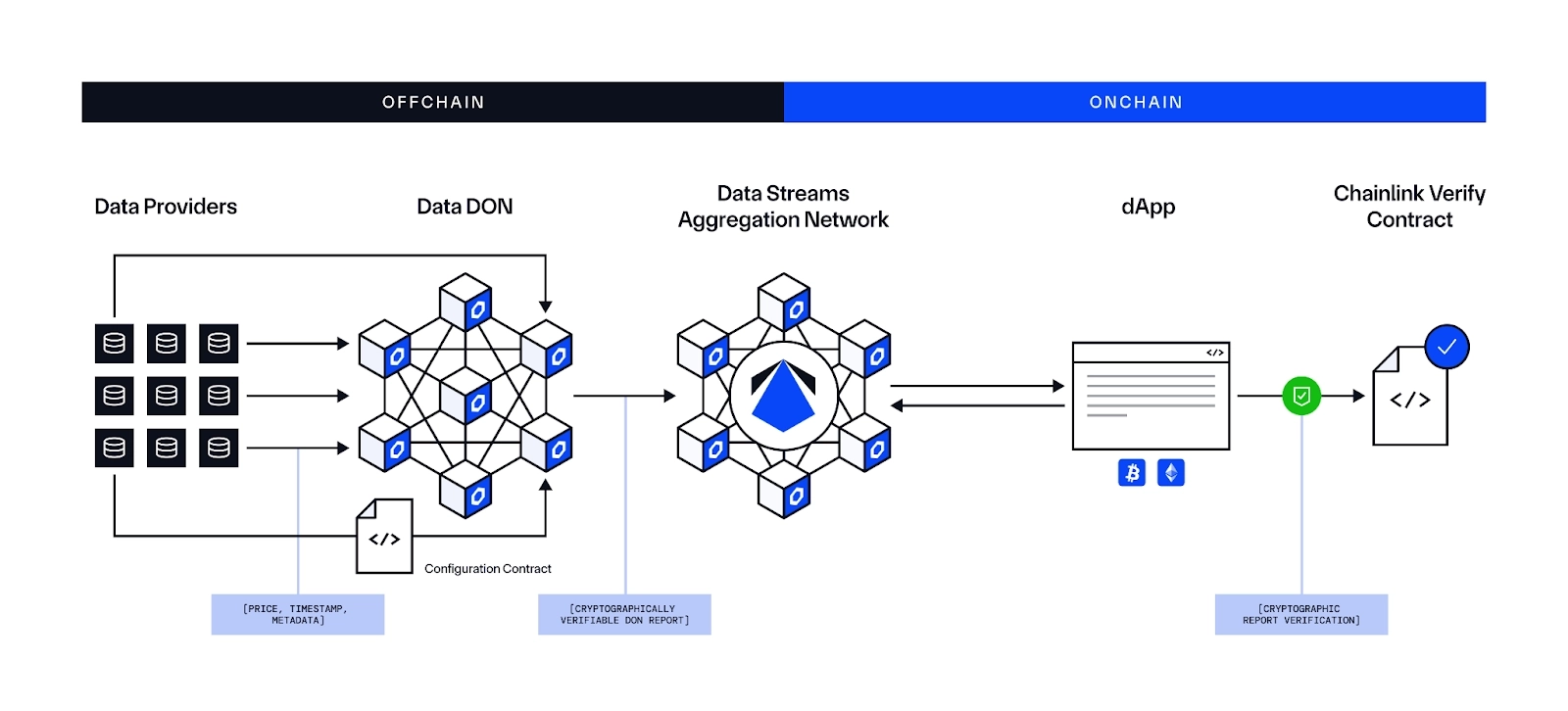
A low-latency oracle service designed for high-throughput DeFi markets, such as perpetual futures, that require sub-second data delivery. Chainlink Data Streams provides real-time, cryptographically verifiable market data, such as market prices, liquidity indicators, and volatility metrics. This enables low-latency trading, advanced onchain risk management, and frontrunning protection, bringing DeFi performance closer to centralized exchanges without sacrificing decentralization. Data Streams are pull-based oracles that make data available offchain at sub-second frequencies, which can then be pulled onchain at any time by users or Chainlink Automation to power blockchain applications.
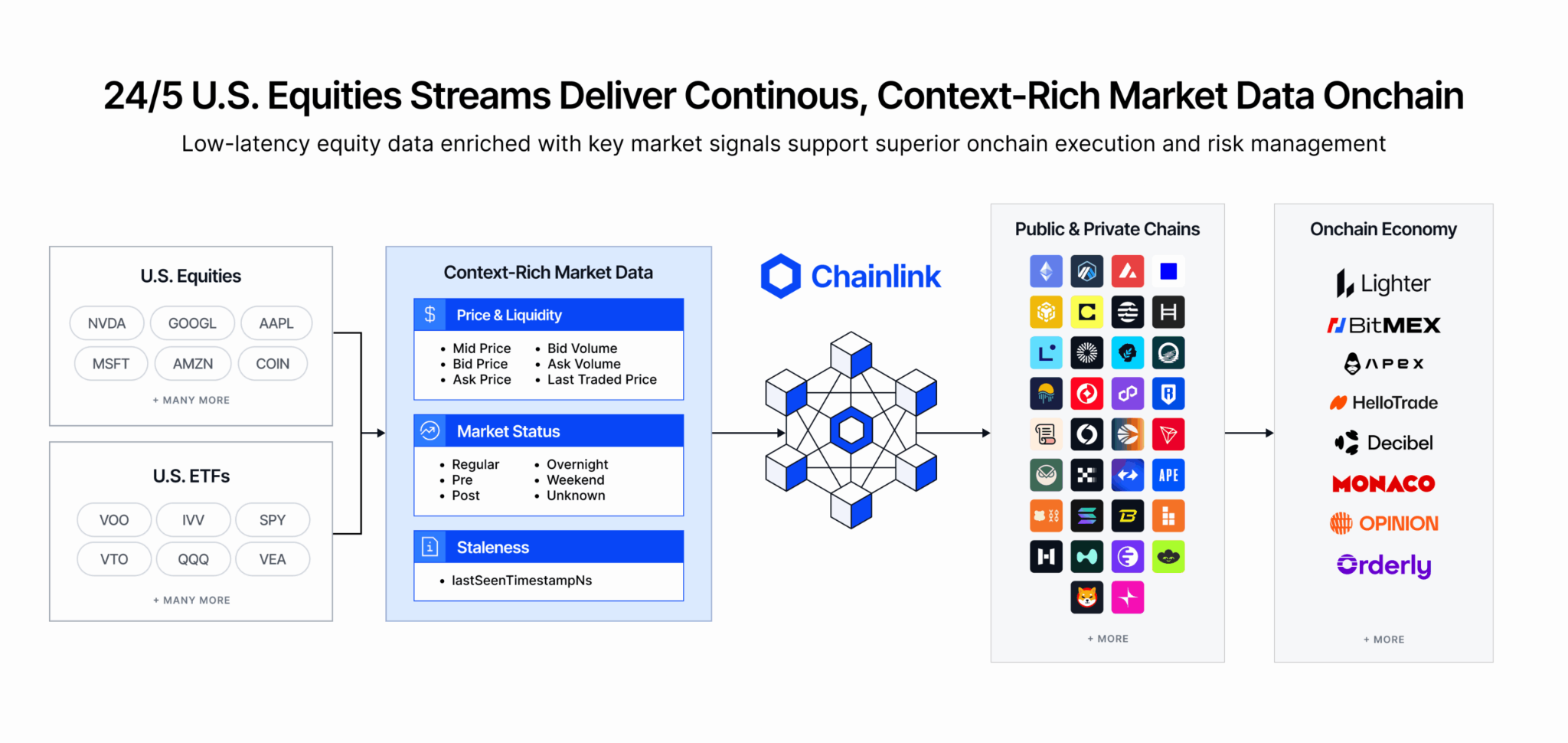
24/5 U.S. Equities Streams
A category of Data Streams that extends low-latency market data to U.S. stocks and ETFs across regular, pre-market, post-market, and overnight trading sessions. Alongside prices, the streams provide bid and ask data, volumes, and market-status information, giving protocols the inputs needed to support equity-linked perpetual futures, lending markets, and other onchain financial products beyond traditional exchange hours.
Chainlink also provides APAC Equities Streams for stocks and indices across Japan, South Korea, mainland China, Taiwan, and Hong Kong. These streams follow each exchange’s local trading sessions, extending the range of global assets that developers can support onchain.
Smart Value Recapture (SVR)
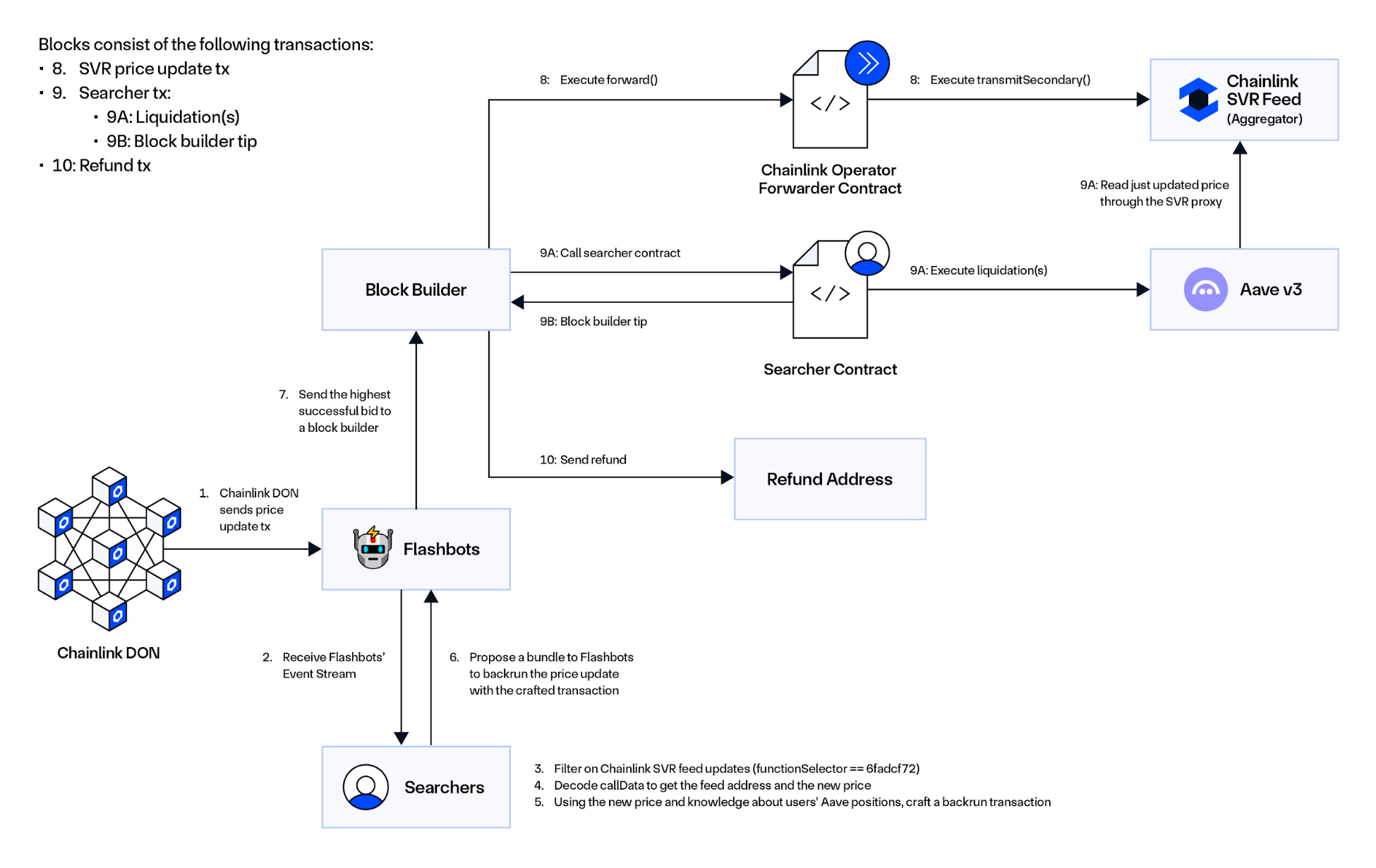
A novel oracle solution that enables DeFi protocols to recapture Oracle Extractable Value (OEV)—a subset of non-toxic Maximal Extractable Value (MEV) associated with oracle updates, most commonly during the liquidation process of lending protocols. The value recaptured by Chainlink SVR provides DeFi protocols with an additional revenue stream while also supporting the economic sustainability of the Chainlink Network.
SVR has expanded beyond its initial Ethereum deployment to support lending markets on additional networks, including Base, Arbitrum, and BNB Chain. Auction infrastructure varies by network, with Ethereum integrations using various order-flow auction providers including Flashbots and Titan Builder, while additional networks are supported through Atlas. SVR-enabled feeds retain the familiar Chainlink Price Feeds interface and use a Dual Aggregator architecture with a fallback mechanism for price delivery. Recaptured oracle-related MEV is shared between integrating protocols and the Chainlink Network, creating a revenue stream tied to the value that oracle updates enable. Aave’s usage of Chainlink SVR can be viewed at https://svr.llamarisk.com/.
Proof of Reserve
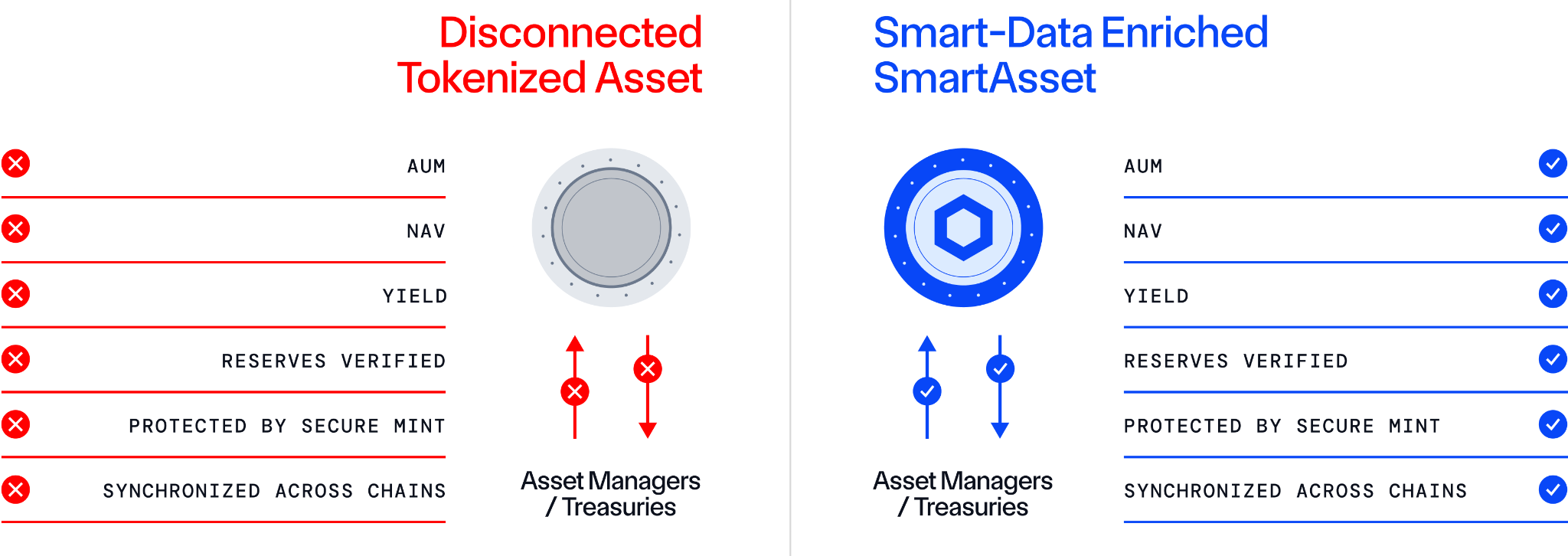
A decentralized oracle service that provides real-time, automated verification of the collateral reserves backing onchain and cross-chain assets like stablecoins, wrapped tokens, and tokenized assets. By replacing slow, infrequent, and opaque manual audits with tamper-resistant, onchain transparency, Chainlink Proof of Reserve reduces systemic risk, enables circuit breakers in DeFi protocols, and increases user confidence in the solvency and backing of digital assets. Asset issuers can integrate Proof of Reserve into their token’s minting smart contract (referred to as Secure Mint), helping mitigate against "infinite mint attacks” by preventing the issuance of new units of tokens unless there are reserves sufficient to maintain collateralization.
.png)
DataLink
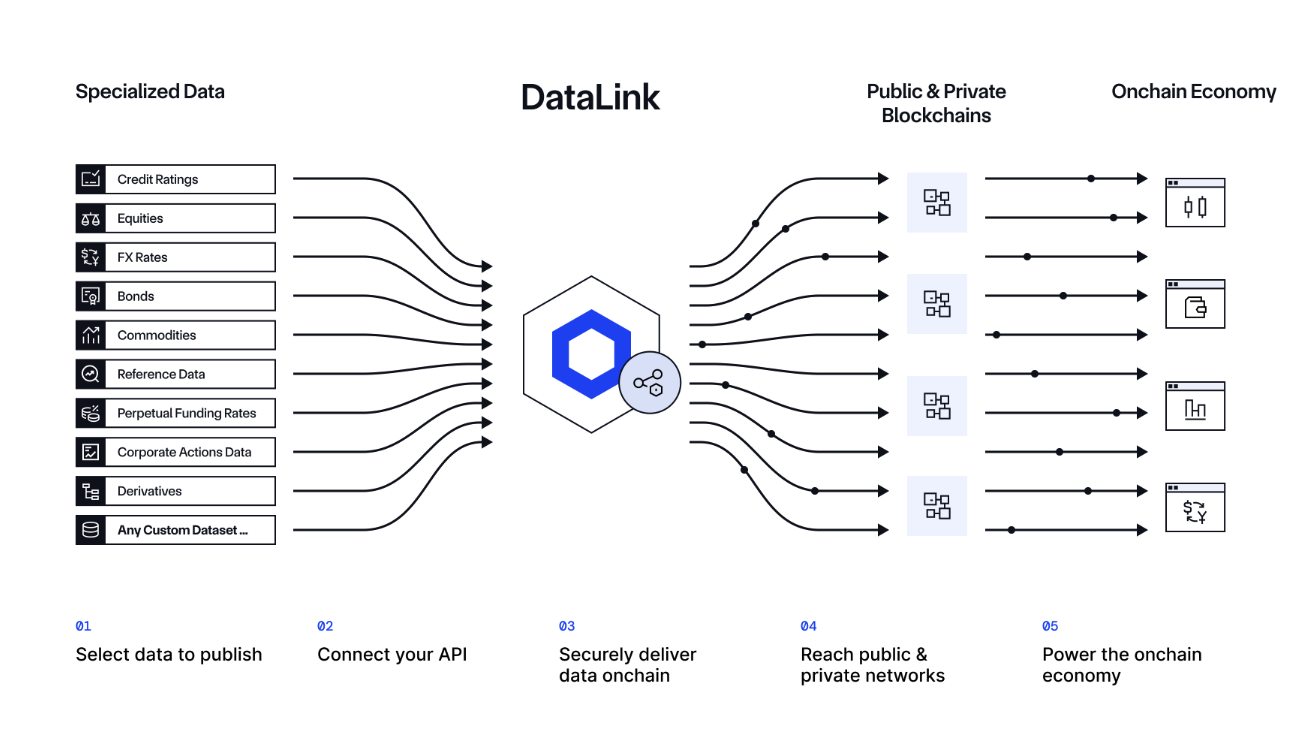
An institutional-grade data publishing solution that leverages Chainlink infrastructure to enable data providers to deliver, distribute, and commercialize their data onchain. As a turnkey service, DataLink empowers data owners to seamlessly publish data to blockchains in a secure manner and realize all the benefits of connecting to onchain markets without requiring them to build or maintain new infrastructure. By providing secure access to the same high-quality data that institutions already rely on, DataLink accelerates institutional adoption of digital assets and enables organizations to rapidly scale onchain.
SmartData
A suite of onchain data offerings designed to unlock the utility, accessibility, and reliability of tokenized assets. By providing secure minting assurances alongside essential data, such as reserves, Net Asset Value (NAV), and Assets Under Management (AUM) data, Chainlink SmartData embeds security and enhances the functionality of tokenized-asset offerings. As financial institutions continue to embrace tokenization, the demand for a variety of data types beyond market pricing is expanding rapidly, with Chainlink supporting that demand by bringing multitudes of specialized data onchain in a highly secure and reliable manner.
Interoperability
Cross-Chain Interoperability Protocol (CCIP)
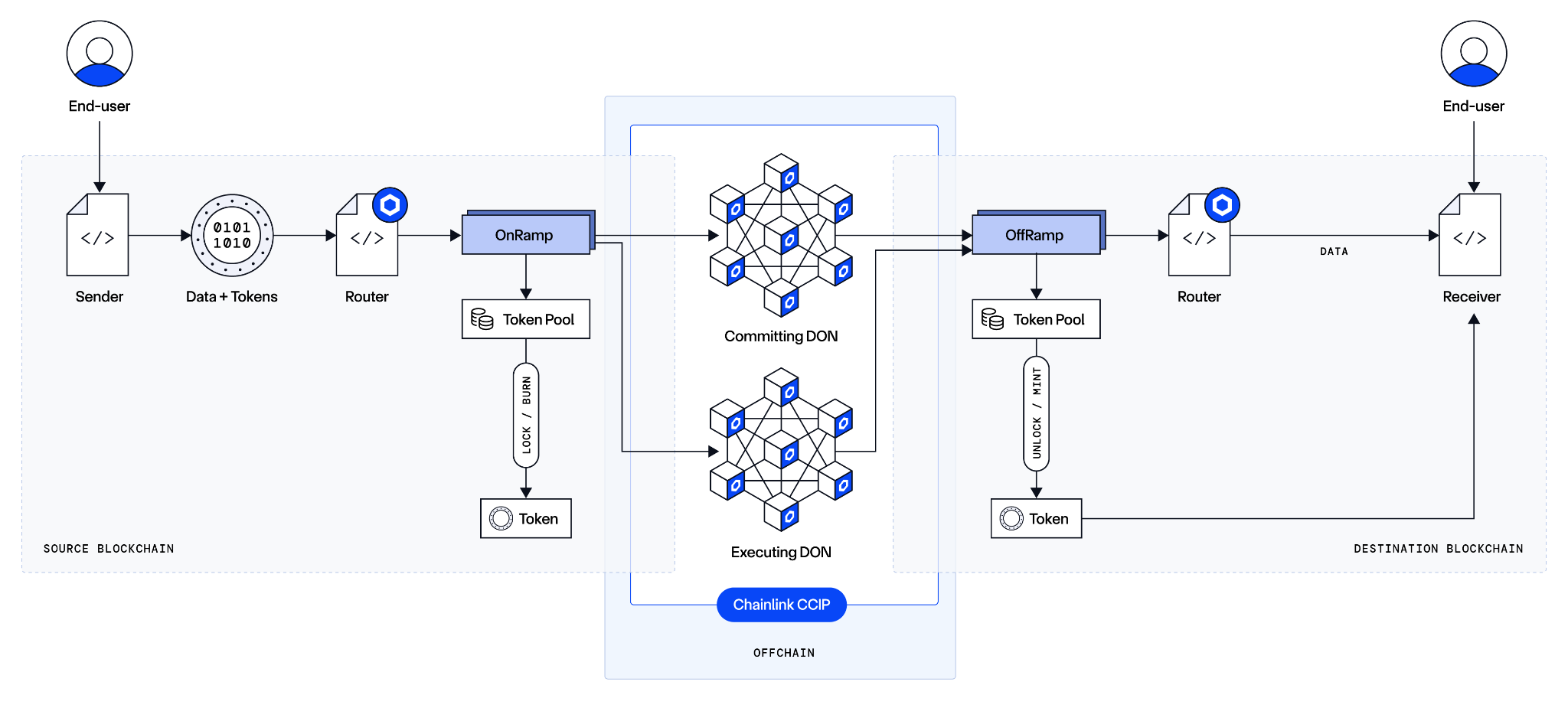
A standard for the transmission of data and value between blockchain networks. Chainlink CCIP enables the secure transfer of tokens, data, or both simultaneously (Programmable Token Transfers) across heterogeneous blockchains (both public and private), eliminating the need for fragmented and costly chain-specific integrations.
The Cross-Chain Token (CCT) standard enables token developers to integrate new and existing tokens with CCIP in a self-serve manner in minutes. CCTs are cross-chain native tokens secured by CCIP that support self-serve deployments, full control and ownership for developers, enhanced programmability, and zero-slippage transfers.
By default, CCIP is secured by 16 independent node operators, with infrastructure distributed across geographies and operating environments to reduce correlated points of failure. Its security model combines decentralized verification with controls such as rate limits and monitoring. Through the CCT standard, issuers retain control of their tokens and can configure cross-chain transfers without embedding bridge-specific logic into the token itself.
Following industry security incidents, a growing number of leading protocols, organizations, and governments have deprecated their legacy cross-chain and oracle solutions and migrated to Chainlink, including the Wyoming Stable Token Commission, BitGo, Kraken, and more.
Compliance
Cross-Chain Identity (CCID)
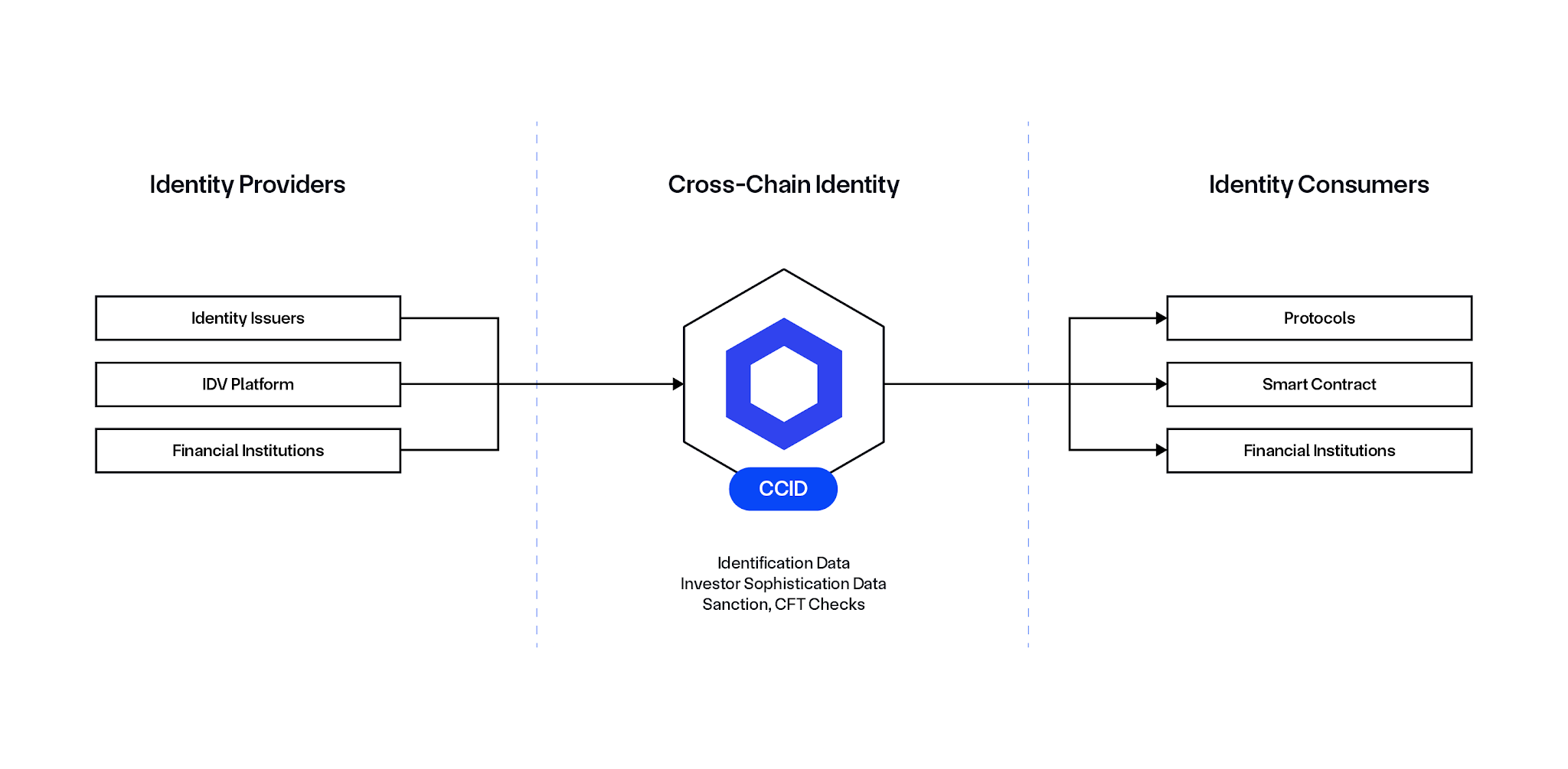
A reusable identity standard for representing investor identities, attestations, and credentials across multiple blockchains by storing cryptographic proofs of verified credentials, including know-your-customer (KYC), anti-money laundering (AML), investor sophistication status, and more, while keeping personal information (e.g., NPI/PII) offchain. CCID is compatible with existing identity standards, such as LEI/vLEI, ONCHAINID, and DIDS.
Prior to CCID, users were required to pass KYC information every time they onboarded to a platform. With CCID, KYC can be completed once, with all accumulated credentials and attestations collected and stored via CCID. This allows those credentials to be reused as a reliable proof of KYC across different platforms that accept those identity credentials.
Policy Manager
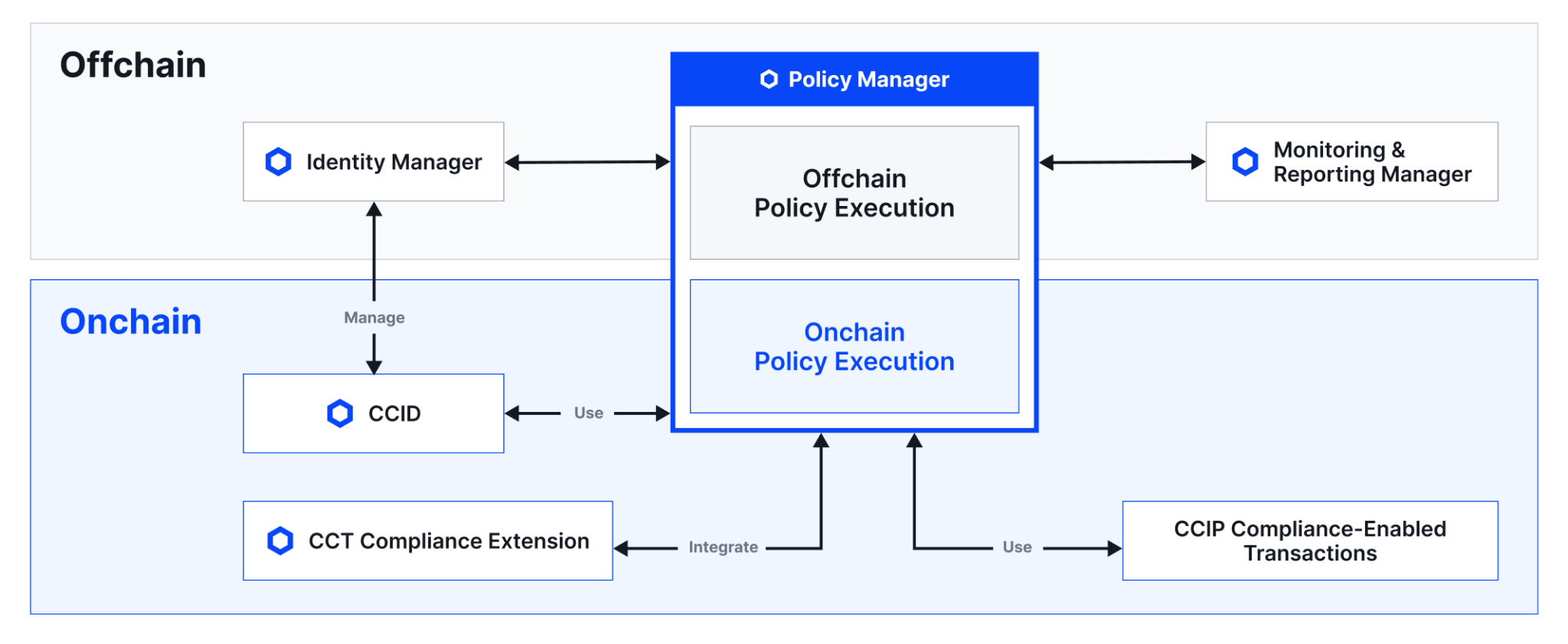
A customizable rules engine that enables users to define, manage, and enforce compliance policies directly within smart contracts. The Policy Manager employs both an onchain component (a set of smart contracts) and an offchain system to facilitate both on- and offchain policy execution. Policy enforcement can be implemented to satisfy regulatory requirements (e.g., investor sophistication certification) or internal business rules (e.g., transaction limits, collateral requirements, etc.). Policy enforcement is critical for managing operational, financial, legal, and reputational risks with regulated tokenized and digital assets.
Policy enforcement can be at the asset-level, where it is embedded directly into smart contract logic, ensuring that unauthorized actors cannot access the asset. Policy enforcement can also be at the protocol level, where policies are enforced within the smart contracts governing broader transactional or operational workflows.
Automated Compliance Engine (ACE)
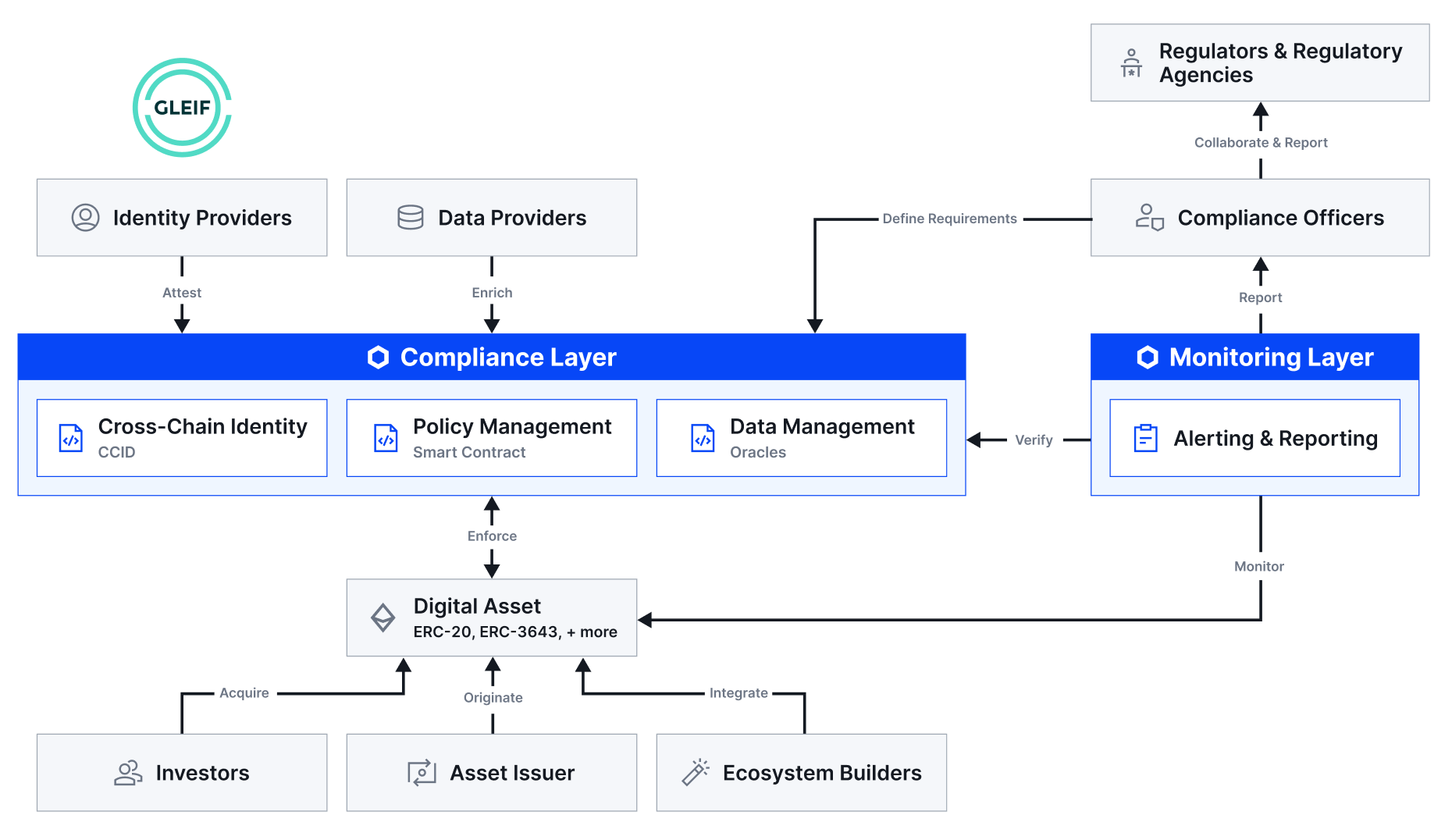
An end-to-end solution powered by CRE that enables anyone across traditional or decentralized finance to build, manage, and execute complex financial transactions across multiple jurisdictions, counterparties, digital assets, and execution environments in a compliance-focused and privacy-preserving manner.
In addition to built-in support for CCID and the Policy Manager, Chainlink ACE also features an Identity Manager and Monitoring and Reporting Manager that help automate and simplify compliance operations. Chainlink ACE is unique in its ability to extend identity and compliance data to blockchains and tokenized assets, empowering institutions to automate policy enforcement, simplify regulatory processes, and operate confidently onchain.
Chainlink ACE launched in collaboration with multiple leading identity frameworks for institutional tokenized assets, including:
- Apex Group is a prominent global financial services provider that services over $3.4 trillion in assets and provides institutional-grade tokenization solutions. Apex Group and Chainlink collaborated to strengthen institutional-grade compliance for tokenized assets. The collaboration centers around integrating Chainlink ACE with ERC-3643 permissioned tokens, starting with ONCHAINID, the open-source identity framework built into the token standard.
- GLEIF is an organization overseeing and ensuring the integrity of the only globally adopted, mandated, and G-20 initiated Legal Entity Identifiers (LEIs) standard, which enables reliable identification of legal entities in financial transactions. Integrating Chainlink ACE with verifiable LEI (vLEI) unlocks a compliance-first digital asset infrastructure, where GLEIF anchors global legal entity identities while Chainlink operationalizes it through decentralized infrastructure. The partnership brings verifiable legal entity identity (vLEI) data onchain for the first time.
- ERC-3643 Association is a non-profit organization dedicated to standardizing the tokenization market through ERC-3643, and collaborated with Chainlink to engineer an implementation of ERC-3643 that leverages a combination of Chainlink ACE and GLEIF vLEIs for identity verification. ERC-3643 is a permissioned token standard that ensures compliance and controls.
Privacy
Confidential Compute
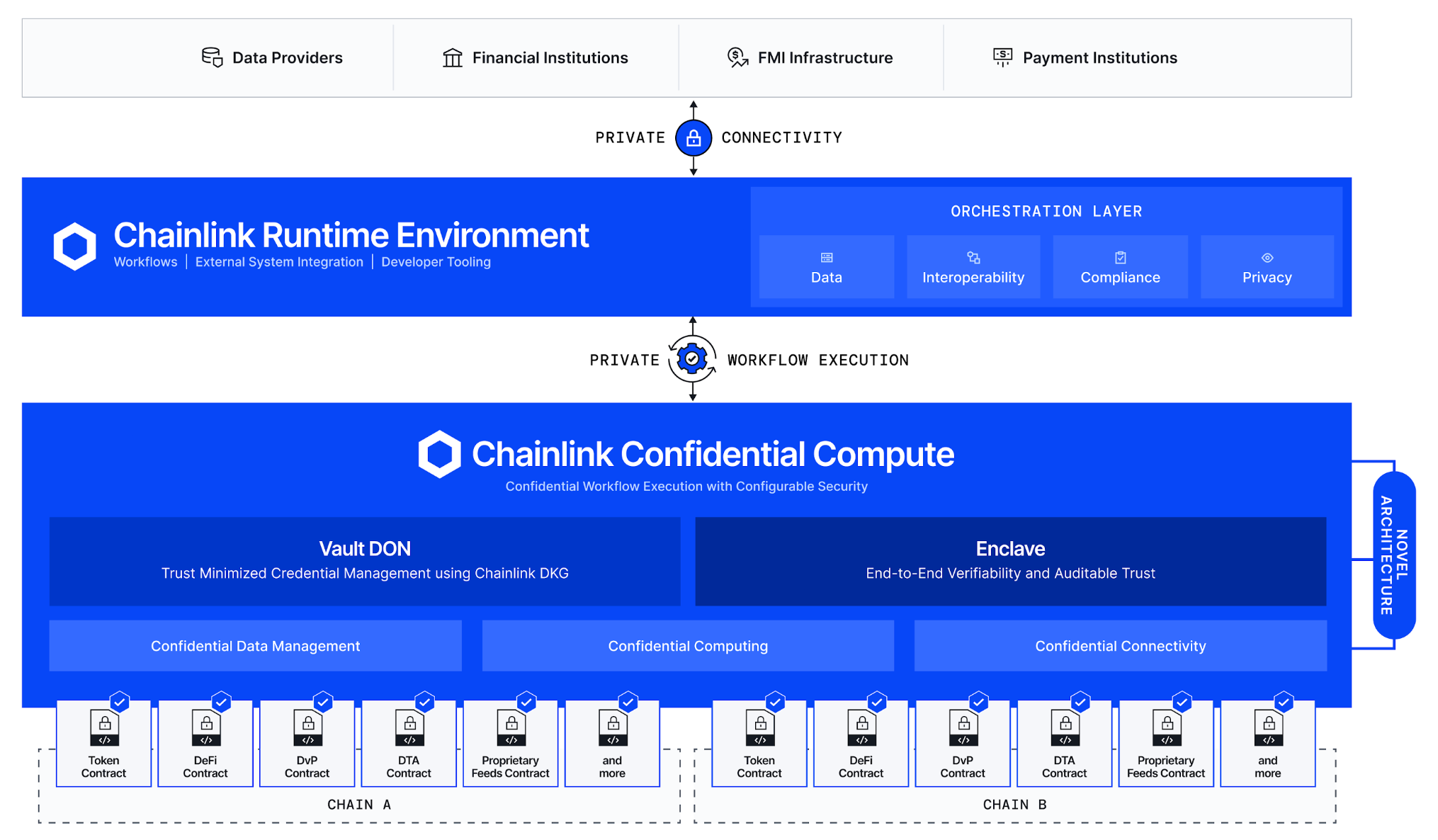
A breakthrough oracle service that enables private smart contracts on any blockchain. Smart contract executions are publicly visible, allowing anyone to see what inputs and computations yielded what outputs, and creating headwinds for institutional adoption. Chainlink Confidential Compute deploys decentralized computation in tamper-proof physical enclaves called “Trusted Execution Environments” (TEEs). Combined with advanced, trust-minimizing cryptographic techniques, Confidential Compute delivers private computations to any blockchain, providing the foundation for private smart contracts built to institutional standards.
Confidential Compute is powered by the CRE, which means privacy can underpin every part of the transaction lifecycle, from data inputs, API requests, and identity verification to transaction processing, cross-chain transfers, and final settlement. Chainlink Confidential Compute unlocks a new class of private smart contracts that connect to real-world financial data and Web2 systems and interoperate across blockchains while keeping proprietary data, business logic, external connectivity, and computation fully confidential. This unlocks new, previously impossible onchain use cases for institutions, such as private transactions, privacy-preserving tokenization, confidential data distribution, privacy-preserving cross-chain interoperability, and privacy-preserving identity and compliance.
Blockchain Privacy Manager
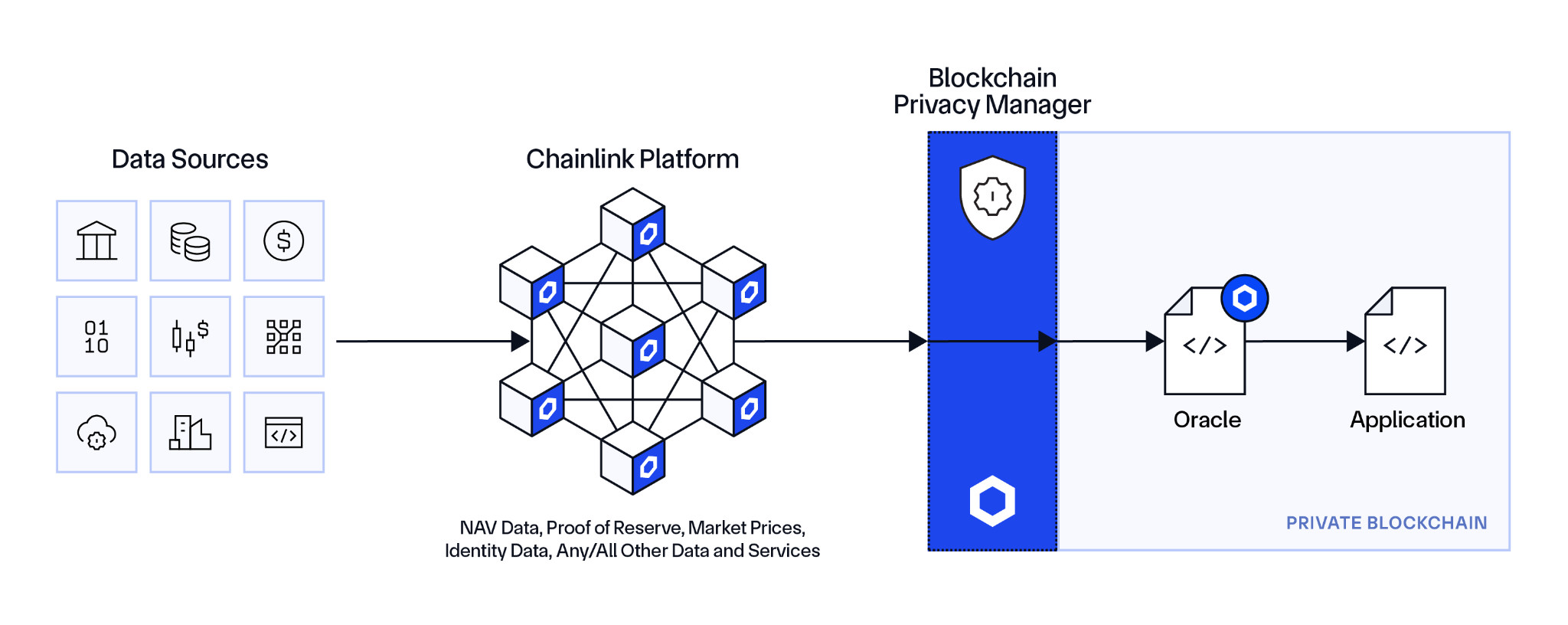
An oracle service that allows institutions to integrate their private blockchain networks with existing systems, such as traditional enterprise backends, while limiting onchain data exposure. This capability enables private chains to be integrated with the public Chainlink platform, providing access to crucial offchain data, such as Proof of Reserve, NAV, market prices, and identity data, without exposing sensitive private-chain data to third parties. Institutions can also leverage the public CCIP network to connect private blockchains to other public or private chains while only revealing information necessary to process each transaction.
The Blockchain Privacy Manager uses offchain infrastructure run by private chain operators to establish strict, fine-grained read/write access policies for private blockchains, as well as flexible data redaction capabilities at the Remote Procedure Call (RPC) level. The offchain infrastructure is fully configurable by institutional users, allowing for granular control over which RPC requests and responses are authorized based on the relevant use case.
CCIP Private Transactions
An oracle service built on top of the Blockchain Privacy Manager that introduces a novel onchain symmetric encryption/decryption protocol designed and developed by the Chainlink Labs research team to enable fully confidential cross-chain transfers between private blockchain networks using the public CCIP network. The use of end-to-end encryption, with the keys generated and held by institutional users, prevents Chainlink node operators or any unwanted third parties from either viewing or tampering with the contents of cross-chain transactions, including token amounts, sender/receiver addresses, and data instructions. Institutions can also choose to share their encryption key with authorized parties of their choice, such as counterparties, compliance auditors, or financial regulators.
CCIP Private Transactions works by deploying an onchain smart contract to each private blockchain network, which is responsible for encrypting sensitive information in outbound CCIP messages before they leave the blockchain, and decrypting sensitive information in inbound CCIP messages as soon as they are processed on the blockchain. Combined with the Blockchain Privacy Manager, institutions can keep both data-at-rest and data-in-transit entirely confidential, or revealed exclusively on a strictly need-to-know basis.
.png)
DECO
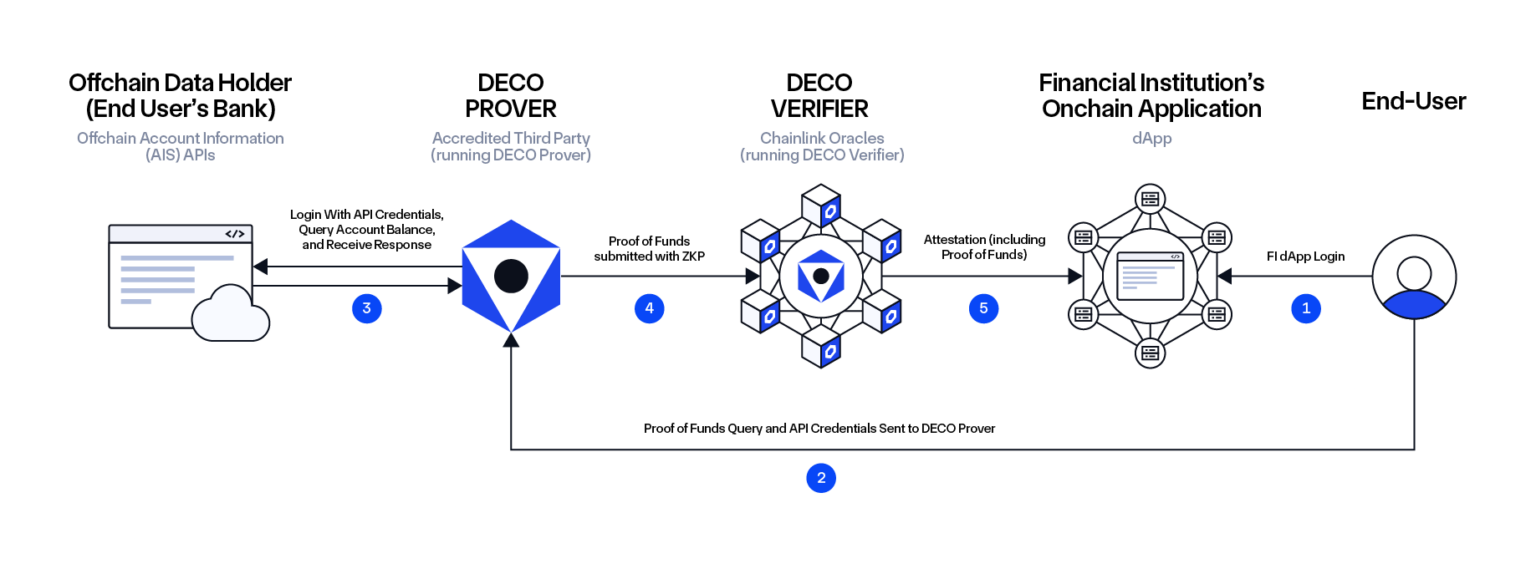
A privacy-preserving data verification oracle service that uses zero-knowledge proofs (ZKPs) and TLS to authenticate and prove the provenance of offchain data without exposing sensitive details onchain. DECO enables institutions and developers to engage in privacy-preserving blockchain use cases, such as identity verification, proof of funds, and sanctions screening, that enable secure and compliant financial workflows onchain.
Capital Markets
Digital Transfer Agent (DTA) Technical Standard
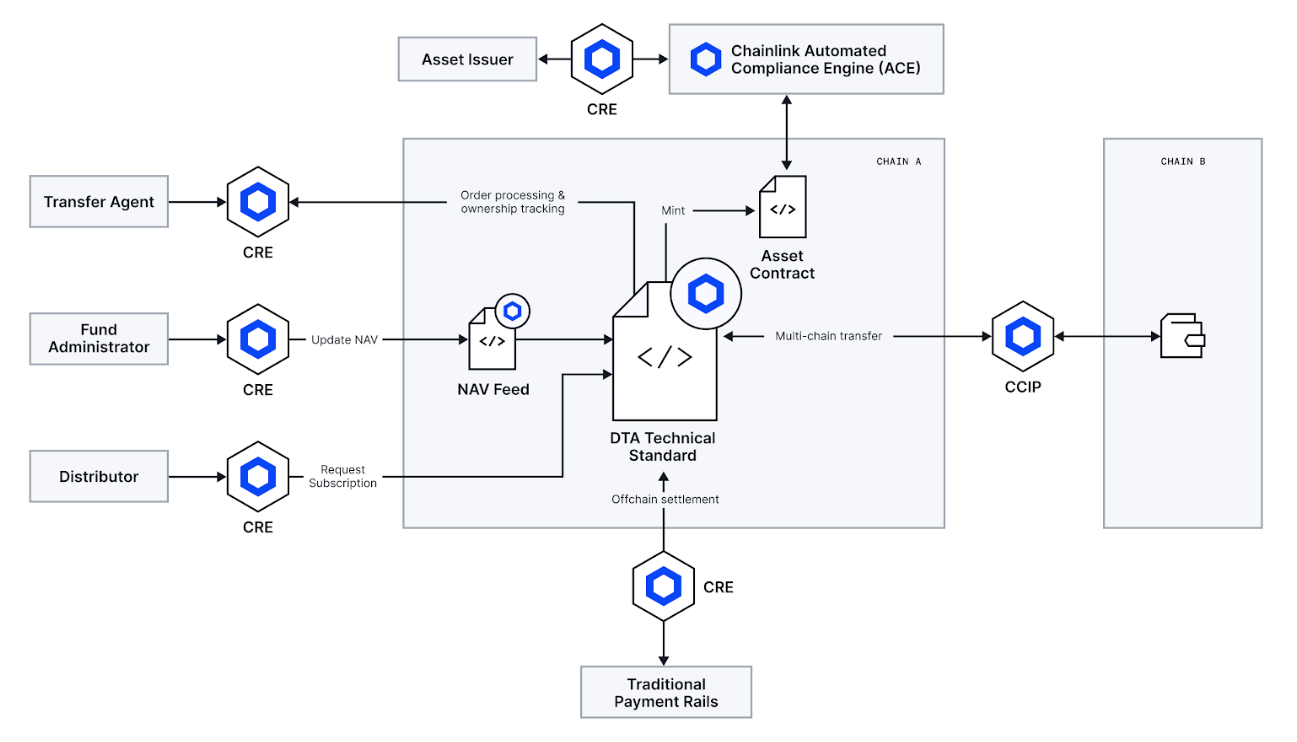
A comprehensive set of technical standards that define how transfer agents and fund administrators can expand their operations onchain while complying with existing regulatory frameworks. The Chainlink DTA technical standard leverages multiple time-tested Chainlink capabilities to provide the easiest and most reliable path for licensed market participants to launch their own onchain transfer agency services and capture the emerging opportunity of tokenized financial markets.
The Chainlink DTA technical standard runs seamlessly on top of the CRE to leverage core capabilities, such as legacy-systems integrations, access to fiat settlement via established payment rails, and record reconciliation with offchain systems. Furthermore, the Chainlink DTA technical standard leverages multiple standards and services within the Chainlink platform, including:
- CCIP to enable multi-chain distribution of tokenized assets.
- ACE to enforce role-based controls and compliance requirements onchain.
- SmartData for NAV to process tokenized fund subscriptions and redemptions.
Delivery vs. Payment (DvP)
An end-to-end solution for DvP settlement involving tokenized assets, whether the cash and assets are on the same blockchain, across different blockchains, or a hybrid model in which the fiat leg involves leveraging a traditional offchain payment network. Chainlink DvP leverages multiple time-tested Chainlink capabilities to enable seamless, compliant settlement onchain, such as using stablecoins or other forms of digital money to purchase tokenized assets.
Payment vs. Payment (PvP)
An end-to-end solution for PvP settlement between two forms of digital money, which can exist across different blockchains or involve an offchain fiat currency. Chainlink PvP leverages multiple time-tested Chainlink capabilities to enable seamless, compliant foreign exchange of currencies.
Compute
Note: Legacy compute services, such as Automation and Functions, now exist as core functionality in the CRE.
Verifiable Random Function (VRF)
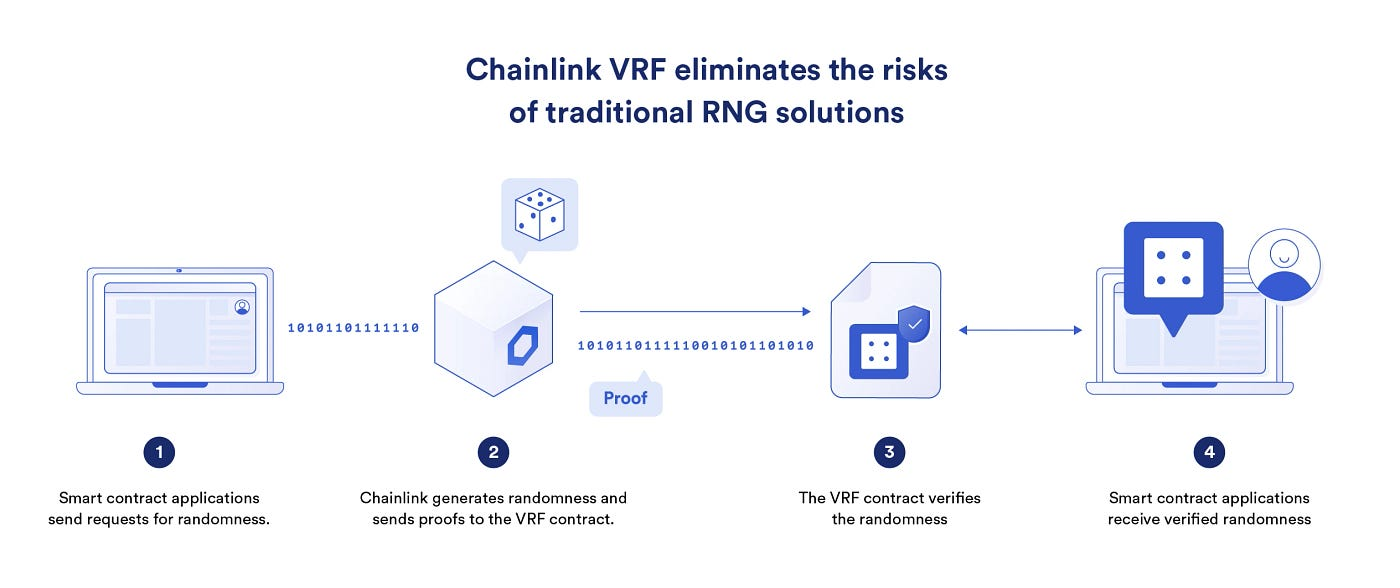
A provably fair and verifiable random number generator (RNG) solution for smart contracts. Chainlink VRF combines block data that is still unknown when the request is made with the oracle node’s pre-committed private key to generate both a random number and a cryptographic proof. The consuming application will only accept the random number input if it has a valid cryptographic proof. VRF provides blockchain applications a secure source of randomness that cannot be manipulated or anticipated by users, node operators, or contract administrators, making it ideal for onchain use cases like gaming, NFTs, and lotteries.
Chainlink Adoption
Use Cases
Tokenized Asset Servicing
Servicing institutional tokenized assets like investment funds, public equities, bonds, real estate, and native digital assets requires coordination across numerous parties, such as investment platforms, custodians, asset issuers, asset managers, fund administrators, and smart contract protocols.
It involves executing complex workflows that span onchain and offchain systems, such as subscription/redemption processing, NAV attestations, transfer agency, borrowing and lending, and trading activity. The Chainlink Platform automates and abstracts this complexity by serving as a unified, credibly neutral coordination layer between all required parties that automatically orchestrates the asset servicing lifecycle.
.png)
These use cases involve a combination of many Chainlink standards and services to work in production and at scale. By providing these key functionalities in each phase of every workflow, Chainlink is able to create and capture value in the primary issuance, secondary trading, and operation maintenance of the $16T tokenized asset opportunity. These tokenized asset servicing workflows involve the use of nearly every Chainlink standard, notably:
- Data Feeds, Streams, SmartData, Proof of Reserve, and DataLink provides critical data, such as NAV and pricing, to facilitate tokenized asset transactions.
- CCIP facilitates DvP settlement and enables tokenized asset flows across blockchains.
- ACE, CCID, and Policy Manager enable identity verification and policy enforcements as a built-in requirement for tokenized asset transactions.
- Confidential Compute enables the concealment of sensitive data, logic, and connections within tokenized asset workflows.
- DTA technical standard enables transfer agents and fund administrators to expand their operations onchain to support tokenized assets.
- CRE coordinates the entire lifecycle end-to-end, synchronizes with legacy systems, and facilitates offchain fiat payments.
Demand for tokenized assets among TradFi end-users and investors drive Chainlink adoption. Clients push investment platforms to offer tokenized assets on-platform, and those platforms integrate Chainlink to support tokenized assets. This creates a network effect whereby the more assets and chains to which Chainlink provides access, the greater the value derived by both asset issuers and end-user platforms.
Interbank Settlement & Payment
Regulated transactions, such as interbank settlements, cross-border payments, and collateral settlement, are notoriously complicated. Regulated institutions engaging in tokenization aren’t equipped to deliver the required compliance, privacy, identity, and interoperability solutions alone.
CRE automates and abstracts these complexities via a unified interface, which can coordinate custom workflows across any number of blockchains or legacy systems. These workflows are reusable and easily modifiable, giving banks and financial institutions the tools they need to innovate quickly and enabling Chainlink to create and capture value in the $18T interbank settlement market.
The following is an example of how the Chainlink Platform enables compliant, complex, cross-border interbank transactions.
.png)
This use case is arguably the most complicated blockchain transaction ever executed, demonstrating the Chainlink Platform’s unique ability to remediate complexity and unlock the tokenized economy.
- CCIP facilitates DvP and PvP to enable stablecoins and CBDCs to purchase tokenized funds across chains.
- SmartData embeds critical NAV data directly into the tokenized fund.
- DTA Technical Standard enables participants to launch DTA smart contracts for fund subscriptions and redemptions.
- ACE provides the framework to build and enforce internal and regulatory compliance policies.
- CCID provides the AML/KYC identity attestations required for interbank settlement.
- CRE provides orchestration and legacy systems connectivity for complex transactions.
Stablecoins & Digital Money
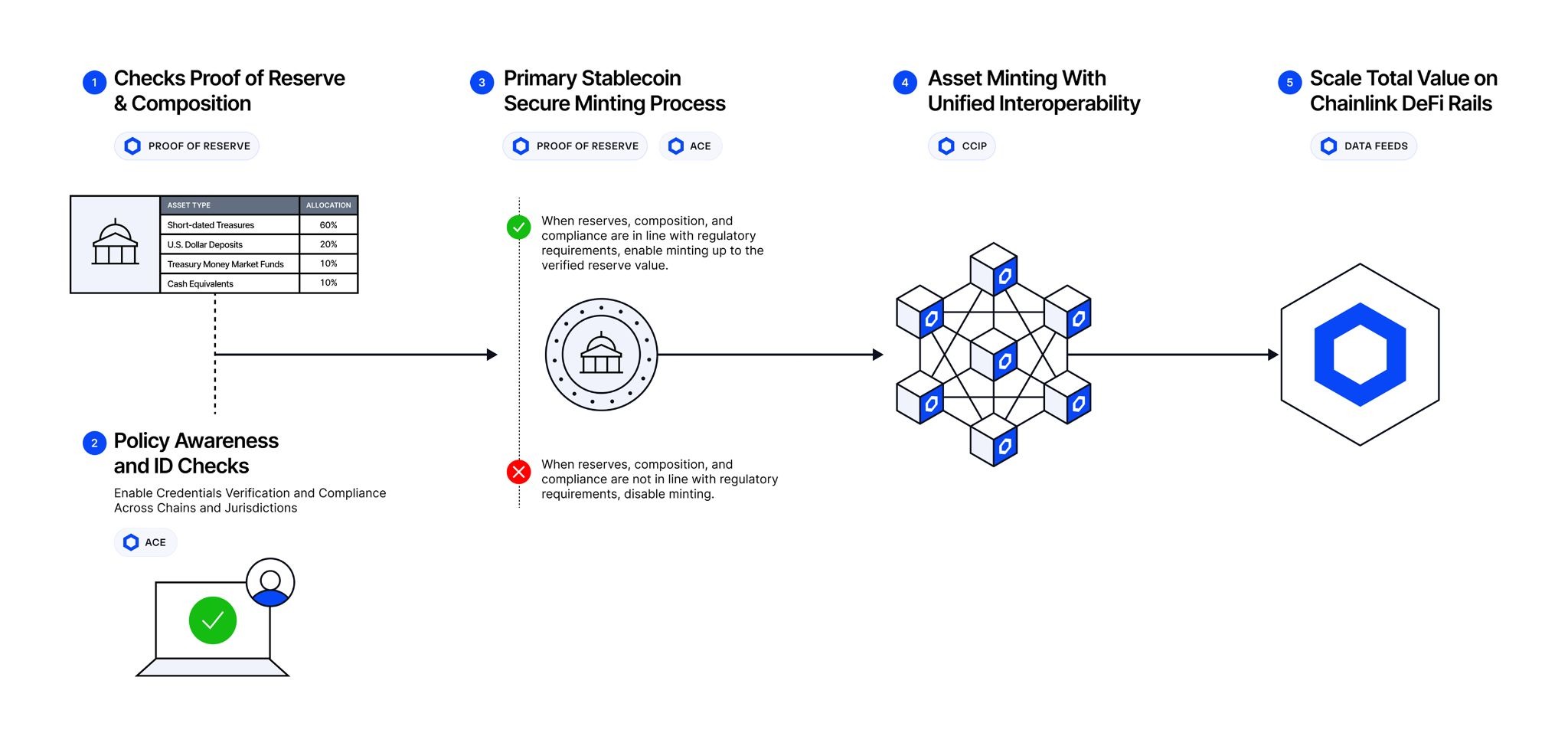
Stablecoins are being widely adopted as the preferred form of remittance. With this adoption comes complex data, interoperability, and compliance requirements. Chainlink provides core infrastructure for the issuance, settlement, and verification of stablecoins, giving the world’s businesses instant remuneration via the $300B and growing of stablecoins in circulation, and allowing Chainlink to create and capture value in the primary issuance, secondary transacting, and management of stablecoins, and engage in general commerce.
- Data Feeds and Streams provide exchange rate data.
- Proof of Reserve provides attestations about stablecoin collateral.
- ACE provides the compliance framework required for stablecoin transactions.
- CCIP and CCT facilitate stablecoin minting and cross-chain interoperability.
- CRE automates stablecoin workflows across systems and facilitates offchain fiat payments.
Institutional Adoption
DTCC Advances Production Tokenization and Collateral Management With Chainlink
DTCC, the premier post-trade market infrastructure for the global financial services industry, is integrating the Chainlink Runtime Environment and data standard into its digitally native Collateral AppChain, a shared infrastructure platform for modernizing collateral mobility and improving capital efficiency. Chainlink data enables the seamless pairing of asset prices, valuations, and movement, while CRE provides a reusable orchestration layer for advanced eligibility, valuation, margining, collateral optimization, settlement, and related post-trade processes.
The collaboration comes as DTCC moves tokenization into production. In July 2026, DTCC successfully converted DTC-held assets into tokens that were used in real production trades across multiple asset classes and use cases, including collateral pledges, securities lending, U.S. Treasury/repo DvP, equity DvP and DvD trades, equity token transfers, and more. The collaboration involved more than 30 financial institutions, including BlackRock, Goldman Sachs, J.P. Morgan, State Street Investment Management, and Vanguard. In the collaboration, Chainlink orchestrated a live production trade where J.P. Morgan posted tokenized stock as collateral to satisfy margin requirements with CME Group.
Wyoming State Government Adopts Chainlink CCIP and Proof of Reserve for Its State-Issued Stablecoin
The Wyoming Stable Token Commission, issuer of the Frontier Stable Token (FRNT), adopted Chainlink CCIP as its exclusive cross-chain infrastructure following a detailed security review, fully migrating away from its legacy bridging provider. FRNT is the first fiat-backed, fully reserved stable token issued by a U.S. public entity and is deployed across eight public blockchains. CCIP now provides the cross-chain infrastructure for securely moving FRNT across these networks while enabling the Commission to retain control over the token’s issuance and deployment.
The Commission also adopted Chainlink Proof of Reserve as its exclusive onchain asset verification infrastructure to provide near-real-time verification of the reserves backing FRNT. The Network Firm independently examines FRNT’s reserve and token-supply balances under AICPA standards, while Chainlink Proof of Reserve delivers the verified reserve data onchain, complementing Wyoming’s existing daily attestations. The Commission is also adopting Proof of Reserve’s Secure Mint capability, which programmatically requires verified reserves to equal or exceed total token supply before new FRNT can be minted.
UBS Completes First In-Production, End-to-End Tokenized Fund Workflow Powered by the Chainlink Digital Transfer Agent (DTA) Technical Standard
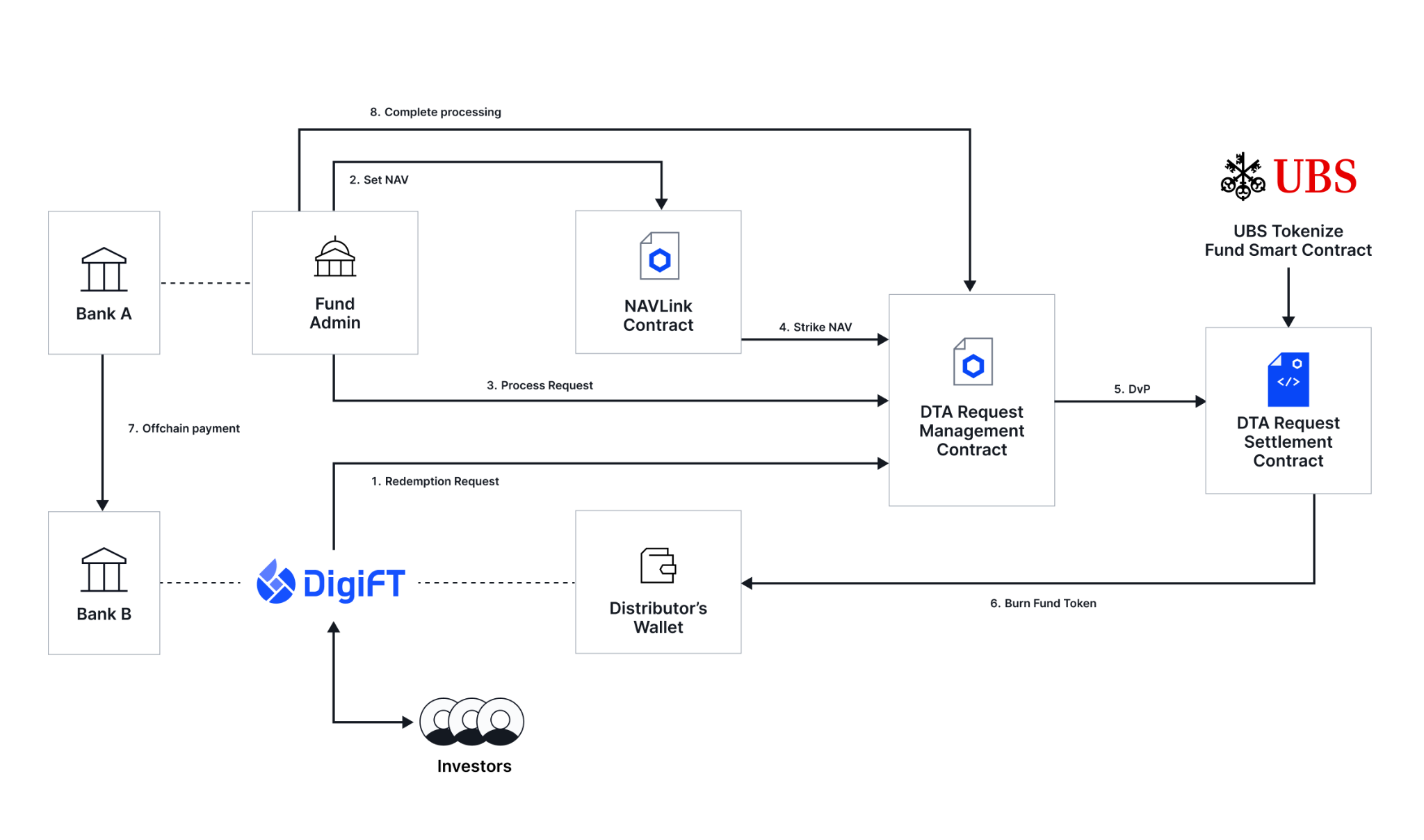
As one of the largest private banks globally, with over $6 trillion in assets under management, UBS worked with its in-house tokenization unit, UBS Tokenize, and DigiFT to complete a live tokenized fund transaction that used the Chainlink DTA technical standard to process the first-ever onchain subscription and redemption request for a tokenized fund.
This achievement builds on prior work between UBS and Chainlink under the Monetary Authority of Singapore’s Project Guardian initiative and proves how fund operations can be seamlessly automated onchain. In this live transaction, DigiFT functioned as the onchain fund distributor and leveraged the DTA technical standard to successfully request and process a subscription and redemption order. The DTA-powered workflow supports every stage of the fund lifecycle, including order taking, execution, settlement, and data synchronization across onchain and offchain systems.
UBS, SBI, Swift, and Chainlink Enabling Next-Generation Tokenized Funds
As part of the Monetary Authority of Singapore (MAS) Project Guardian, UBS Asset Management, SBI Digital Markets, and Chainlink demonstrated how Chainlink enables tokenized funds with automated fund management operations and transfer agency processes. The use case showcased how tokenized funds can leverage traditional Swift’s existing payment rails for issuance and settlement. As a result, digital asset transactions have access to the existing Swift fiat payment system used by 11,500+ financial institutions across 200+ countries.
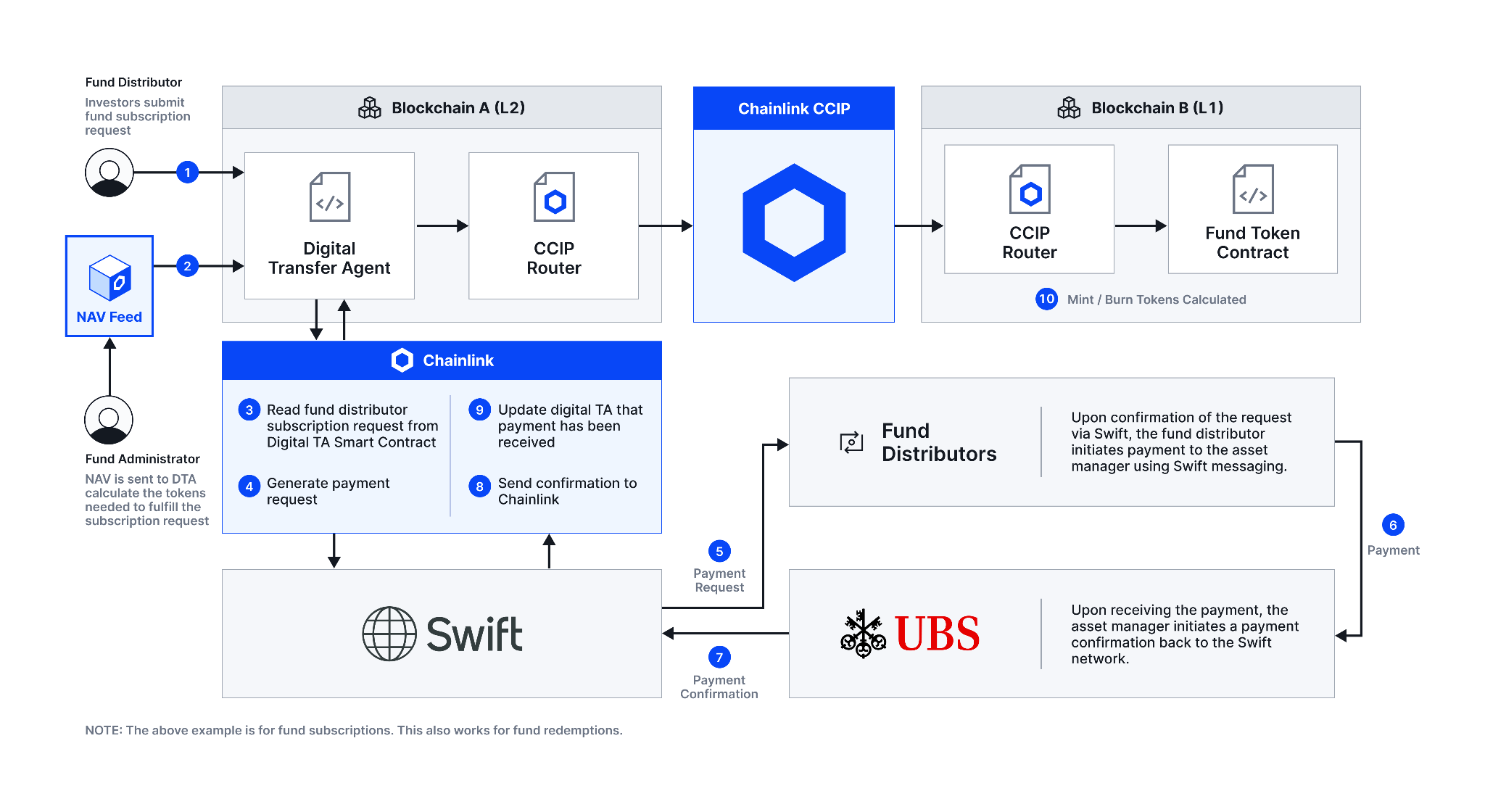
The solution enables tokenized funds to maintain their share register on one blockchain while using the Chainlink interoperability standard for the processing of intensive fund-lifecycle activities like subscriptions and redemptions on another blockchain and cross-chain operations between the DTA contract and the tokenized fund. The Chainlink data standard is also used to bring NAV data onchain, while the CRE integrates existing systems so asset managers can receive transaction status updates and Swift can facilitate offchain payments for tokenized funds. The offering comes together as an end-to-end solution via the Chainlink DTA and DvP technical standards.
ANZ and Fidelity International Use Chainlink for Cross-Chain Settlement
Visa recently highlighted Chainlink’s work with ANZ Bank and Fidelity International under phase 2 of the Hong Kong Monetary Authority’s e-HKD program. Participants built a PvP settlement workflow involving an Australian Stablecoin (A$DC) on ANZ’s DAS Chain and a wrapped Hong Kong CBDC (e-HKD) on Ethereum Sepolia—using Chainlink oracles for cross-chain interoperability, compliance verification, and legacy system integration.
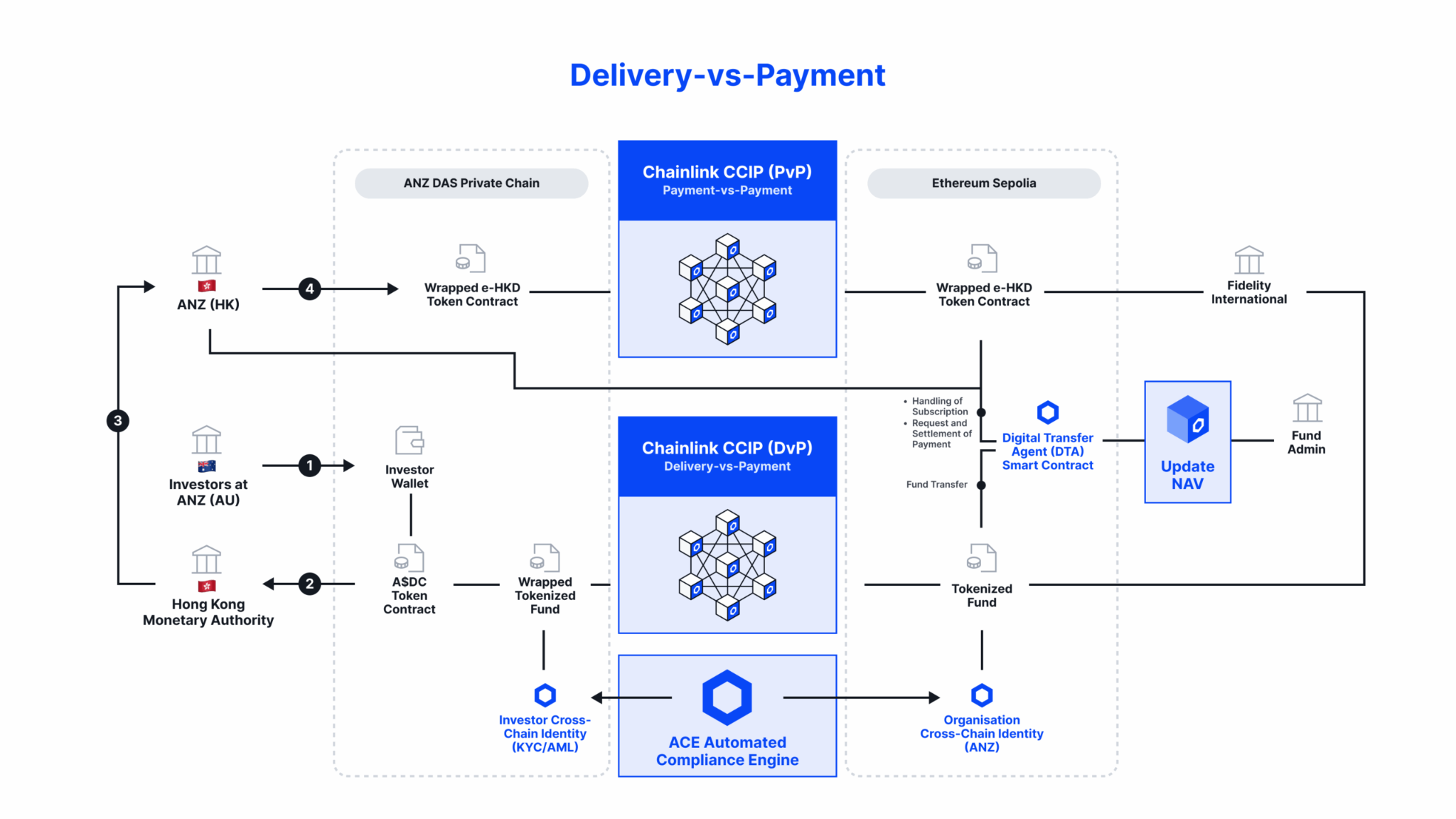
The next phase is a DvP workflow involving an Australian investor purchasing a tokenized asset in Hong Kong, leveraging Chainlink for cross-chain interoperability, compliance verification, NAV pricing, and a new solution built on the DTA technical standard. The use case highlights how Chainlink oracles can be leveraged to overcome three key challenges in creating next-gen smart contracts for institutional transactions:
- Providing data onchain enables proper pricing and supports automated, onchain transfer agent operations. Chainlink provides NAV data that enables the DTA technical standard smart contract to automate updates, ensuring accurate pricing for subscriptions and redemptions of a tokenized money market fund.
- Cross-chain interoperability enables digital assets and data to be securely transferred across multiple public and private blockchain networks. CCIP powers a cross-chain PvP settlement workflow that supports atomic settlement for fiat legs of the transaction (i.e., e-HKD CBDC and ANZ’s stablecoin).
- Bringing verifiable identity data onchain while protecting user privacy enables new use cases that meet institutions’ high regulatory and internal control requirements. Chainlink is enabling compliance by allowing ANZ’s offchain identity registry to be verified onchain and support reusable credentials, ensuring transactions adhere to required regulatory standards across Hong Kong and Australia.
Combining these capabilities, the Chainlink oracle platform is empowering Fidelity International and ANZ to validate how secure, privacy-preserving, and compliance-ready workflows streamline tokenized fund operations across chains at scale.
Chainlink and Multinational Banking Consortia Launch Project Pangea To Develop T+0 Settlement Framework for International FX Markets
Chainlink, FairSquareLab, UniKA, and Qivalis launched Project Pangea, bringing together 50+ banks across Europe and South Korea representing $10+ trillion in AUM to develop a novel solution for international FX markets. The initiative is solving bottlenecks created by delayed T+2 settlement cycles and fragmented market structures by enabling T+0 cross-border settlement using regulated digital money.
By leveraging Chainlink, ISO 20022 messaging, and existing Swift infrastructure, Project Pangea enables banks to execute direct, atomic payment-versus-payment (PvP) swaps of regulated EUR and KRW stablecoins, unlocking atomic FX transactions, instant settlement, and onchain liquidity access. The Chainlink platform provides the data, interoperability, and orchestration standards required for complex cross-chain, cross-border transactions, while enabling banks to connect to public and private blockchains using their existing systems and messaging standards.
J.P. Morgan, Chainlink, and Ondo Cross-Chain Settlement of Tokenized Treasuries
Kinexys by J.P. Morgan, the world-leading financial services firm’s blockchain business unit, and Ondo Finance, a pioneer in asset tokenization, leveraged Chainlink’s cross-chain and orchestration capabilities to complete a landmark cross-chain DvP transaction that combined a permissioned interbank payment network (Kinexys), a public blockchain (Ondo Chain), and a tokenized U.S. Treasuries Fund (OUSG).
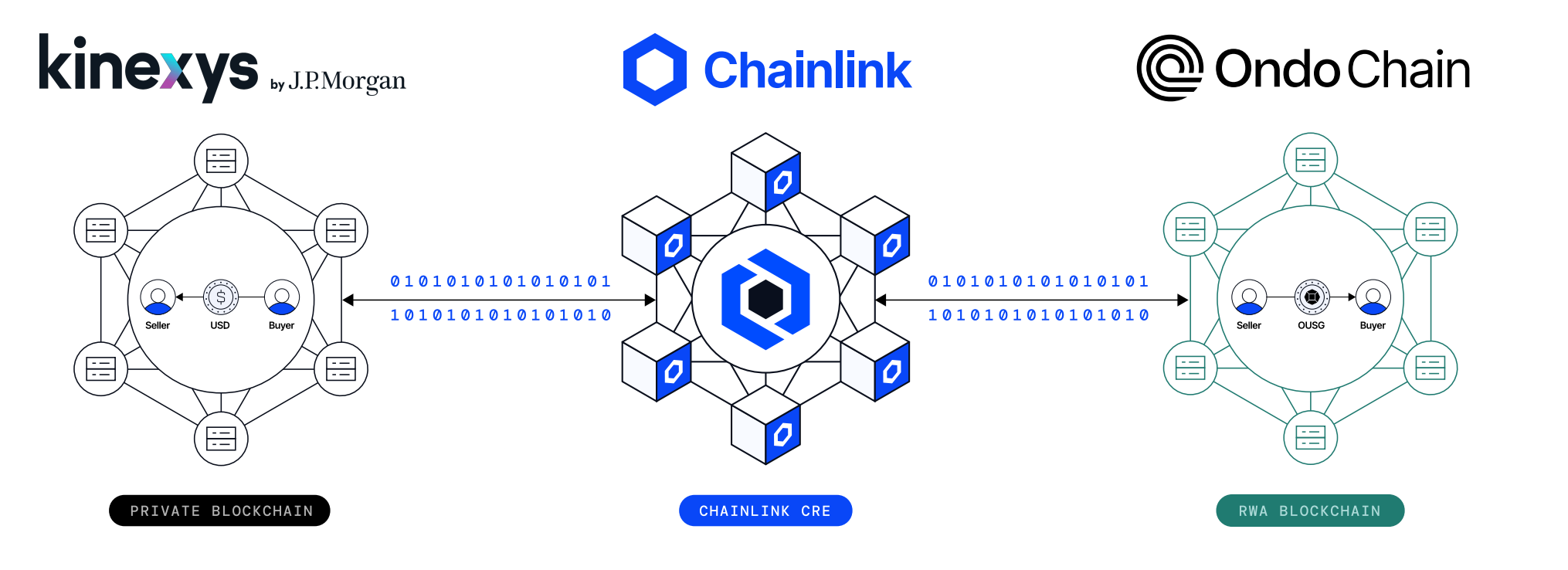
This key milestone marks the first cross-chain, atomic settlement of a tokenized asset between Kinexys’s permissioned blockchain and a public blockchain network. The transaction involved the exchange of Ondo Chain’s Short-Term U.S. Government Treasuries Fund (OUSG) as the asset leg with J.P. Morgan’s Kinexys network serving as the payment leg. This DvP solution was powered end-to-end by CRE, which facilitated seamless settlement between Kinexys and Ondo Chain’s testnet environment while preserving institutional-grade security and compliance standards.
Swift and Chainlink Demonstrate Secure, Cross-Chain Transfers with CCIP
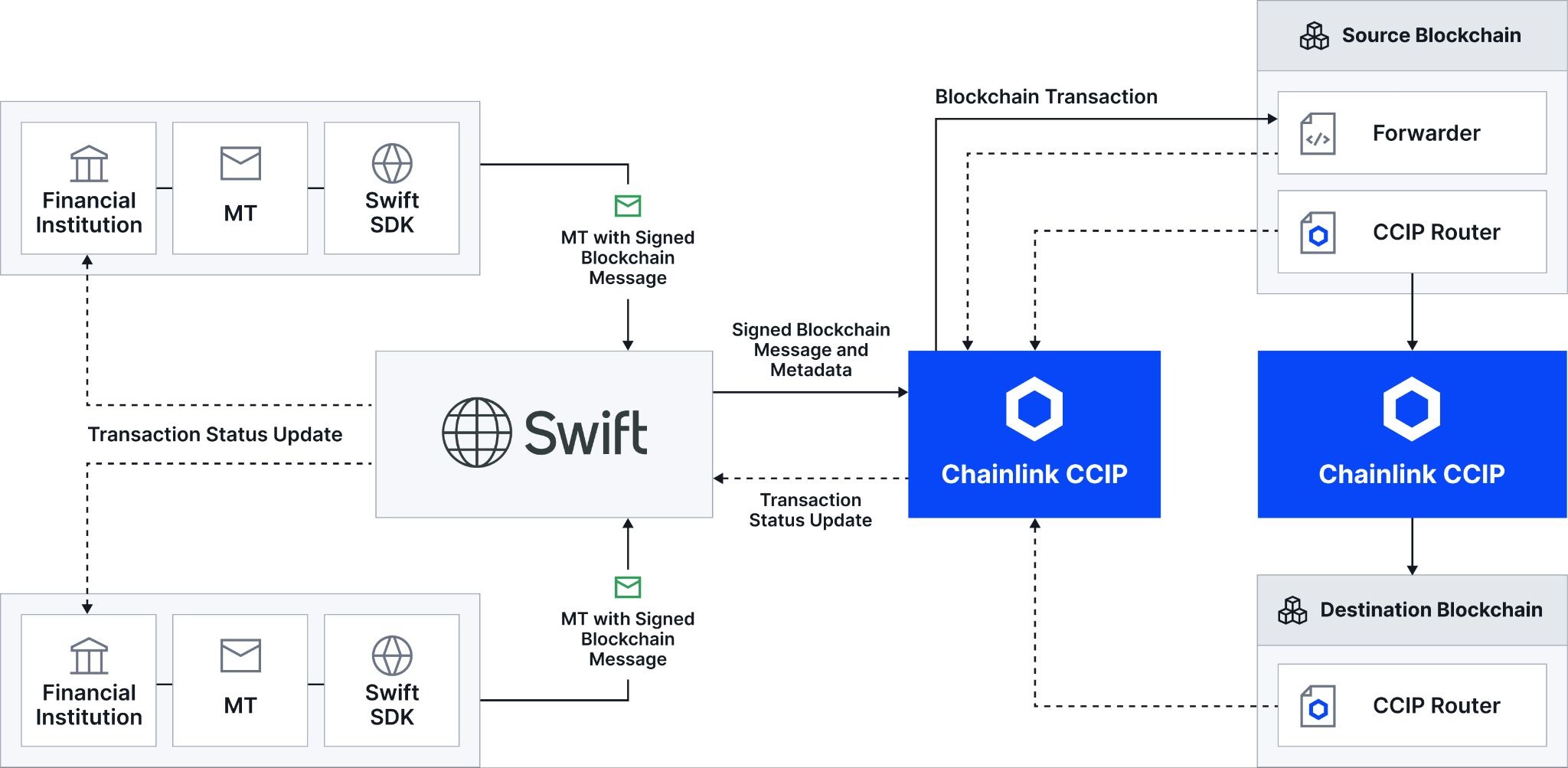
Swift—the international bank messaging standard for 11,500+ banks—is working with Chainlink to enable financial institutions to connect to any public/private chain using Chainlink and existing Swift infrastructure and messaging standards. Chainlink CCIP was used to enable the cross-chain settlement of tokenized assets across public and private blockchains. The successful collaboration featured 12+ world-leading financial institutions, including Euroclear, Clearstream, ANZ, Citi, BNY Mellon, BNP Paribas, Lloyds Banking Group, and SDX.
The Chainlink platform supports this by enabling the creation of adapters that connect any type of legacy system to the Chainlink Network. Once created, the adapter allows institutions to interact across public and private blockchains from a single CCIP integration, removing the need for point-to-point integrations with each chain. The adapter also makes it easy for legacy systems to interact with other legacy systems also integrated with the Chainlink platform, creating a network effect whereby the more institutions that adopt the Chainlink platform, the easier and faster it is to do transactions across counterparties.
State Street and Galaxy Launch Tokenized Cash Management With Chainlink
State Street and Galaxy launched the State Street Galaxy Onchain Liquidity Sweep Fund (SWEEP), a tokenized private liquidity fund designed to enable 24/7 onchain cash management via stablecoins. The fund allows stablecoin holders to turn their stablecoins into a yield-bearing asset and supports subscriptions and redemptions using PayPal USD (PYUSD).
Galaxy is leveraging Chainlink NAVLink to publish SWEEP’s daily NAV onchain and Chainlink CCIP for secure cross-chain interoperability, providing the data and connectivity infrastructure needed to support the fund as it expands across blockchain networks. State Street Investment Management manages more than $5 trillion in assets, making SWEEP a significant step in bringing institutional cash management and liquidity onchain.
Additional Institutional Momentum
In addition to the previously mentioned institutional partnerships, a growing number of financial institutions are adopting Chainlink to unlock the full potential of tokenized assets:
- Euroclear: Partnered with Chainlink and 23 other financial organizations to launch AI-powered corporate action oracles to address the estimated $58 billion-per-year unstructured data challenge for the financial industry.
- Mastercard: Partnered with Chainlink to allow over 3 billion payment cardholders to purchase crypto assets directly onchain via the new Chainlink-powered Swapper app, creating a unified, compliant, and intuitive user experience that brings crypto access to mainstream payment cardholders.
- SBI Group: Partnered with Chainlink to expand institutional tokenization in Asia for fund tokenization, NAV reporting, and PvP settlements under Project Guardian, with plans for yen-backed stablecoins and real estate tokenization. In addition, SBI Group’s digital asset arm, SBI Digital Markets (SBIDM), is adopting Chainlink as its exclusive infrastructure solution to power its digital assets platform.
- Amundi: Adopted Chainlink alongside Spiko for the launch of the Spiko Amundi Overnight Swap Fund (SAFO), using Chainlink for automated onchain NAV reporting. SAFO launched with $100 million in committed AUM under an EU-regulated UCITS structure backed by fully collateralized total return swaps. Amundi is Europe's largest asset manager with €2.3 trillion in AUM.
- ANZ: Partnered with Chainlink and ADDX in Project Guardian on a tokenized RWA use case for commercial paper, leveraging interoperability between private blockchains alongside its A$DC stablecoin.
- Fidelity International: Partnered with Chainlink on a landmark live production use case for tokenized assets where NAV data for Fidelity’s $6.9 billion Institutional Liquidity Fund is onchain via Chainlink, enabling real-time transparency for tokenized fund shares on zkSync.
- Deutsche Börse Group: Deutsche Börse Market Data + Services, a business unit of Deutsche Börse Group, partnered with Chainlink to publish its market data onchain for the first time via DataLink, including real-time data from the largest exchanges in Europe, Deutsche Börse Group’s Eurex, Xetra, 360T, and Tradegate.
- Apex Group: Partnered with Chainlink and the Bermuda Monetary Authority to build an institutional-grade stablecoin framework powered by CCIP, ACE, and Proof of Reserve, and continues to adopt Chainlink services to enable compliant tokenization and liquidity solutions across its $3.5 trillion AUM client base
- WisdomTree: Partnered with Chainlink to use DataLink for bringing NAV data onchain for its $130 billion AUM Private Credit and Alternative Income Fund (CRDT), marking the first tokenized private credit fund with verifiable onchain NAV transparency and expanding Chainlink integration across its broader tokenized fund suite.
- SIX: Adopted Chainlink to bring premium equities data from SIX Swiss Exchange and BME Exchange onchain for the first time via DataLink. The integration makes data covering more than €2 trillion in market capitalization available across 2,700+ applications and 80+ public and private blockchains, enabling use cases including tokenized indices, structured products, and other onchain financial markets.
- GLEIF: Partnered with Chainlink to establish a new institutional-grade identity solution that combines GLEIF’s verifiable Legal Identity Identifier (vLEI) with Chainlink’s ACE and infrastructure for Cross-Chain Identity (CCID) to enable digital asset transactions that are verifiable, compliant, and trusted across jurisdictions while preserving user privacy.
- S&P Global: Partnered with Chainlink to publish S&P Global Ratings’ Stablecoin Stability Assessments (SSAs) onchain via DataLink. This initiative makes S&P Global Ratings' deep, independent stablecoin risk analysis directly accessible within decentralized finance (DeFi) protocols and smart contracts for the first time.
- FTSE Russell: Partnered with Chainlink to bring global index data for the Russell 1000, Russell 2000, Russell 3000, and FTSE 100 Indexes; WMR FX benchmarks; FTSE DAR Digital Asset Prices; and FTSE Digital Asset Indices across blockchains via DataLink.
- Tradeweb: Partnered with Chainlink to publish its U.S. Treasury data onchain for the first time via DataLink, making its FTSE U.S. Treasury Benchmark Closing Prices available to 2,000+ onchain applications across 60+ public and private blockchains in the Chainlink ecosystem.
- SGX FX: Adopted Chainlink to bring its premium OTC FX market data onchain via DataLink. The initial rollout includes spot and one-month forward rates across major G10, Asian, and emerging-market currency pairs, extending benchmark-quality data relied on by 200+ institutions to the onchain economy.
DeFi Adoption
Aave Adopts Multiple Chainlink Services To Support Its Stablecoin and Lending Markets
Aave, the largest DeFi protocol with $50+ billion in total value locked (TVL) and over $3 trillion in cumulative deposits, has integrated multiple Chainlink data and interoperability services to secure its onchain lending markets and decentralized stablecoin. Aave has exclusively used Chainlink oracles for financial market data for over six years, enabling the protocol to scale to 19+ chains and markets while continually providing its users with the highest level of oracle security and reliability.
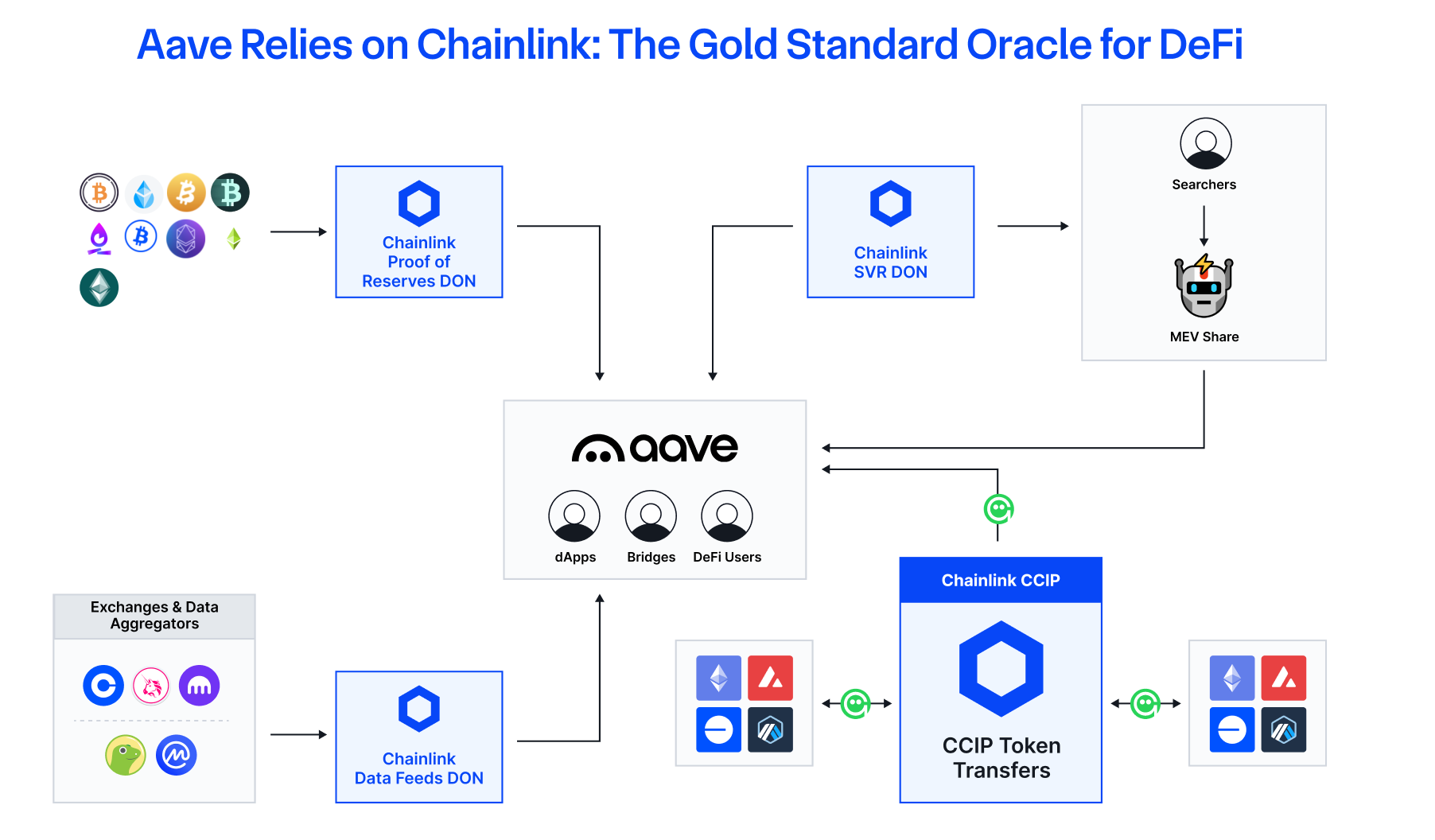
Aave leverages Chainlink Data Feeds to access secure and reliable market data for pricing collateral, critical to ensuring protocol solvency by properly pricing loans at origination and liquidating at-risk positions. Aave supplements its use of Data Feeds on Ethereum by leveraging Chainlink SVR to recapture non-toxic liquidation MEV, creating an additional source of revenue. Aave also leverages Chainlink Proof of Reserve to verify the reserves of supported bridged assets.
Aave Horizon, the largest RWA lending market for institutions or other qualified users to borrow stablecoins against tokenized assets, leverages Chainlink NAVLink to price tokenized asset collateral and has adopted Chainlink ACE to enforce issuer and regulatory standards onchain. Beyond Data, Aave adopted the Cross-Chain Token (CCT) standard for its GHO stablecoin, allowing the token to be transferred across chains via CCIP. Aave also uses CCIP for cross-chain messaging to support governance on multiple chains.
Lido Upgrades to Chainlink CCIP as Official Cross-Chain Infrastructure for wstETH Across All Chains
Lido, the second largest DeFi protocol with $24+ billion in TVL, upgraded to Chainlink CCIP as the official cross-chain infrastructure for wstETH, across all chains. With this upgrade, all cross-chain transfers of Lido’s Wrapped Staked Ether (wstETH), the largest liquid staking token in the industry, become secured by CCIP by leveraging the Cross-Chain Token (CCT) standard.
This upgrade builds on Lido’s existing use of the Chainlink platform, including secure Data Feeds that facilitate the adoption of stETH/wstETH across DeFi and CCIP-powered Direct Staking rails that enables users to stake ETH directly from other networks and receive wstETH.
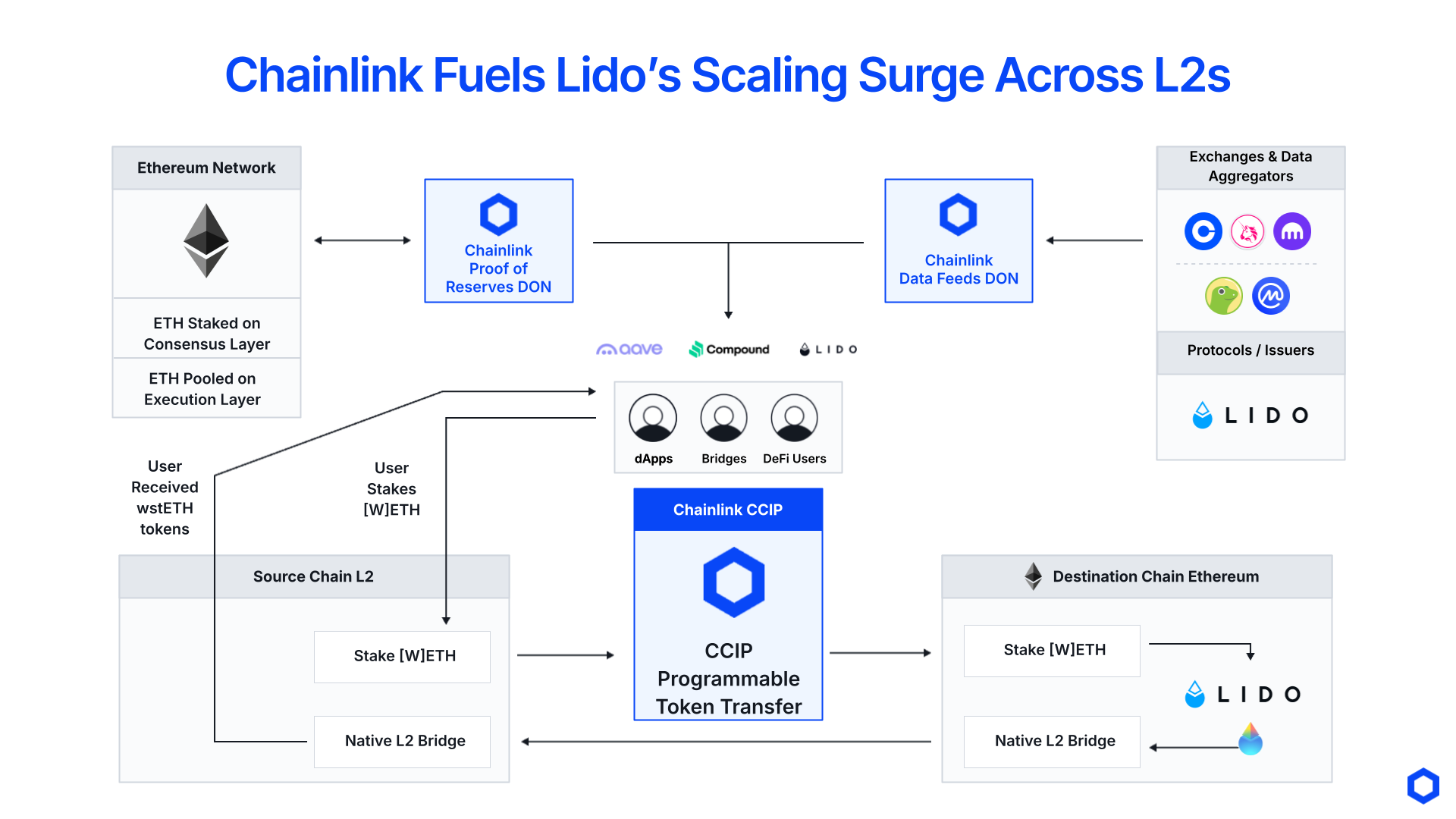
Lido makes use of the Chainlink data standard by sponsoring Data Feeds and Data Streams for pricing its liquid staking tokens. It also uses Proof of Reserve to prove that its liquid staking tokens are fully collateralized by reserves held on Ethereum. These data services enhance the utility of Lido tokens by enabling other DeFi protocols to support secure and reliable markets for those tokens.
Growing Adoption of CCIP Through Asset Migrations
Following recent industry security incidents, a growing number of leading protocols, asset issuers, and public-sector organizations have deprecated legacy cross-chain infrastructure and migrated to Chainlink CCIP. Collectively, these migrations represent $15+ billion in value, reflecting a broad industry-wide shift to secure-by-default cross-chain infrastructure with institutional-grade operational standards.
Major migrations from legacy bridges to CCIP include:
- Wyoming Stable Token Commission: Migrated the Frontier Stable Token (FRNT), the first sovereign stablecoin in the United States, to CCIP as its exclusive cross-chain infrastructure in a multi-year contract. The Commission determined that CCIP was the only solution uniquely capable of meeting its rigorous standards.
- BitGo: Migrated $7.7 billion of Wrapped Bitcoin (WBTC) to CCIP and adopted Chainlink as its exclusive cross-chain infrastructure for all future BitGo-issued assets.
- Kraken: Migrated Kraken Wrapped Bitcoin (kBTC) to CCIP and adopted Chainlink as its exclusive cross-chain infrastructure for all future Kraken Wrapped Assets.
- Mantle: Migrated the Mantle Super Portal, the bridge infrastructure co-developed with Bybit, and the MNT token to CCIP, representing $2.5+ billion in migrated value.
- KelpDAO: Migrated $1.5+ billion in rsETH to CCIP, following an exploit of their legacy bridging provider.
- Lombard ($1B+ in LBTC and BTC.b), Solv Protocol ($700M+ in SolvBTC), Virtuals Protocol ($700M+ in VIRTUAL), and more.
Additional DeFi Momentum
In DeFi, Chainlink is embedded across lending, derivatives, and tokenized asset platforms. In addition to Aave and Lido, some of the other notable in-production users of Chainlink include:
- Robinhood: Partnered with Chainlink as its official data and cross-chain oracle infrastructure for Robinhood Chain. CCIP, Data Feeds, and Data Streams were made available on day-1 mainnet launch, supporting Robinhood-issued assets, including Robinhood Stock Tokens, with verifiable data and cross-chain connectivity.
- Coinbase: Partnered with Chainlink to adopt CCIP as the exclusive bridge infrastructure for all Coinbase Wrapped Assets, including cbBTC and cbETH. Coinbase also selected Chainlink Data Feeds as the official oracle infrastructure for its tokenized stocks on Base, enabling DeFi applications to reference prices for assets including tokenized Apple, Nvidia, Alphabet, and Meta shares.
- Polymarket: Partnered with Chainlink to unlock high-speed crypto prediction markets and enhance resolution accuracy. Data Streams powers near-instant resolution and payouts across Polymarket’s 5-minute, 15-minute, and 4-hour crypto markets, which have generated $10+ billion in trading volume.
- Kamino: Partnered with Chainlink to leverage low-latency market data through Data Streams to secure the largest DeFi protocol on Solana, with $3+ billion in TVL.
- Ondo: Partnered with Chainlink and selected Chainlink as the official data oracle for Ondo Global Markets, delivering custom market data for tokenized stocks and ETFs that accounts for economic and corporate action events such as dividends.
- Securitize: Partnered with Chainlink to price Securitize tokenized funds used as collateral on Aave's Horizon, starting with VanEck's first tokenized fund, VBILL.
- xStocks: Partnered with Chainlink to adopt CCIP for cross-chain transferability of tokenized U.S. equities, Proof of Reserve for collateralization verification, and Data Streams for pricing RWAs across DeFi and integrating with corporate actions data.
- Lighter: Adopted Chainlink Data Streams as its official oracle solution for RWA markets, using high-fidelity pricing data for commodities, equities, and FX to power liquidations, margin calculations, and conditional and limit orders.
- ether.fi: Partnered with Chainlink to integrate Proof of Reserve to provide verifiable proof of the reserves backing its staked assets, assuring users that their funds are secure.
- Pendle: Partnered with Chainlink to adopt the Chainlink data standard to access funding rates onchain to power its futures platform, Boros.
- Maple Finance: Partnered with Chainlink to power syrupUSDC with Price Feeds and CCIP, surpassing $2 billion in AUM and $130 million in cross-chain volume.
- Spiko Finance: Partnered with Chainlink to integrate CCIP to let money market fund shares transfer seamlessly across chains, eliminating the need for manual redemption and resubscription.
In addition to the above, hundreds of independent DeFi applications across dozens of blockchain networks use Chainlink services to secure tens of billions in user deposits.
Adoption Metrics
Total Value Locked (TVL)
A widely used metric within the DeFi ecosystem that tracks the value of crypto assets that have been deposited by users to a protocol. TVL proxies for protocol adoption in that liquidity typically flows into protocols as their usage and user base expand. For example, Aave, the most popular DeFi lending protocol for 5+ years running, has a TVL of $50B+ as of writing (including borrows), meaning that users have deposited upwards of $50B to engage in borrowing and lending activity on the platform.
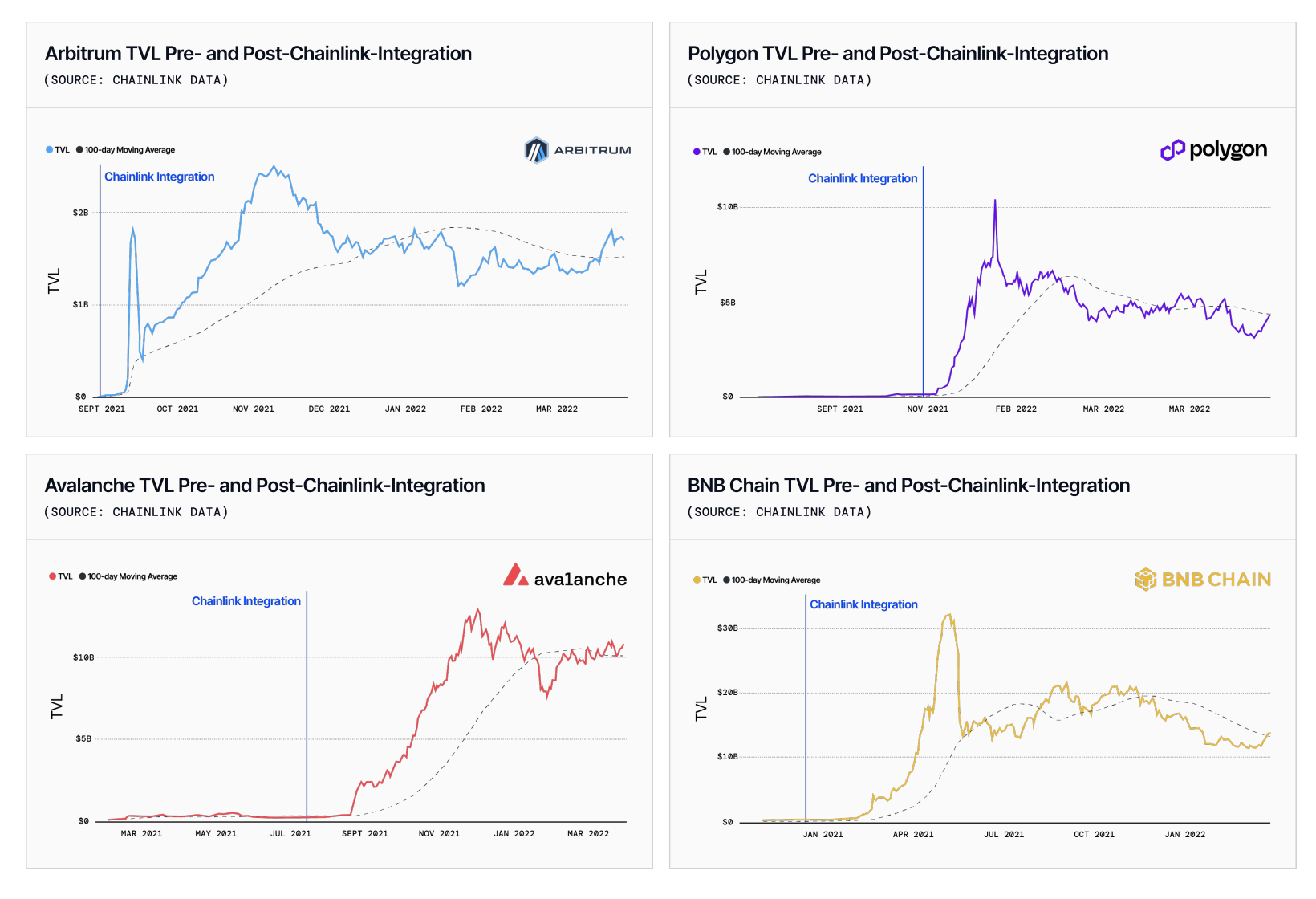
Blockchains integrating the Chainlink platform benefit materially from the host of functionalities provided to their smart contract developers. A blockchain integrating Chainlink means that developers on that chain can build more useful decentralized applications (dApps), which typically garners more users transferring digital assets to that blockchain. This flywheel between Chainlink deployments and TVL growth is a common trend and is responsible for much of the success of the Scale program.
Total Value Secured (TVS)
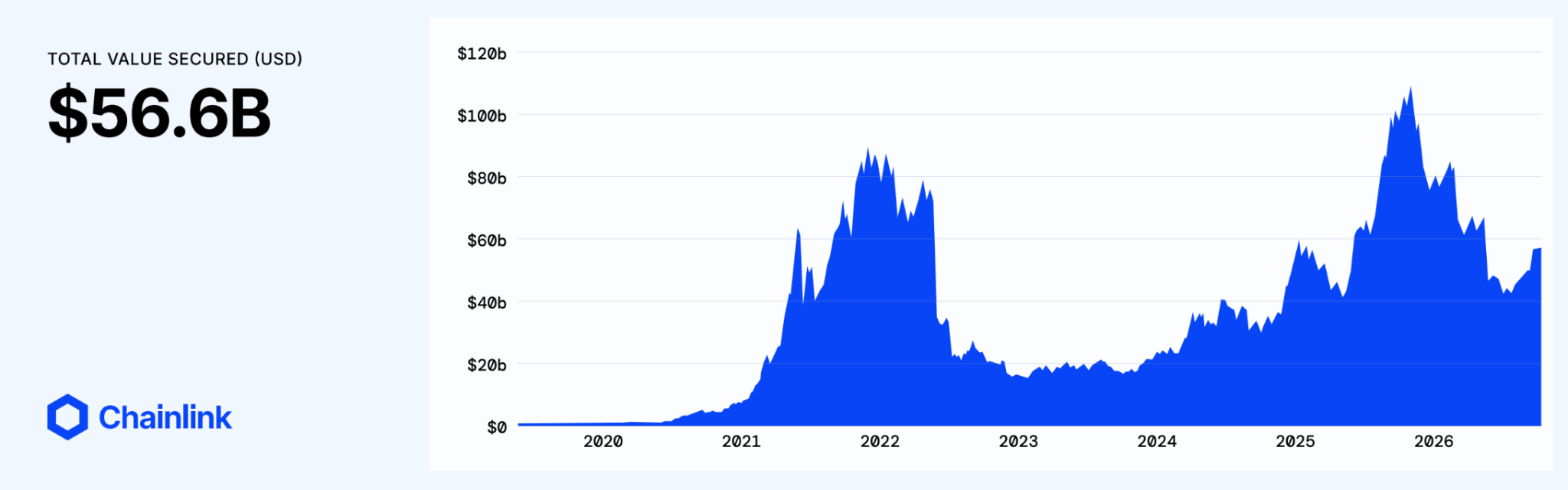
A metric specific to oracle networks that reflects the total value deposited into or borrowed from smart contract applications secured by a particular oracle network. TVS was pioneered by Chainlink and has since become the industry-standard metric for tracking oracle network adoption, such as being adopted by popular DeFi analytics websites like DefiLlama.
Chainlink oracles actively secure more than $130B in onchain value, powering many of the largest DeFi protocols by TVL, such as Aave. Chainlink oracles are used by over 532+ live DeFi apps across dozens of blockchains to enable many of the most popular onchain use cases, such as lending, stablecoins, real-world assets, liquid staking, perpetual futures, yield aggregators, insurance, and more.
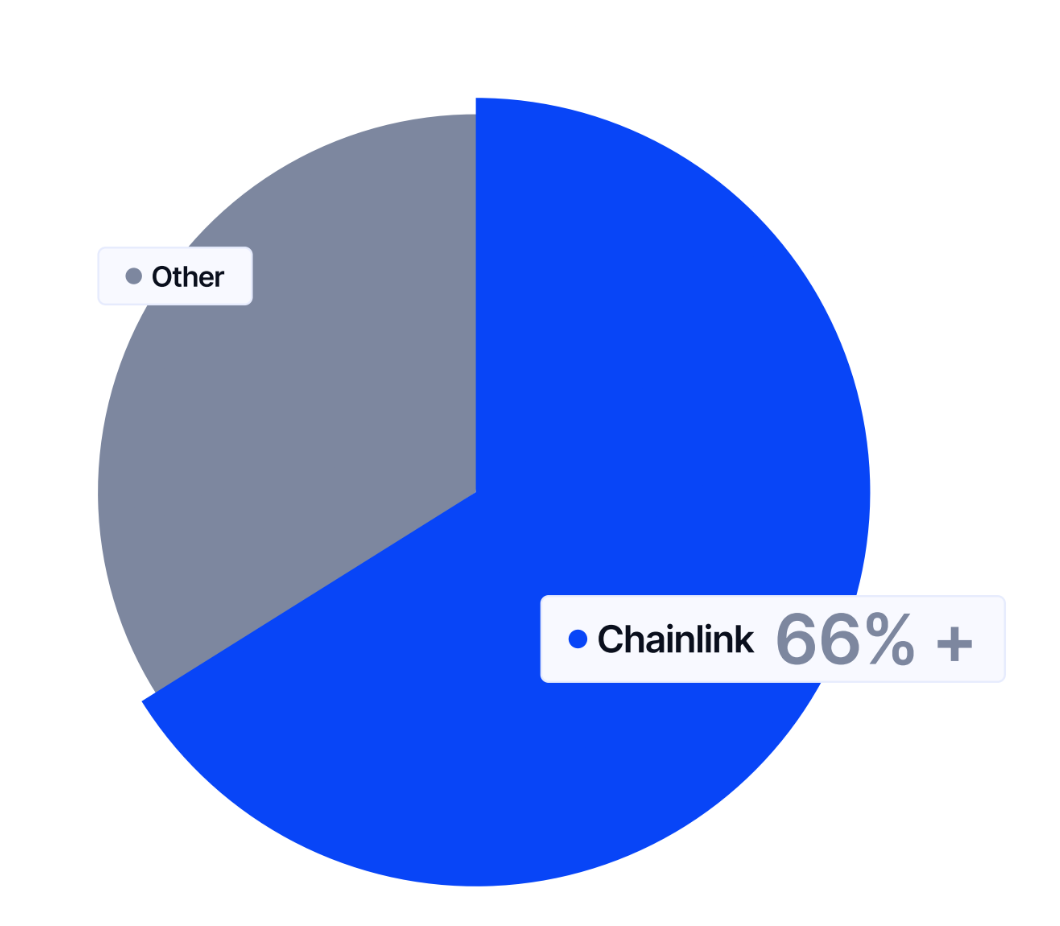
Chainlink secures more value than all other oracle providers combined, with a TVS market share of approximately 70% across all blockchain ecosystems, including 80%+ market share on Ethereum.
Total Cross-Chain Token Value
Cross-Chain Tokens (CCTs) are tokens integrated with Chainlink CCIP to unlock secure cross-chain transfers across blockchains. This includes tokens for which the token issuer has granted burn/mint authority to CCIP and tokens that have adopted a canonical wrapped token that uses CCIP. The CCT standard enables issuers to make new or existing tokens cross-chain transferable in a self-service manner while retaining full ownership and control over their token contract deployments. CCTs support both burn-and-mint or lock-and-mint transfer mechanisms to move value across chains without requiring separate liquidity pools, helping reduce liquidity fragmentation and enabling zero-slippage transfers.
Total Cross-Chain Token Value measures the fully diluted value of all CCTs integrated with Chainlink CCIP, totaling $73+ billion as of September 2026.
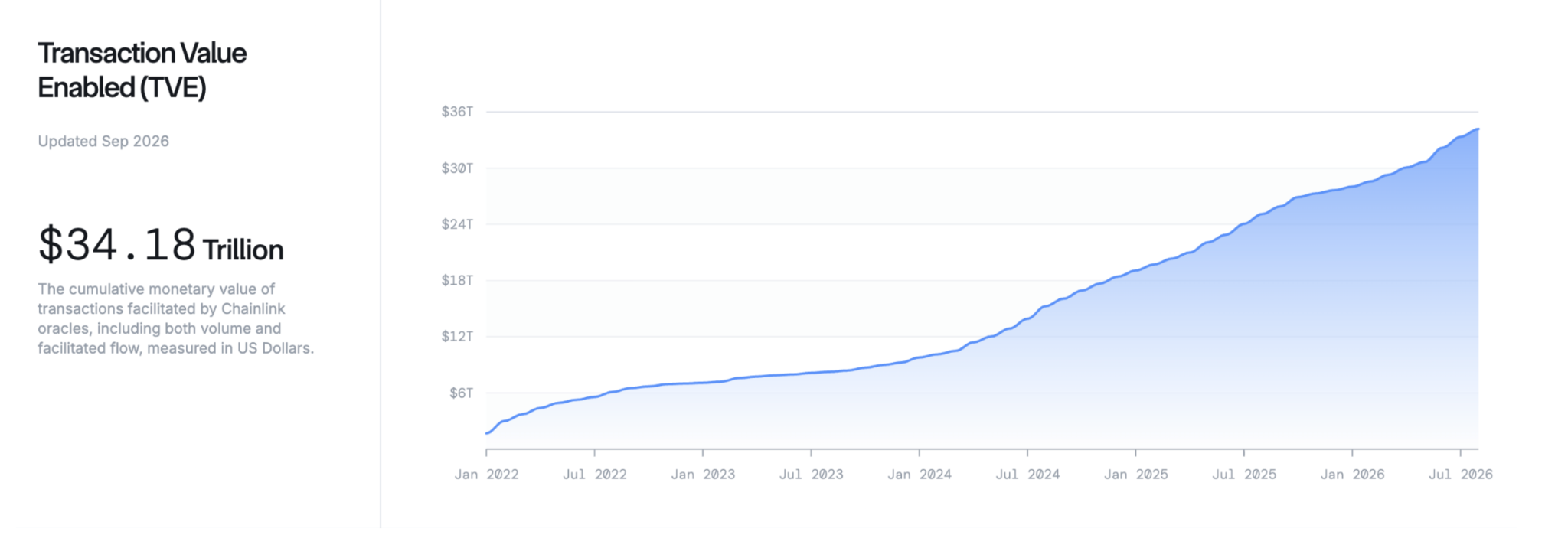
Transaction Value Enabled (TVE)
A metric that tracks the cumulative dollar value of transactions facilitated by oracles, including both volume and facilitated flow. While TVS tracks the value secured by Chainlink oracles at a given point in time, TVE tracks the historical cumulative value of transactions that involved the use of Chainlink oracles.
Beyond value locked in protocols continuously, Chainlink has enabled more discrete transaction value than any other provider, with over $34 trillion in TVE.
Total Verified Messages (TVM)
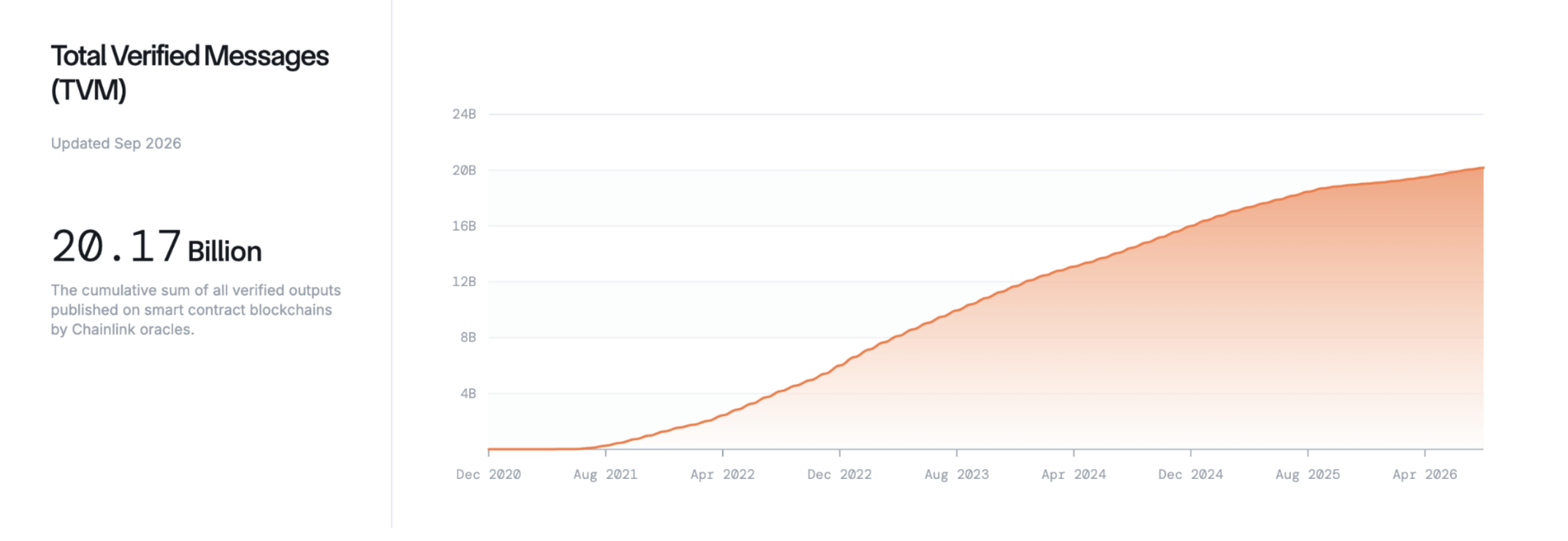
As an oracle platform, Chainlink DONs fetch, aggregate, validate, and deliver various types of data messages between and across onchain and offchain systems. Total Verified Messages (TVM) is a metric that tracks the total number of messages generated by the Chainlink platform that have been published and verified on a public blockchain network with smart contract functionalities. This includes both data oracle messages (e.g., market data) from an offchain system delivered to a blockchain, as well as cross-chain messages transferred between blockchains (e.g., a token transfer).
As of writing, the Chainlink Network has delivered more than 20 billion verified messages onchain across 80+ smart contract-enabled blockchains.
Integrated Chains
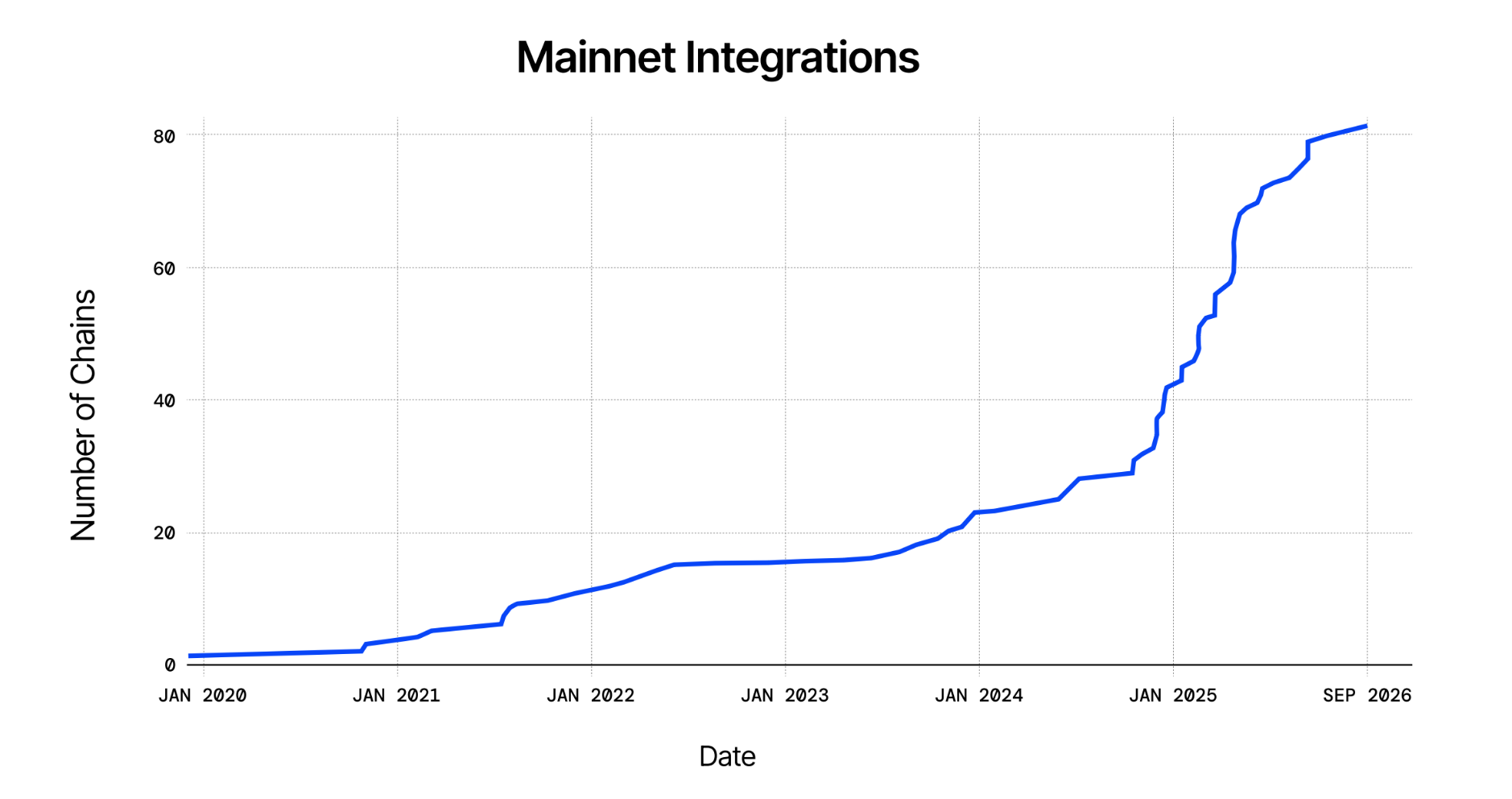
The Chainlink Platform is currently integrated with over 80+ public and private blockchains, not including testnet networks. These integrations include a heterogeneous collection of chains featuring different consensus models (e.g., PoW, PoS, PoA, etc.), runtime environments (e.g., EVM, SVM, MoveVM, etc.), and network architectures (e.g., Layer 1, Layer 2, sidechain, etc.), reflecting the complexity and scope of Chainlink interoperability. These integrations span multiple oracle service verticals, including data, cross-chain, and more, providing developers access to the critical infrastructure required to build advanced blockchain applications on that network.
Smart Contract Count
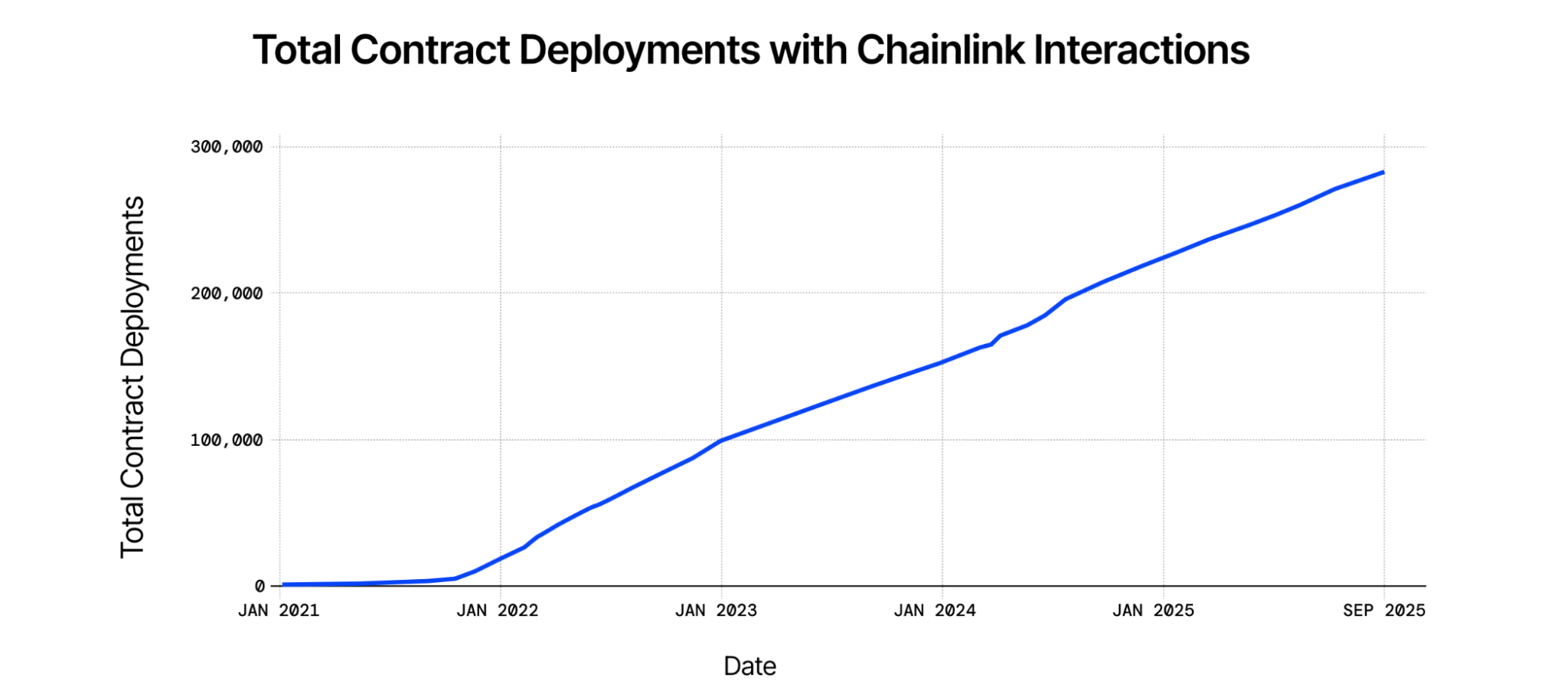
Nearly 300,000 smart contracts have interacted with Chainlink services. Deployments of smart contracts that leverage Chainlink services on their first day of deployment, continue to rise, underscoring the foundation nature and growing integration of Chainlink services within the broader blockchain ecosystem.
Chainlink Economics
As essential infrastructure for the onchain economy, the Chainlink Platform must maintain a consistently high level of security, reliability, and accuracy for years into the future. To achieve this goal, the network is built on an economic model that directly rewards service providers—such as node operators, data providers, and stakers—for maintaining network security and reliability. By establishing a virtuous cycle where network service providers are economically supported, Chainlink aims to provide secure and reliable oracle infrastructure that scales with the next wave of blockchain adoption.
Chainlink Economics centers on three key pillars: revenue growth, cost reduction, and cryptoeconomic security.
- Revenue growth helps support the long-term economic sustainability of the Chainlink Network, such that service providers are sufficiently rewarded to maintain network security and reliability.
- Reductions in operating costs, such as through the implementation of OCR, help make oracle services more efficient to produce and deliver, lowering the minimum threshold of fees required for sustainability.
- Cryptoeconomic security ties payments and staking-based commitments to service performance, aligning incentives and reinforcing reliability as the value secured increases.
Together, these pillars create a durable feedback loop, where more usage funds better security at lower unit costs, supporting the long-term oriented operation and the scale required for a global onchain economy.
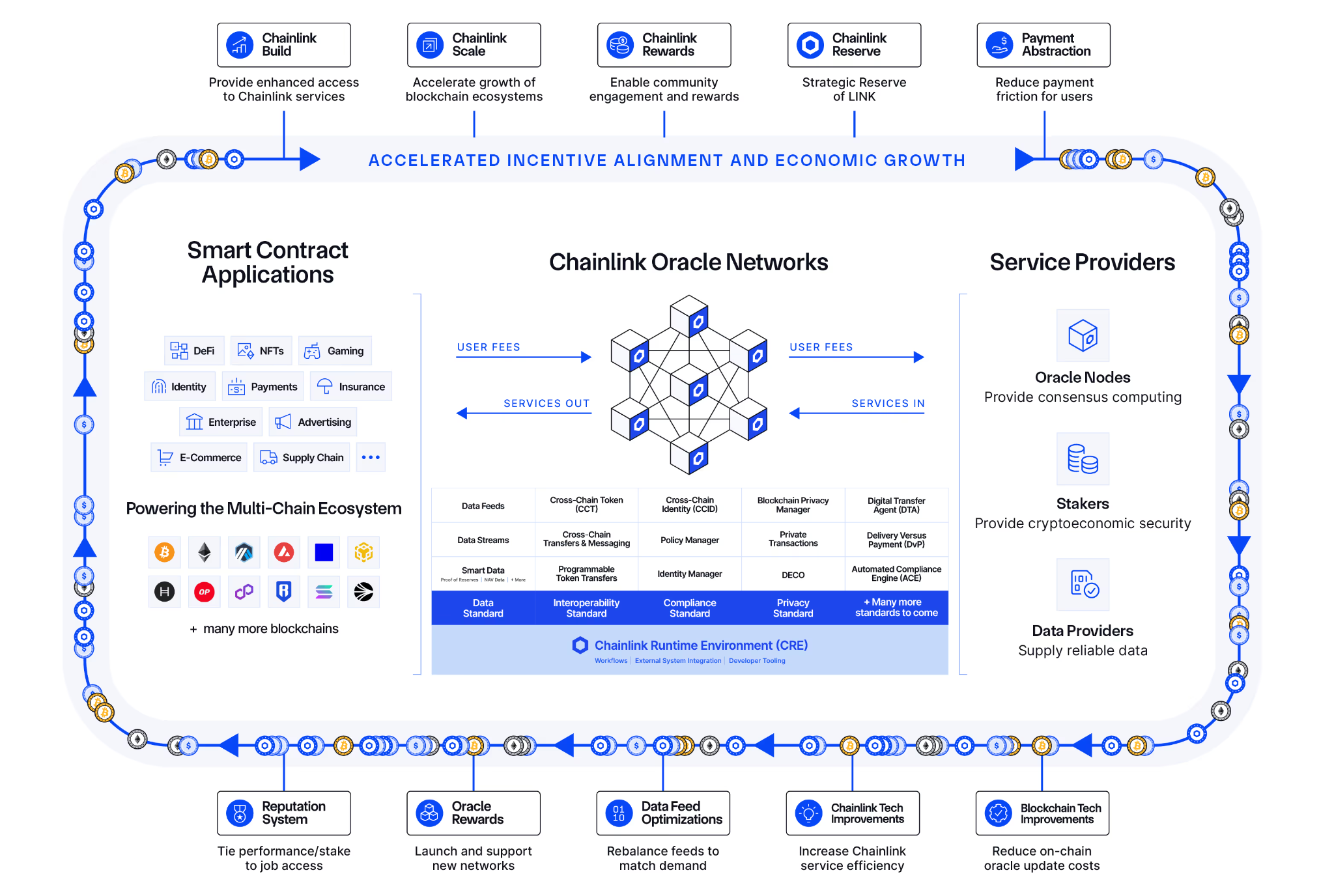
The LINK Token
LINK is the native token of the Chainlink Network, used to pay for services, enhance network security, and earn rewards. Similar to how the native coins of blockchain networks are used to pay for transaction gas fees (e.g., ETH on Ethereum), the LINK token is used by developers and organizations to pay fees to access Chainlink services.
LINK is also the standard form of compensation to network service providers, such as nodes, for successfully facilitating Chainlink services, thereby directly aligning their incentives with the proper functioning and long-term health of the network. In addition, LINK is staked by node operators and community stakers to help increase the network’s cryptoeconomic security, backstopping service performance with economic commitments. The LINK token also funds “oracle rewards” to bootstrap new decentralized oracle networks before fee-driven sustainability is achieved, similar to how blockchain networks use “block rewards” as a form of network incentive.
Originally issued on the Ethereum blockchain as an ERC-677 token—an extension of the popular ERC-20 token standard—the LINK token now circulates across numerous blockchain networks with cross-chain transfers secured by CCIP. The total LINK token supply is capped at one billion tokens.
Platform Monetization
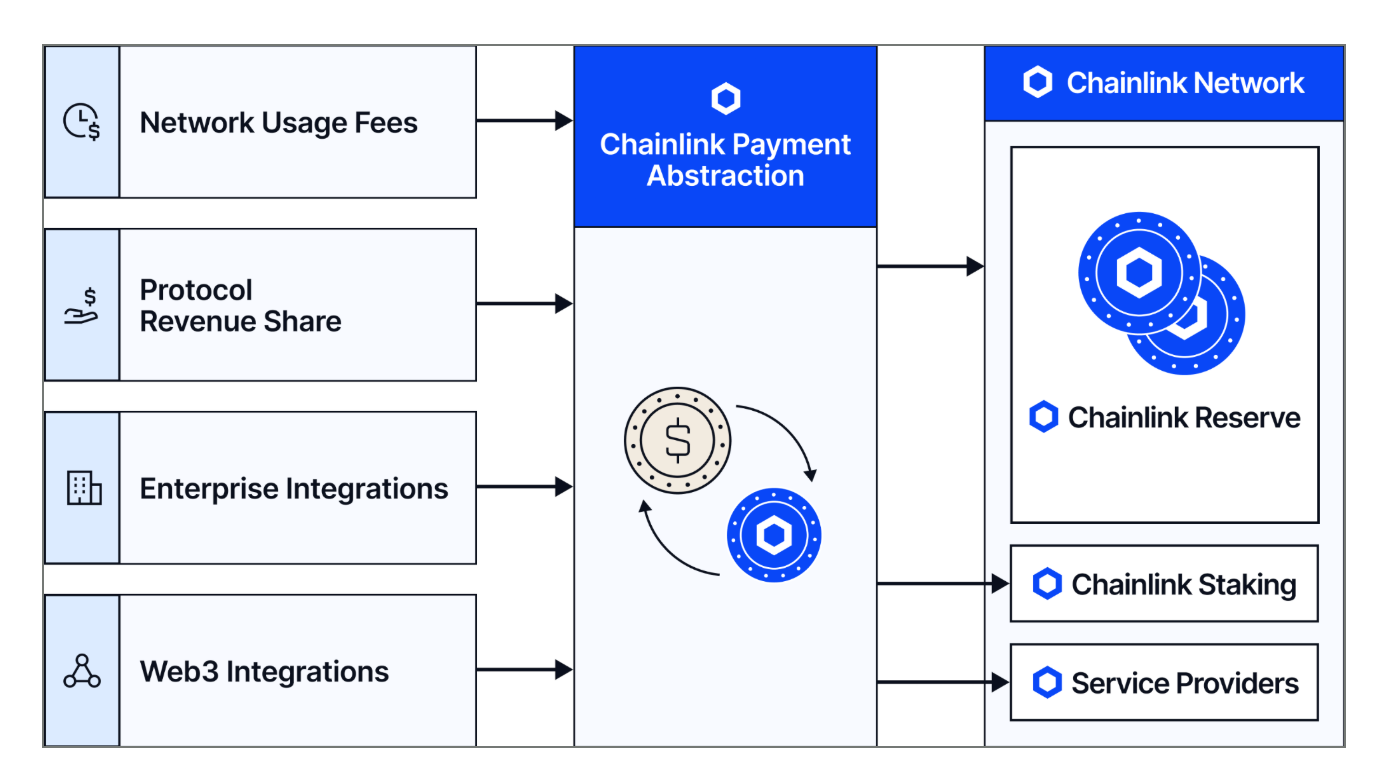
The suite of products and services built on the Chainlink platform falls into two broad integration frameworks: (1) open standards, in which developers interact directly with Chainlink smart contracts and pay usage-based fees, and (2) managed services, in which organizations pay for integrations and services related to the Chainlink product stack.
The Chainlink platform features a wide array of payment and billing methods related to the integration, usage, and maintenance of Chainlink products and services. As a result, the Chainlink platform can meet the unique requirements of Web3 dApps, Web2 enterprises, and traditional financial institutions.
- Network Usage Fees: A model of payment where users pay for oracle services based on marginal usage, including both subscription-based models (e.g., VRF, etc.), where applications keep fee balances within an onchain subscription contract that is drawn upon as services are consumed, and per-call payments (e.g., CCIP, Data Streams, etc.), where users pay when executing transactions involving an oracle service.
- Protocol Revenue Share: Applications share a portion of fees generated with the Chainlink Network as a way to pay for the oracle services they consume. This includes certain Data Streams deals, such as with GMX, which pays 1.2% of total fees for its use of low-latency market data. It also includes SVR users, such as Aave and Compound, where 35%-45% of recaptured liquidation MEV on SVR-integrated markets is collected by Chainlink.
- Enterprise Integrations: Institutional tokenization and smart contract development require reliable oracle services, and traditional enterprises pay the Chainlink Network to integrate and provide them these services. These deals position Chainlink as the secure connectivity layer for the entire blockchain industry, connecting legacy systems to public and private blockchains, as well as the key interoperability layer for getting data and value into, out of, and across blockchains. Capital markets adoption of Chainlink continues to accelerate, with a number of production use cases already live and many pre-production use cases approaching fully live deployment by some of the world’s largest financial institutions.
- Web3 Integrations: Blockchain-native applications and protocols also pay to integrate with the Chainlink Platform, particularly through the Scale program. Chainlink Scale is a program within Chainlink Economics designed as a foundational growth pillar for supporting blockchain ecosystems.
.png)
Payment Abstraction
Onchain infrastructure that enables users to pay for Chainlink services in their preferred form of payment, including onchain digital assets (e.g., gas tokens and stablecoins) and offchain fiat payments (e.g., USD wire transfers). Payments are then programmatically converted into LINK using a combination of Chainlink services and decentralized exchange infrastructure. By enabling users to pay for Chainlink services in their preferred format, the LINK token has become a “Universal Gas Token” enabling any blockchain transaction or use case. Chainlink Payment Abstraction allows revenue from both onchain service usage and ongoing offchain enterprise integrations to flow through the Chainlink Network.
Chainlink Reserve
A strategic onchain reserve of LINK tokens designed to support the long-term growth and sustainability of the Chainlink Network by accumulating LINK using offchain revenue from large enterprises that are adopting the Chainlink standard and from onchain service usage. The Chainlink Reserve is being built up by using Payment Abstraction to convert offchain and onchain revenue into LINK.
The Reserve has already accumulated millions of dollars worth of LINK and is expected to grow gradually. No withdrawals are expected from the Reserve for multiple years. As demand for Chainlink’s unique capabilities increases, adoption of Chainlink services can enable the Reserve to grow further. The Chainlink Reserve can be viewed at https://reserve.chain.link.
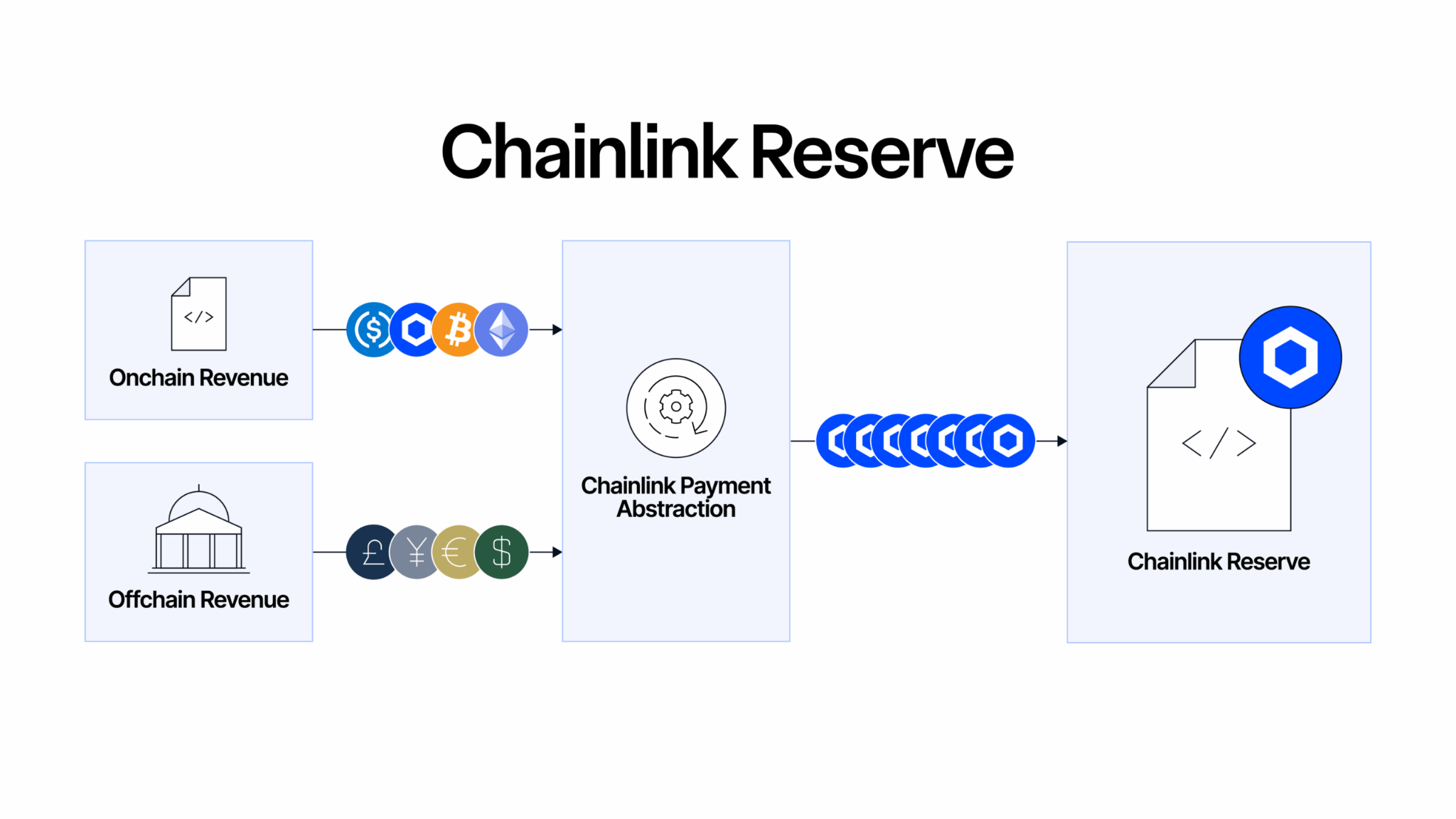
Chainlink Staking
A cryptoeconomic security mechanism designed to enhance the security and reliability of oracle services and, in turn, accelerate the adoption of the Chainlink Network. In Chainlink Staking, node operators and community members stake (lock up) LINK tokens, which can be slashed (forfeited) if DONs do not meet predefined performance requirements. In exchange, stakers receive staking rewards.
Community stakers earn base rewards for securing the network by staking LINK, and can earn additional rewards by providing timely and valid alerts about DON performance. The Chainlink Staking protocol first launched with v0.1, and later expanded with v0.2, featuring improved security guarantees for Chainlink oracle services through the slashing of staked LINK from node operator stakers.
.png)
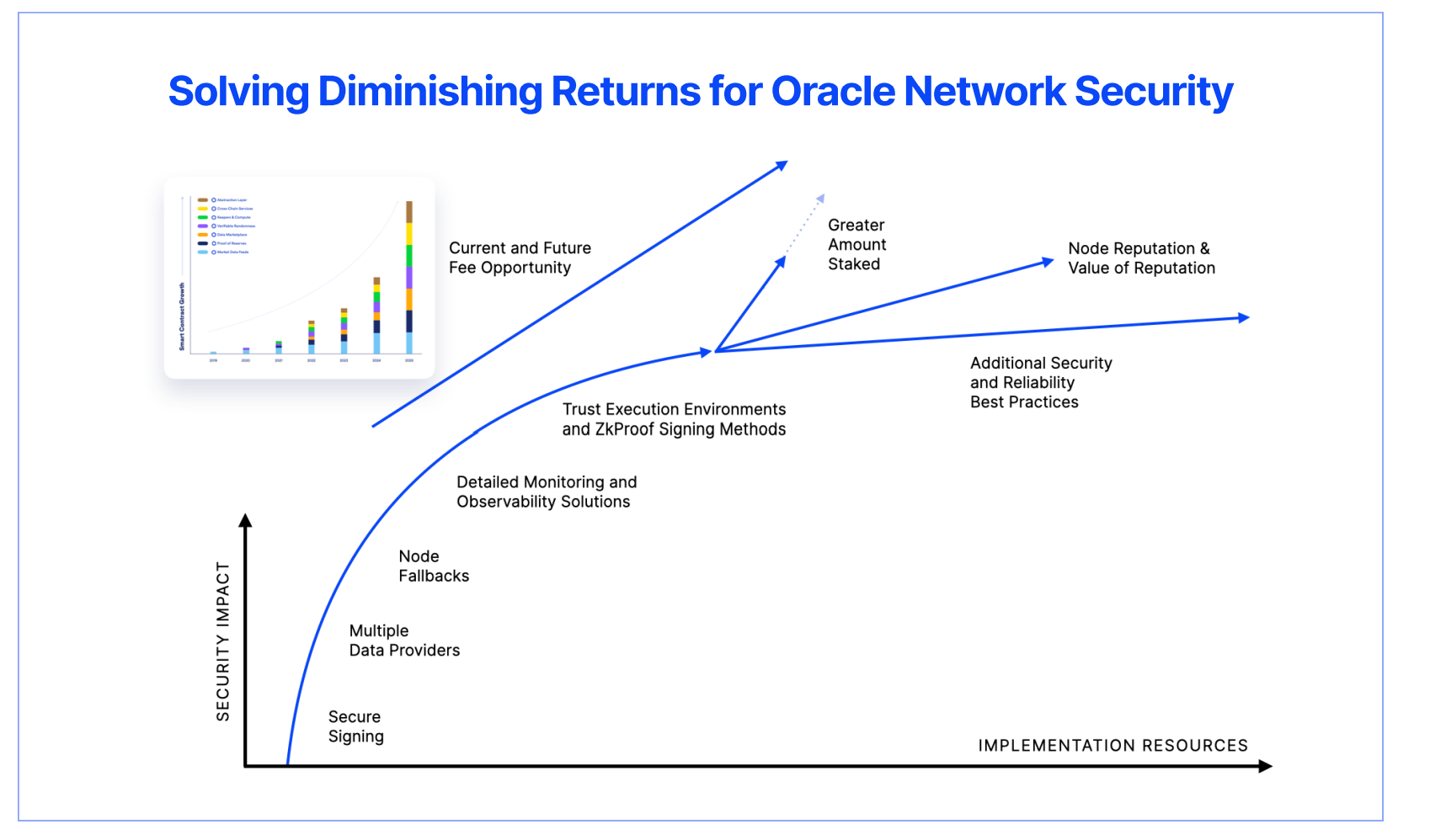
Chainlink Scale
A program that helps blockchain ecosystems kickstart developer adoption by enabling them to contribute resources that cover the integration, maintenance, and operating costs of deploying Chainlink on their chains, ultimately accelerating development while supporting the economic sustainability of Chainlink services. In doing so, ecosystem developers get access to a variety of oracle services, which can include configurations specific to their ecosystem needs. As blockchain ecosystems in the Chainlink Scale program mature, the operating costs of oracle networks can increasingly transition toward being fully covered by dApp user fees. This moves dApp ecosystems toward a holistic economic model that is more viable long-term for all participants.
.png)
Build the Future of Onchain Finance With Chainlink
As tokenization moves from experimentation to production, institutions need infrastructure that unifies data, interoperability, compliance, privacy, and existing systems across the full transaction lifecycle. Chainlink provides the foundation for building and operating institutional-grade onchain applications at scale.
To explore how Chainlink can support your tokenization strategy, talk to an expert. Developers can explore the Chainlink documentation to start building with the Chainlink platform.
.jpg)