What Is a Futures Contract?
A futures contract is a standardized, exchange-traded agreement to buy or sell an asset—such as oil, a stock market index, or a cryptocurrency—at a predetermined price on a specified future date, with settlement by physical delivery or cash.
The origins of futures contracts are thought to have been developed in agricultural markets in Japan centuries ago to help farmers manage the risk of bad harvests. Unlike a "spot" trade where cash is exchanged for the asset immediately, a futures contract locks in the transaction details today for settlement later. By locking in prices before crops were grown, farmers could hedge against a variety of risks. Over time, this mechanism has extended beyond agriculture to include a wide range of financial instruments like interest rates, equities, and cryptocurrencies.
Key Characteristics of a Futures Contract
Futures contracts standardize terms which allows them to be traded with less friction. A typical contract specifies:
- Underlying asset—The specific asset being traded (e.g., 100 barrels of crude oil or 1 Bitcoin).
- Contract size—The exact quantity of the asset represented by one contract.
- Delivery/expiration—The specific date when the contract expires and the final transaction takes place.
- Tick size—The minimum price movement allowed. For example, the S&P 500 E-mini futures might move in increments of 0.25 points.
- Settlement method—How the contract settles. This means either physical delivery (assets are delivered) or cash settlement (only the profit/loss difference is exchanged in cash).
How Does a Futures Contract Work?
- Opening a position—A market participant, such as an institution or trader, deposits collateral (cash, stablecoins, or other accepted collateral). They go long (buy futures) if they believe the price will rise, or go short (sell futures) if they believe the price will fall.
- Margining and mark-to-market—If the market moves in their favor, their margin balance increases. If it moves against them, their margin balance decreases. If margin falls below the required level specified in the contract, collateral must be added or the position may be liquidated.
- Closing a position—Most traders don’t hold to expiration. To close a long, they sell the same contract. To close a short, they buy it back.
- Settlement at expiration—For cash-settled contracts, they receive or pay the difference between the futures price and a final reference price, for physically-delivered contracts, the underlying asset is delivered.
Types of Futures Contracts
- Commodities/agricultural—These can include corn, wheat, soybeans, coffee, and more.
- Energy—Critical for global commerce, including crude oil and natural gas.
- Precious metals—Gold, silver, platinum, and more are used for hedging against inflation or industrial needs.
- Currencies—Contracts on major exchange rates (e.g., euro vs. U.S. Dollar) are commonly used by corporations and financial institutions.
- Financial instruments—The largest category by volume, including stock indices (e.g., S&P 500) and interest rates (e.g., Treasury bonds).
- Digital assets—Contracts allowing exposure to Bitcoin and other digital assets.
What Is a Perpetual Futures Contract?
A perpetual futures contract (often called a perpetual swap or perp) is a type of futures contract without an expiration date. Perp prices are often tied to an external reference index of spot exchanges, which requires reliable, tamper-resistant price data. As there’s no expiry, exchanges use a funding rate mechanism to keep the perp price anchored to the spot price:
- When the perp market trades above the spot/reference price, the funding rate is positive, and longs pay shorts.
- When the perp market trades below the spot/reference price, the funding rate is negative, and shorts pay longs.
Perps are the dominant derivatives product on many crypto-native exchanges and commonly used in decentralized finance (DeFi). As perps trade continuously with no rollover, traders can hold positions indefinitely as long as they maintain sufficient margin.
The Importance of Futures Contracts for Crypto
On both traditional venues and crypto-native exchanges, futures contracts underpin digital asset markets.
- Hedging—Miners, funds, and DeFi protocols can hedge price risk without selling their digital asset holdings.
- Price discovery—Liquid futures markets can help determine fair market value. Due to them being highly liquid, futures prices can lead spot markets during major news events.
- Leverage and capital efficiency—Futures enable directional exposure with less upfront capital. Institutions can also adopt market-neutral strategies to capture basis spreads.
- Onchain structured products—Onchain protocols can use futures prices to build vaults and structured yield products, stablecoins, or synthetic assets.
- Institutional onramps—Regulated futures products (e.g., on CME) provide a structured gateway for institutions to gain digital asset exposure.
CME and Crypto Futures
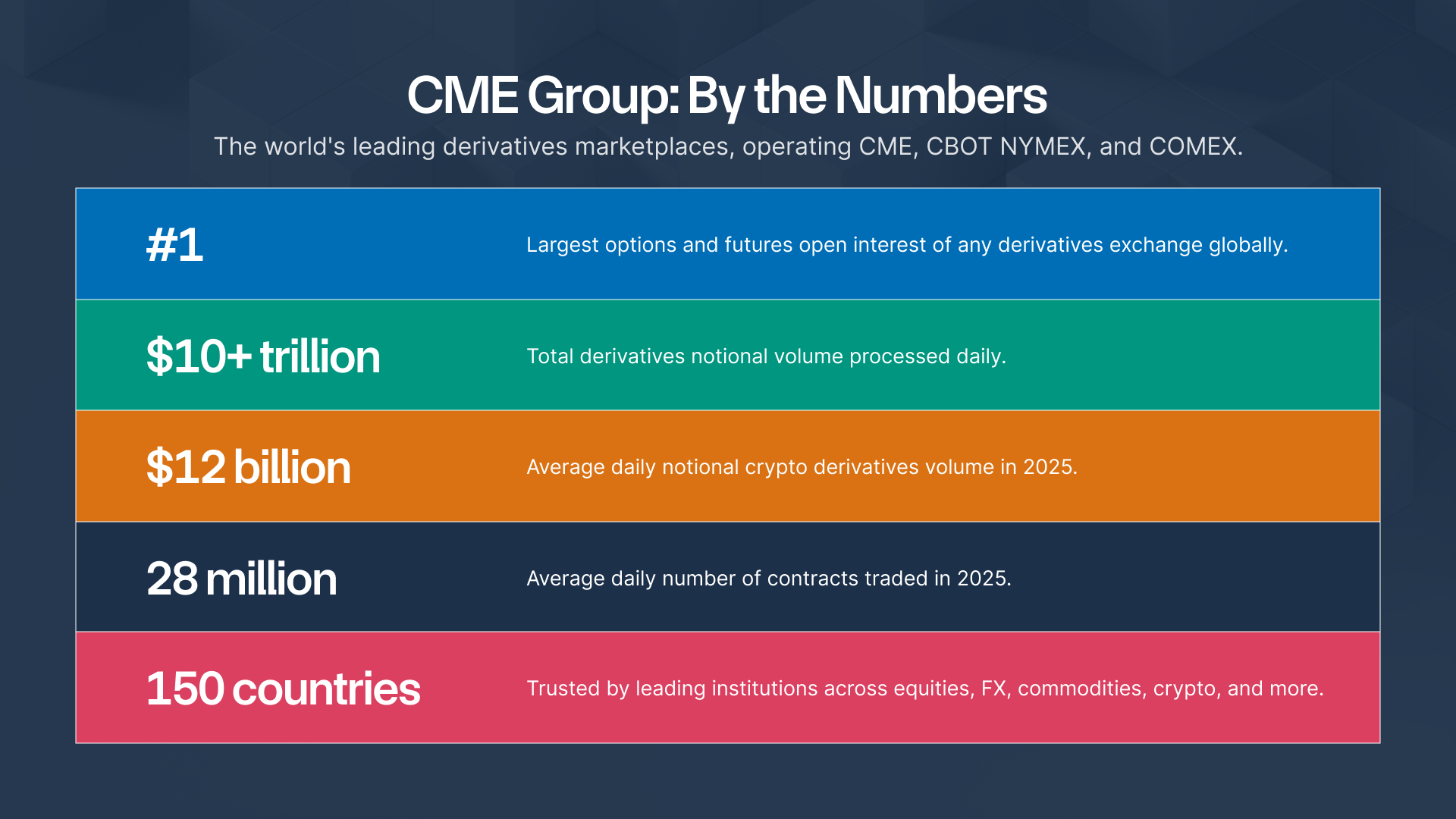
The Chicago Mercantile Exchange (CME) is one of the largest and most influential derivatives exchanges in the world and a major venue for institutional crypto exposure. With the first futures contracts traded in 1858, CME Group is the world’s leading derivatives marketplace, which operates four major exchanges: CME, CBOT, NYMEX, and COMEX.
In 2025, CME Group reported a record 28.1 million contracts in average daily volume, processing trillions of dollars of derivatives exposure every day for customers in roughly 150 countries across interest rates, equity indices, FX, energy, metals, agricultural commodities, and more.
Within this selection, digital assets are a growing category. CME offers regulated futures and options on Bitcoin (BTC), Ether (ETH), and other digital assets, with around $12 billion in average daily crypto derivatives notional volume in 2025. Out of the thousands of tokens that exist, only a handful have CME-listed futures.
Chainlink’s Role
When it comes to onchain futures contracts, a smart contract on a blockchain cannot natively access the price of oil, gold, or Bitcoin. This is where the Chainlink data standard is essential to bring secure data onchain.
- Chainlink Data Streams: Decentralized futures exchanges, particularly those offering perpetual contracts, require high-frequency, low-latency market data to manage liquidations and calculate funding rates accurately. Chainlink Data Streams (a pull-based oracle solution) is the most widely used solution for decentralized futures as it provides sub-second price updates, enabling onchain futures markets to compete with the speed of centralized exchanges. Centralized exchanges also use Chainlink Data Steams for futures contracts to provide additional assurances to their users.
- Chainlink Data Feeds: For standard settlement and mark-to-market calculations, Chainlink Data Feeds are the industry standard, securing tens of billions of dollars in value across the DeFi ecosystem by providing tamper-proof, volume-weighted pricing.
- Proof of Reserve: If futures contracts are tokenized or when stablecoins or tokenized assets are used as collateral, Chainlink Proof of Reserve can provide automated verification that the onchain assets are fully backed by real-world reserves.
FAQ
- How long can you hold a futures contract?
- You can hold a standard futures contract until its expiration date. However, traders commonly "roll" their position forward—closing the expiring contract and opening a new one for a later date—to maintain exposure. Perpetual contracts can be held indefinitely as long as sufficient margin is maintained.
- What happens when a futures contract expires?
- It depends on the settlement method. In physical delivery, the buyer must pay for and accept the actual goods (e.g., barrels of oil). In cash settlement, the difference between the contract price and the final spot price is paid in cash, and no physical goods are exchanged.


