Introducing CCIP Vault Adapters: Enabling 1-Click Deposits From Any Chain
.png)
TL;DR
- Chainlink has launched a new solution enabling DeFi vaults to directly accept deposits from users across 80+ blockchains without having to recreate vaults on each chain, significantly expanding access to capital, users, and liquidity.
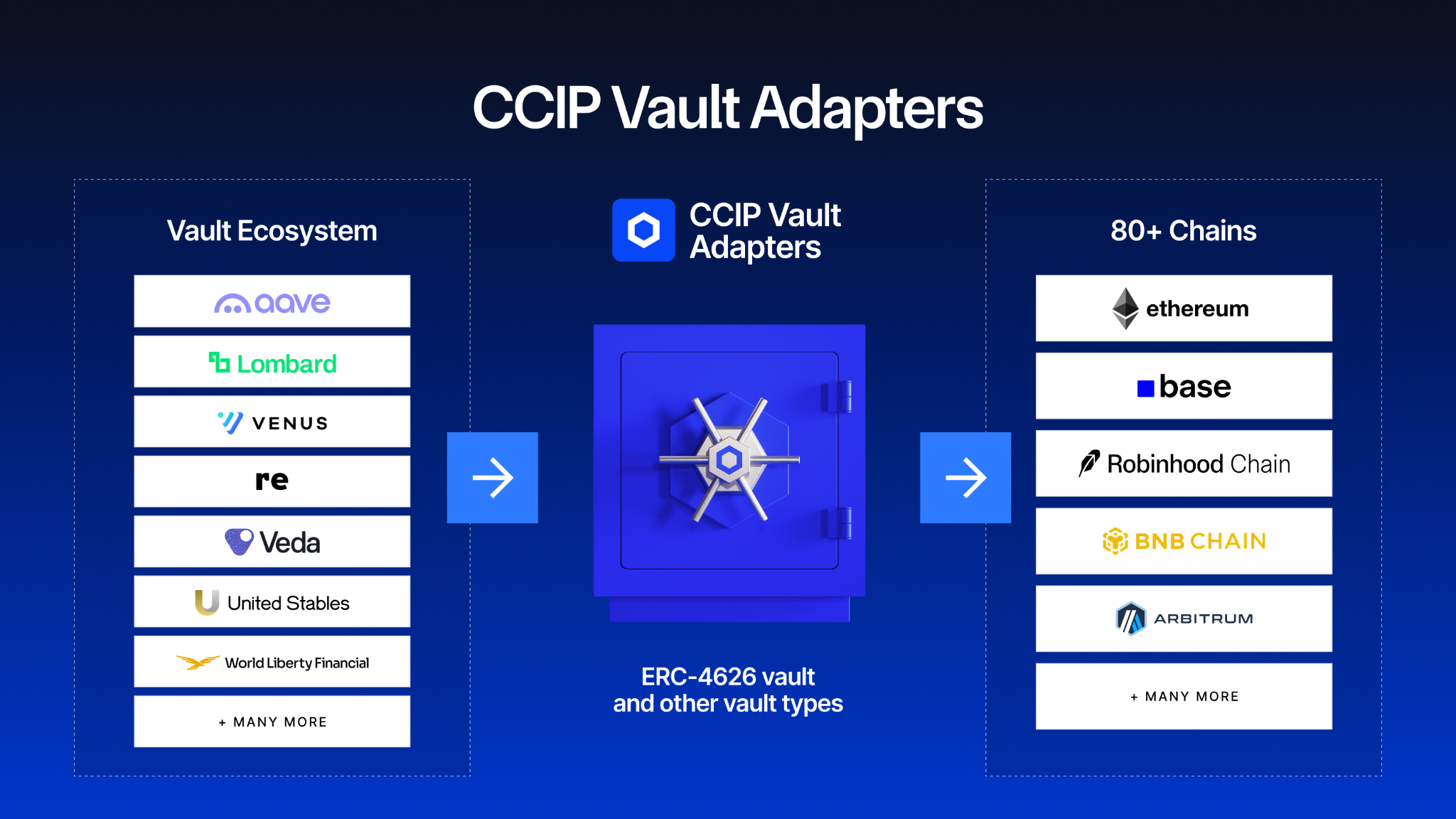
CCIP Vault Adapters are now live, enabling DeFi vaults on a single network to accept deposits from 80+ supported blockchains with a single click. Already being adopted by Aave, Lombard, United Stables, Veda, Venus, and many others, CCIP Vault Adapters unlocks multi-chain liquidity and expands distribution and user access for vault protocols across onchain finance.
Vaults are one of the fastest-growing vehicles for packaging digital assets and financial strategies into easily accessible DeFi products, with billions in deposits already deployed across stablecoins, lending, yield strategies, digital credit, tokenized assets, and more. However, as the vault ecosystem grows, issuers compete for capital fragmented across chains, with high-quality vaults often isolated on a single network while potential depositors hold assets elsewhere.
This challenge introduces significant tradeoffs for vault providers and introduces heavy friction for users who have to manually bridge assets, switch networks, and complete multiple transactions, creating a major roadblock to scaling vaults into the hundreds of billions and beyond.
CCIP Vault Adapters are designed to change this paradigm.
Unifying Vault Liquidity Across the Multi-Chain Economy
Powered by Chainlink’s Cross-Chain Interoperability Protocol (CCIP), the new solution enables vault providers to reach all potential depositors across the multi-chain economy while keeping their core vault operations and underlying TVL unified on a single home chain. Instead of staying on a single chain, redeploying everywhere, or asking users to bridge manually, vault providers can keep their vault where they are and bring cross-chain access directly to the user.
Standard ERC-4626 vaults can integrate CCIP Vault Adapters in minutes through a factory contract, with no custom cross-chain code required. The open-source adapter can also be extended to support alternative vault flows such as asynchronous redemptions, multi-asset deposits, and other bespoke implementations. The result is a seamless path to cross-chain vault distribution. Deploy once, reach users across supported chains, and keep vault operations in one place.
CCIP Vault Adapters is already being adopted by leading DeFi protocols, including Aave (largest DeFi lending protocol), Lombard (~70% of yield-bearing Bitcoin market share), Venus (top lending protocol on BNB Chain), and Re (leading tokenized reinsurance platform). They are joined by a growing ecosystem of vault issuers, curators, and infrastructure platforms, including World Liberty Financial, Accountable, Turtle, Saturn, Huma Finance, RockawayX, and more.
Vaults Today Have a Distribution Problem
Vaults have become one of the more important product formats in decentralized finance over recent months. They can represent lending deposits, yield strategies, protocol liquidity, tokenized assets, and other financial instruments in a standardized, scalable format.
But capital is increasingly fragmenting across a growing number of blockchains. A typical user may hold assets on a particular preferred chain while the vault they want to access operates on a completely different blockchain. Today, accessing that vault would require the user to manually bridge assets, switch RPC networks, provide token approvals, and complete a separate deposit transaction. Every additional step introduces friction, increases the risk of user error and exposure to additional attack vectors, and creates another opportunity for users to abandon the flow altogether.
Vault providers face an equally difficult set of tradeoffs. They can:
- Remain single-chain and limit their addressable depositor base to only one ecosystem.
- Redeploy separate, redundant vault instances across chains and fragment accounting, liquidity, governance controls, risk models, and operations.
- Build bespoke cross-chain infrastructure and take on the burdens of immense engineering, continuous maintenance, end-to-end security hardening, and significant cost increases.
None of these approaches deliver the operating model vault providers ultimately want: one vault, one source of truth, and distribution across any blockchain. Multi-chain access has evolved from a nice-to-have feature to a requirement in order for a vault to gain meaningful traction.
The Solution: CCIP Vault Adapters
CCIP Vault Adapters provide a superior path by bringing your vault to any chain without rebuilding or redeploying anything. Rather than redundantly redeploying a vault everywhere users hold capital and fragment liquidity, vault providers can maintain a single home-chain operating model while making the vault accessible to users across supported ecosystems.
For vault providers, CCIP Vault Adapters unlock a more scalable the distribution model:
- Reach users across chains without redeploying the vault everywhere.
- Reduce manual bridge-and-deposit friction for users.
- Keep accounting, strategy, governance, and risk controls on the home chain.
- Use a pre-built Chainlink-powered cross-chain path instead of building bespoke infrastructure.
The solution leverages CCIP’s Programmable Token Transfer capabilities to enable users to make secure deposits from a source chain directly into a vault on a destination chain, replacing a manual bridge-and-deposit journey with an integrated cross-chain deposit flow. In addition, the vault's receipt token (deployed by the vault provider) can be made a Cross-Chain Token (CCT), giving users the option to bridge their vault shares to the chain of their choice. This extends DeFi composability across chains, as vault shares minted on the home chain can be tracked and used in applications on other networks.
Key capabilities of CCIP Vault Adapters include:
- Faster go-to-market with factory-based deployment—Deploy the adapter via a factory contract in minutes, with no custom code required for all standard vaults, including ERC-4626. CCIP Vault Adapters are also designed to be flexible and interface with custom vault deployments, which can use the open-source adapter as a template and fork it to customize deposit and/or redemption logic while retaining CCIP security.
- Simplified operations with home-chain accounting—Keep vault logic, accounting, governance, and risk parameters on a home chain while CCIP Vault Adapters enables deposits from supported source chains. This preserves a single source of truth rather than fragmenting operations across isolated deployments, with no separate vault deployments required.
- Build confidently on Chainlink-secured foundation—CCIP is built on the same battle-tested Chainlink decentralized oracle network infrastructure (DON) that has securely enabled tens of trillions in transaction value. Vault providers build on a decentralized, secure-by-default foundation rather than assembling and maintaining their own cross-chain stack.
- Separate responsibilities with role-based operations—Separate dedicated roles for admin (e.g., multisig), fee setter (e.g., automated bot or keeper), and fee collector (e.g., treasury) roles provide operational flexibility out of the box.
- Cleaner UX using failed message resolution—Robust failed message handling to help ensure that stuck funds have a path back to the owner if deposits revert on the destination chain.
- Support a broad range of diverse deposit assets—Vault providers can configure adapters to accept any asset from any supported chain, including assets that use the CCT standard and do not leverage CCIP natively, allowing vaults to connect to a broader range of existing onchain liquidity.
The initial focus is on ERC-4626 standard cross-chain deposits and redemptions. Additional vault patterns, such as asynchronous vault interactions, cooldowns, multi-asset, and permissioned vault adapters, are on the way.
CCIP Vault Adapters also enables vault products to leverage the capabilities of the broader Chainlink platform. Vault workflows can tap into industry-standard Chainlink services, including Data Feeds, Data Streams, Proof of Reserve, SmartData, Automated Compliance Engine (ACE), and the Chainlink Runtime Environment (CRE). For protocols already powered by Chainlink infrastructure, CCIP extends that existing foundation without introducing any additional trust assumptions.
For example, vaults can leverage Proof of Reserve to verify underlying collateral, ACE to enforce compliance and policy controls, and CRE to orchestrate automated workflows spanning all services across multiple chains and systems.
This results in an advanced solution that unlocks seamless cross-chain distribution and increasingly sophisticated end-to-end onchain financial products.
How Top DeFi Platforms, Stablecoins, and Tokenized Assets Are Using CCIP Vault Adapters
Asset Issuers
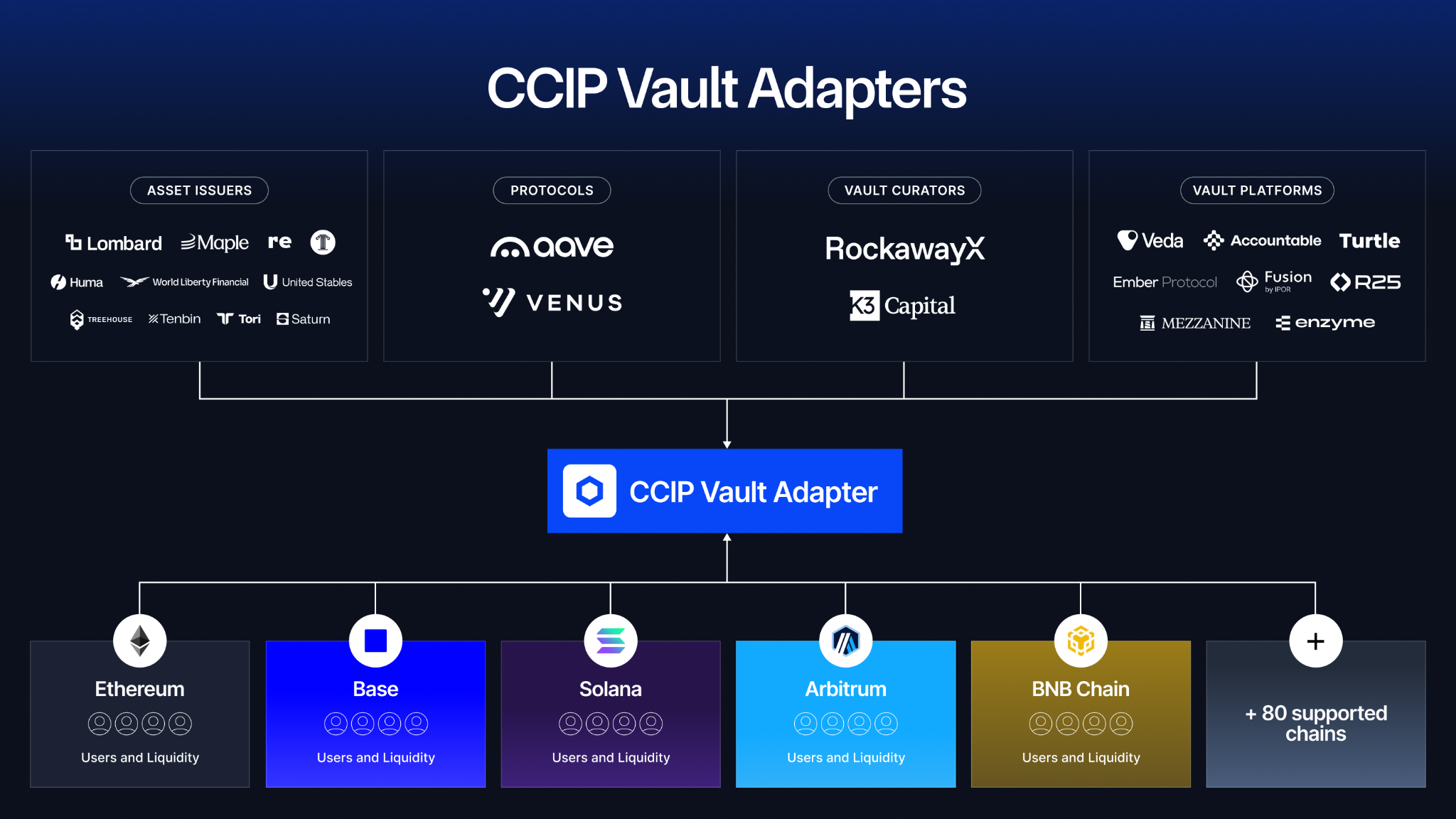
Asset issuers, including Lombard, Maple, Huma Finance, Re, United Stables, Tenbin, Tori Finance, Saturn, World Liberty Financial, and USDX (Stable), are adopting CCIP Vault Adapters to turn single-chain products into cross-chain capital products, enabling them to reach depositors wherever their capital sits without fragmenting minting, redemption, or risk controls across deployments.
Lombard routes BTC deposits into its Bitcoin Onchain Credit Strategy, enabling Bitcoin holders on Avalanche (BTC.b) to deposit directly into its Ethereum vault and access institutional-grade yield, including credit premiums, without manually bridging first. Maple brings the same model to credit, enabling users on supported chains to deposit directly into its vaults while underwriting and credit decisions remain on the home chain. United Stables is adopting CCIP Vault Adapters for its upcoming U-denominated vault product, designed to give depositors a cross-chain path into the vault from day one.
Protocols
Protocols including Aave and Venus are adopting CCIP Vault Adapters to pull liquidity in from supported chains to grow deposits without splitting core logic, risk parameters, or governance across multiple chains.
For example, Aave is extending its sGHO vault beyond Ethereum. Users can execute instant GHO/sGHO swaps on supported networks, while larger transactions and liquidity rebalancing are routed through Aave’s CCIP Vault Adapter.
Vault Curators
Curators and aggregators, including RockawayX and K3, are leveraging CCIP Vault Adapters to grow AUM by reaching depositors across chains without requiring every vault to deploy natively in each ecosystem or build their own bespoke cross-chain infrastructure.
RockawayX is live with CCIP Vault Adapters, giving depositors in its curated vaults cross-chain access without modifying the underlying strategy or risk model.
Vault Deployment Platforms
Vault deployment platforms, including Veda, Accountable, Ember, Enzyme, Fusion by IPOR, Mezzanine, Treehouse, R25 by Ant Group, and Turtle, are adopting CCIP Vault Adapters to make cross-chain distribution a native capability of vault creation itself. Instead of retrofitting interoperability later, teams launching vaults on these platforms can start with access to users across supported chains from day one.
Veda, the vault infrastructure platform with more than $32 billion in volume handled across 200+ vaults, is integrating CCIP Vault Adapters to expand cross-chain access to the vault products it powers.
Start Building With CCIP Vault Adapters
CCIP Vault Adapters give asset issuers, protocols, vault infrastructure providers, and curators a secure way to scale vault deposits across supported chains. Deploy once, reach users across chains, all while keeping vault accounting in one place.
Start building cross-chain vault deposit flows with CCIP Vault Adapters using the official documentation or reach out to the Chainlink Labs team.
—
Disclaimer: This post is for informational purposes only and contains statements about the future, including anticipated product features, development, and timelines for the rollout of these features. These statements are only predictions and reflect current beliefs and expectations with respect to future events; they are based on assumptions and are subject to risk, uncertainties, and changes at any time. There can be no assurance that actual results will not differ materially from those expressed in these statements, although we believe them to be based on reasonable assumptions. All statements are valid only as of the date first posted. These statements may not reflect future developments due to user feedback or later events, and we may not update this post in response. Chainlink does not deploy, control or operate any vault or vault adapter and does not endorse or recommend any particular vault or vault strategy. Please review the Chainlink Terms of Service, which provides important information and disclosures.


.jpg)