Blockchain Voting: How It Can Transform Elections
Free and fair elections are fundamental to public trust in democratic systems. But many voting processes still rely on outdated infrastructure, making them vulnerable to tampering, delays, and opacity. Blockchain voting systems record votes on a tamper-proof ledger and enable real-time verification. This can improve election processes by making them more secure, accessible, and auditable. Chainlink provides infrastructure that supports these systems—connecting onchain voting processes to offchain data in a secure, reliable, and decentralized way.
Key Takeaways
- Blockchain can improve election integrity by recording votes on a tamper-proof ledger and enabling real-time, independent verification.
- Governments are beginning to explore blockchain voting. In the U.S., New York and West Virginia have proposed legislation related to blockchains, and globally, countries like South Korea and Romania have tested blockchain in election processes.
- Blockchain voting still faces challenges, including device security, legal uncertainty, and public trust.
Challenges in Traditional Voting Systems
Most election systems weren’t built with modern cybersecurity or transparency standards in mind. Paper ballots, electronic machines, and centralized databases each present challenges:
- Tampering and fraud—Centralized systems create single points of failure and can be susceptible to manipulation.
- Lack of transparency—In many elections, the process of counting votes and verifying outcomes is not easily auditable by the public.
- Access barriers—Voters in remote areas or living abroad may find it difficult to participate, especially via physical polling stations or postal systems.
- Reporting delays—Manual vote counting or siloed digital infrastructure can slow down result delivery.
These issues are driving renewed interest in emerging technologies, such as blockchain, that can help strengthen electoral systems.
Real-World Voting System Failures Expose Key Risks
In the 2024 U.S. elections, several states faced technical and operational challenges that underscored vulnerabilities in traditional voting systems.
In Milwaukee, Wisconsin, over 30,000 absentee ballots had to be reprocessed after officials discovered a security issue with ballot tabulator machines. While no tampering occurred, they had to reset the machines and rescan all the ballots to preserve trust in the process.
Arizona's Maricopa County received over a dozen bomb threats that disrupted voting and delayed reporting. These threats targeted physical polling sites—highlighting the risks of centralized, in-person systems.
Meanwhile, other states faced printer failures, security mismanagement, and disinformation attacks. Blockchain voting could reduce these vulnerabilities by enabling remote and tamper-resistant vote submission with real-time verification.
How Blockchain Technology Can Enhance Voting
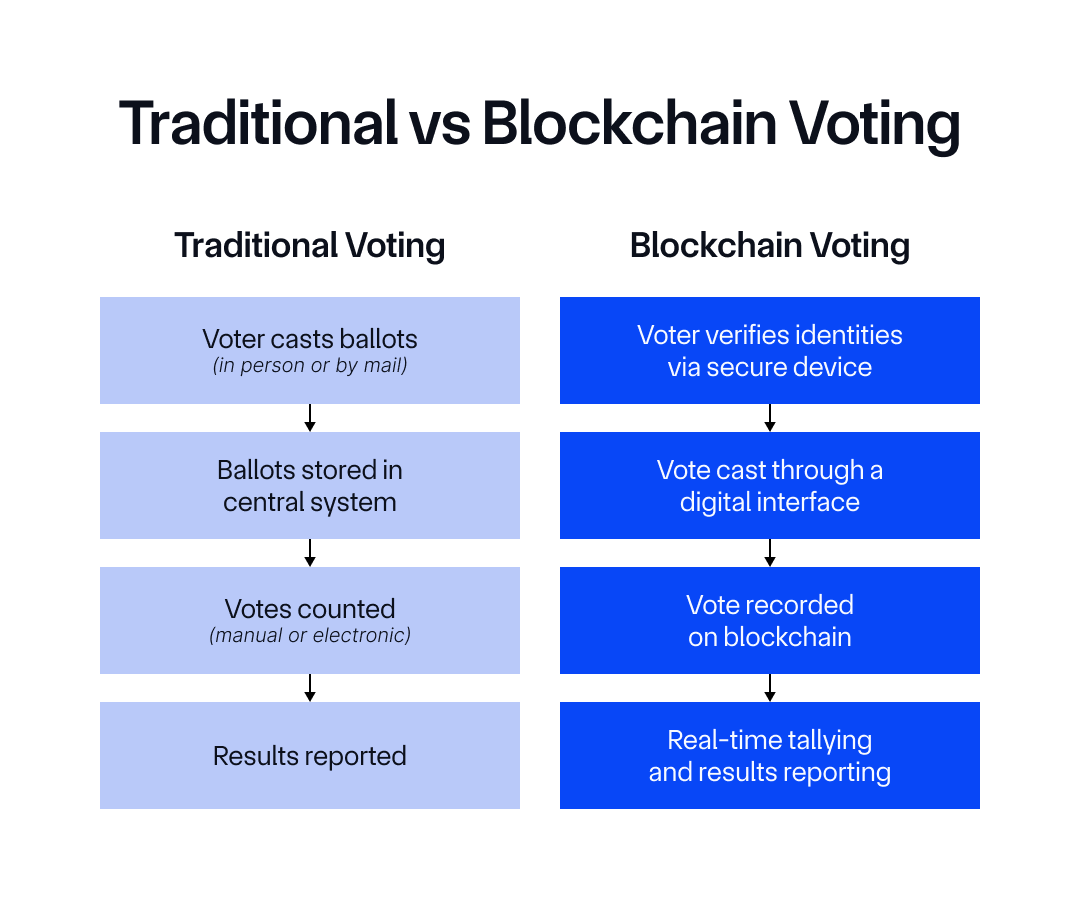
Blockchain technology offers a set of features that directly address today’s challenges in voting systems. By decentralizing control, ensuring immutability, and enabling open access to records, blockchain voting can support greater transparency and resilience.
Smart contracts on blockchain networks can automate critical parts of the voting process—from verifying voter eligibility and accepting vote submissions to tallying results in real time. Because blockchains are tamper-proof and time-stamped, they make it much harder to manipulate or dispute outcomes.
Voters, auditors, and regulators can all access the same tamper-proof results—strengthening confidence in the results.
Blockchain voting could offer several advantages:
- Unified Golden Record—A unified, continuously updated record of voter eligibility can aggregate data across different registration systems.
- Tamper resistance—Votes recorded on a blockchain can’t be retroactively altered, reducing the risk of post-vote manipulation.
- Auditability—Blockchains record and timestamp every vote, allowing independent verification of the full voting process.
- Real-time verification—Voters can confirm that their vote was received and counted without revealing their identity.
- Remote voting—Voters can securely submit ballots from authorised devices, improving access for those who can’t vote in person.
“The idea of utilizing blockchain technology to create a tamper-resistant electronic/online voting network is gaining momentum” — Blockchain for Electronic Voting System—Review and Open Research Challenges
How Governments Are Already Exploring Blockchain Voting
Some governments are already exploring blockchain for elections. For example, Romania was the first country in the European Union to use a blockchain-based reporting tool for national elections. The country’s electoral authority introduced blockchain to improve transparency and enable real-time monitoring of vote data.
In 2021, South Korea’s National Election Commission launched a blockchain-based online voting system to improve transparency and voter authentication. The project aimed to support over 10 million users. In 2022, the South Korean government allocated $1.1 million to fund research and development of blockchain voting systems.
In April 2025, New York lawmakers reintroduced the Blockchain for Election Integrity Act. The bill proposes a formal study on how blockchain could help secure voter records and improve transparency. West Virginia has also experimented with blockchain voting, allowing overseas military personnel to vote using a blockchain-based internet application.
Chainlink’s Role in Blockchain Voting Systems
Blockchain voting systems often need to connect with offchain data—for example, to verify voter identity, coordinate timing, or share results across networks. Chainlink’s privacy-preserving connectivity and interoperability infrastructure can help secure these needs. It could enable secure data exchange between onchain voting systems and offchain identity databases, without exposing sensitive information.
Chainlink’s cross-chain capabilities could also allow voting data to move securely between blockchains and traditional public-service infrastructure. This supports broader system coordination without central points of failure.
These services give blockchain voting systems the offchain connectivity, automation, and interoperability needed to work seamlessly in live elections.
Conclusion
Blockchain offers a practical solution to upgrade voting systems, making them more secure, transparent, and accessible. By recording votes on a tamper-proof ledger and enabling real-time verification, blockchain can improve trust in electoral processes. At the same time, blockchain technology can reduce the risks of fraud, delay, and voting miscounts. While challenges remain, blockchain voting presents a unique alternative to the existing voting process.