


What Is a Blockchain Oracle?
Oracles are a core component of onchain financial systems, providing the external connectivity and computation that blockchains cannot natively support.
They connect blockchains to real-world data, existing systems, APIs, and industry standards, while also enabling verifiable computation for onchain privacy, compliance, orchestration, and other advanced services.
By allowing onchain code to securely interact with offchain systems, oracles enable developers to build useful blockchain applications and tokenized assets at institutional scale.
Blockchain technology is transforming financial markets, global trade, insurance, gaming, and many other data - and value - intensive industries. Trillions of dollars in assets are already transitioning to this new blockchain-based tokenized format, while blockchain-based applications (i.e., smart contracts) are unlocking superior methods of transacting and automating business processes.
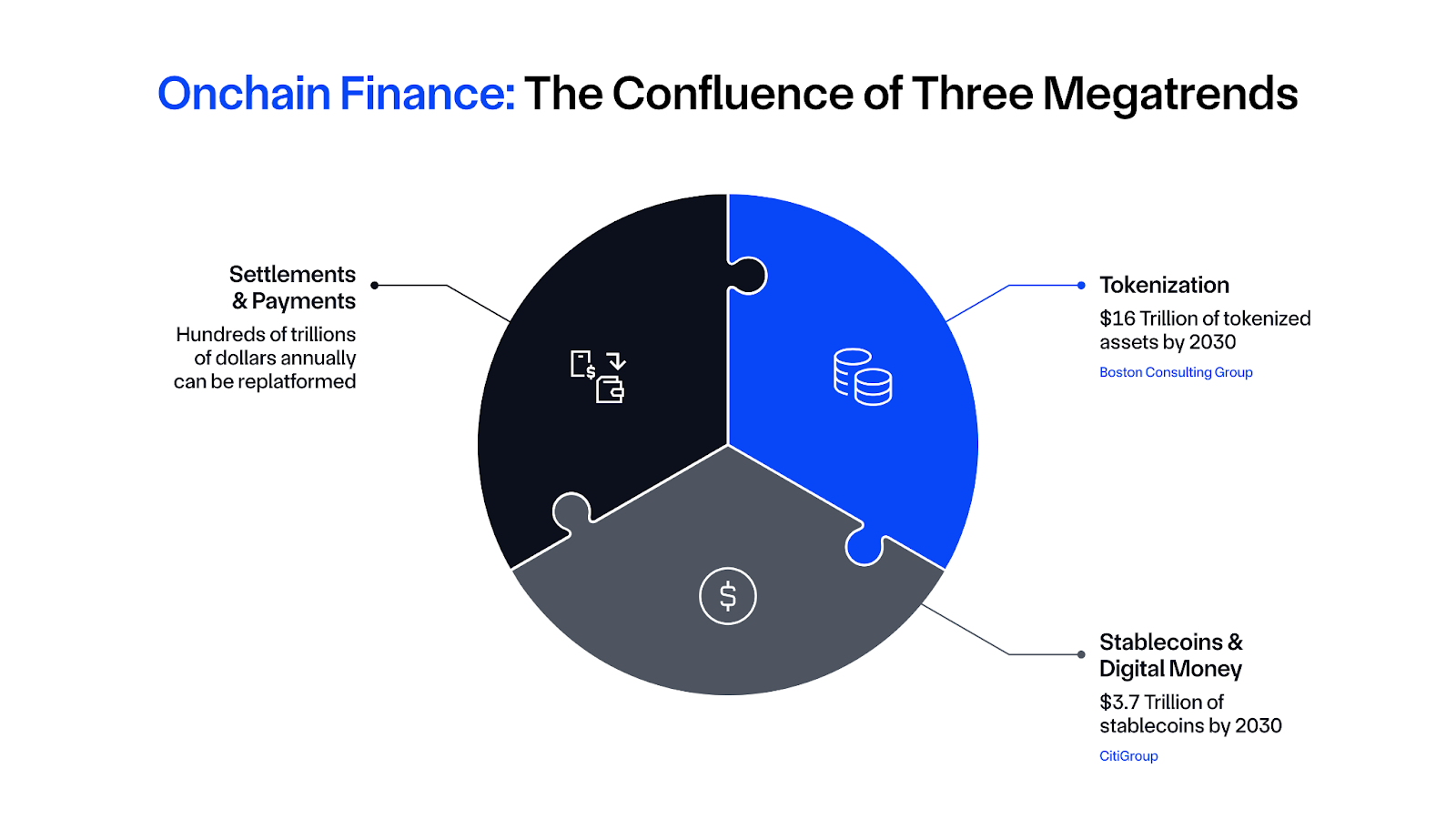
Oracles are foundational to this new “onchain” economy. They not only connect blockchains to external data, systems, and technologies, but also provide a wide range of critical services to institutions and developers building impactful blockchain applications. These services include cross-chain interoperability, compliance enforcement, smart contract privacy, and orchestration of workflows across onchain and offchain environments.
Chainlink is the industry-standard oracle platform bringing capital markets onchain and powering the majority of decentralized finance (DeFi). Many of the world’s largest financial institutions are adopting Chainlink, including Swift (global messaging network for 11,500+ institutions), DTCC (world’s largest securities settlement system, processing $3.7+ quadrillion annually), and J.P. Morgan (the largest U.S. bank with $3T+ AUM), as well as top DeFi protocols like Aave, Lido, and ether.fi. To date, Chainlink has enabled over $27.6 trillion in transaction value.
Chainlink is empowering institutions and developers to quickly and securely deploy advanced, institutional-grade smart contracts that underpin how billions of users and trillions of dollars in assets are transacted globally.
What Is an Oracle?
Oracles provide essential services for building useful blockchain applications and tokenized assets. Most notably, oracles connect blockchains to external data, systems, and standards—i.e., offchain resources. However, oracles go far beyond facilitating communication between blockchains and offchain resources; they also provide verifiable computation that supports onchain compliance, privacy, orchestration, and other key services.
Only through oracles can onchain code be combined with offchain systems to unlock more advanced institutional use cases and decentralized applications (dApps). Without oracles, smart contracts would be limited to executing logic based on data already stored on the blockchain—severely restricting their utility and innovation. In this way, oracles can be thought of like a combination of the Internet for computers and an onchain cloud services platform for organizations building smart contracts.
In practice, oracle networks allow smart contracts to:
- Read and react to data from the real world.
- Trigger actions in external systems.
- Coordinate activity across multiple blockchains.
- Use identity data to automate compliance checks before settlement.
- Execute verifiable computation that’s impractical to perform onchain.

Consider an example: Alice and Bob want to bet on the outcome of a sports match. Alice bets $20 on team A and Bob bets $20 on team B, with the $40 total held in escrow by a smart contract.
When the game ends, how does the smart contract know whether to release the funds to Alice or Bob? Because blockchains cannot directly access external data, the contract relies on an oracle to fetch match outcomes from offchain sources (e.g., sports data provider) and deliver them to the blockchain.
The Oracle Problem
The blockchain oracle problem refers to a fundamental limitation of smart contracts: they cannot natively interact with data and systems outside the blockchain on which they’re deployed in a secure and reliable manner.
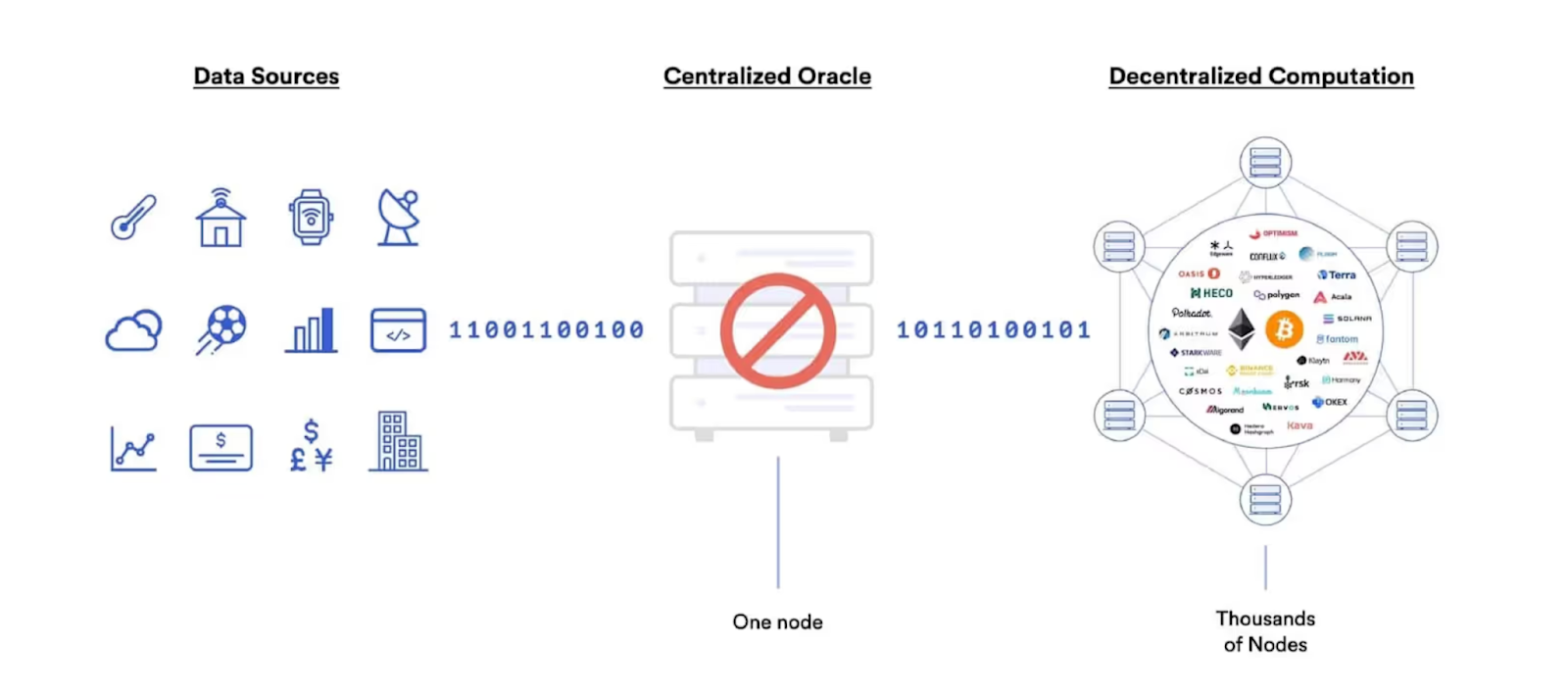
This is because blockchains are deliberately isolated from external systems. This design feature is how blockchains achieve their most valuable properties, such as strong tamper resistance, global accessibility, and high uptime.
Solving the oracle problem is of the utmost importance because the vast majority of smart contract use cases—including institutional tokenization and DeFi—require interaction with existing data, systems, and financial standards residing offchain. However, because the data delivered to and from smart contracts determines key outcomes like payouts and application security, the correctness, availability, and security of the oracle mechanism are mission-critical.
Decentralized Oracles
Smart contracts that rely on centralized oracles to deliver them data introduce a single point of failure, defeating the very purpose of a decentralized blockchain application. For example, if the single oracle goes offline, then the smart contract will not have access to the data required for execution, or will execute improperly based on stale data. Even worse, if the single oracle is corrupted, the data delivered onchain may be highly incorrect, leading to smart contracts executing very wrong outcomes.
This aligns with the old adage “garbage in, garbage out,” which holds that poor inputs yield poor outputs. Additionally, because blockchain transactions are automated and immutable, a smart contract outcome based on faulty data cannot be reversed, potentially resulting in the permanent loss of user funds. Therefore, centralized oracles are a non-starter for smart contract applications.
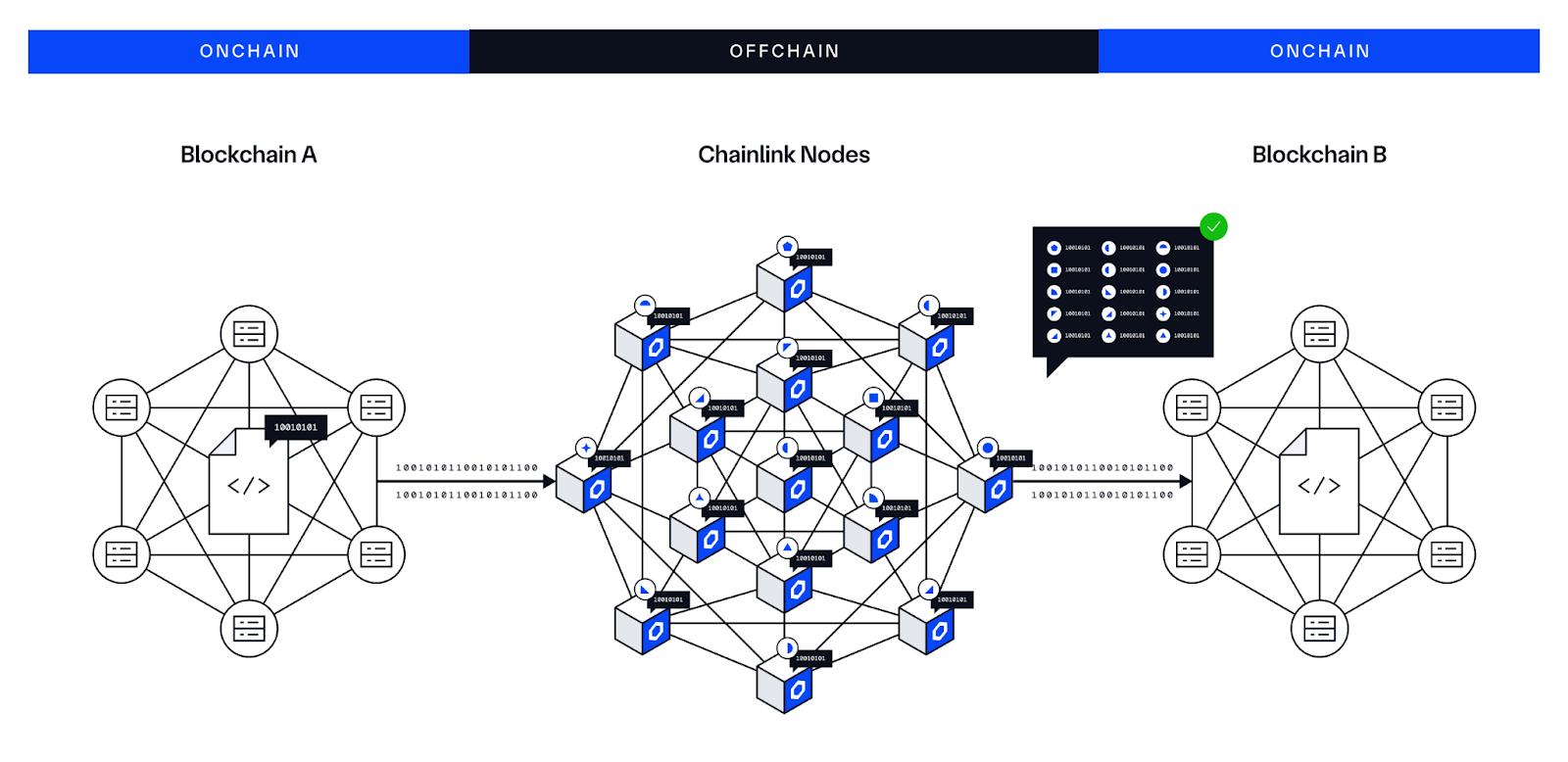
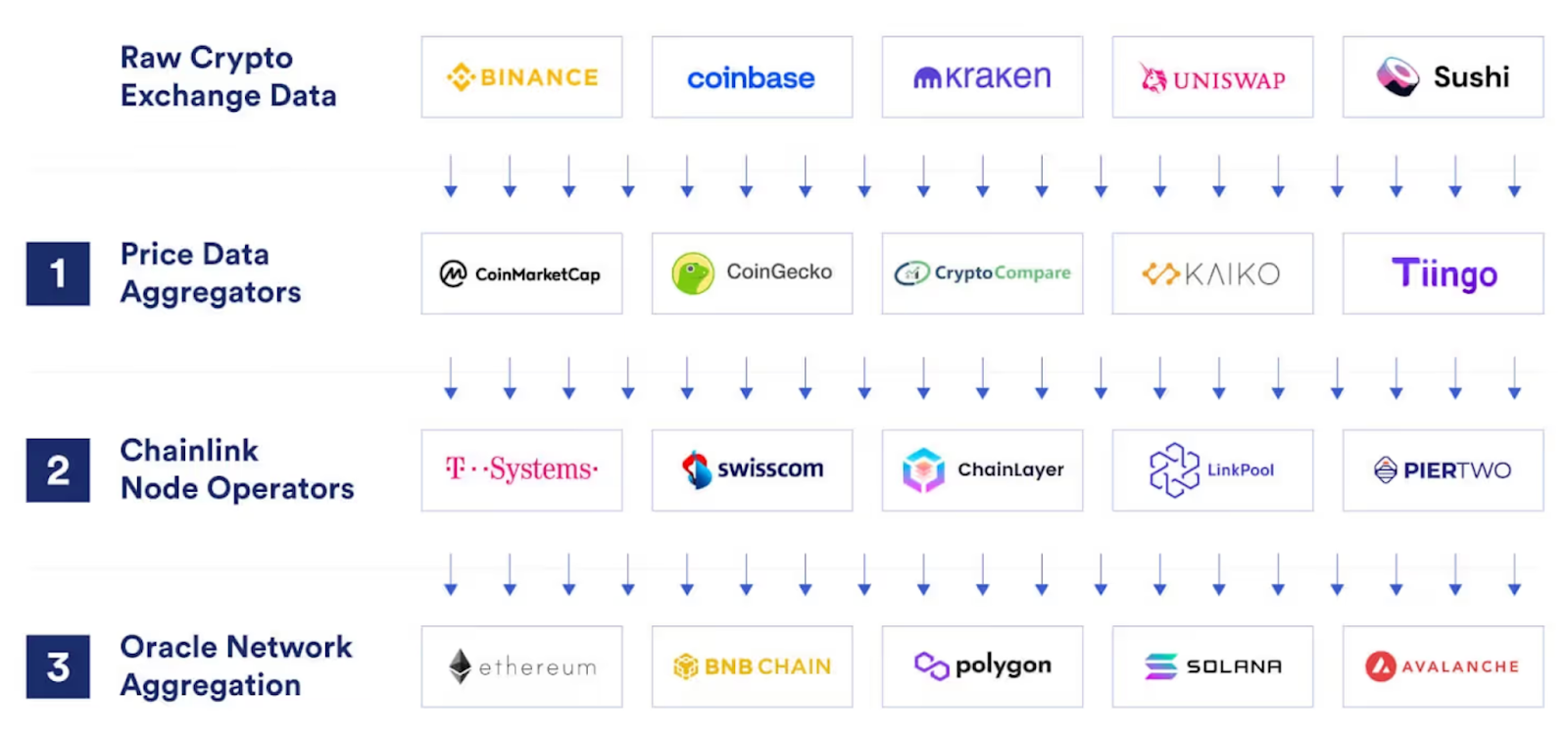
Truly overcoming the crypto oracle problem requires decentralized oracles that prevent data manipulation, inaccuracies, and downtime. A decentralized oracle network, or DON for short, combines multiple independent oracle node operators and multiple reliable data sources to establish end-to-end decentralization for the data and computations they provide.
Many Chainlink services, such as Cross-Chain Interoperability Protocol (CCIP), Price Feeds, and Data Streams, utilize multiple layers of decentralization. For example, Chainlink Price Feeds utilize decentralization at the data source, individual node operator, and oracle network levels to eliminate single points of failure. Through this multi-layered decentralization approach, Chainlink has become the industry-standard oracle platform, securing over 70% of the DeFi ecosystem and ensuring smart contracts can safely rely on data inputs during execution.
Oracle Mechanisms: Push-Based and Pull-Based
Push-Based Oracles
One type of oracle mechanism is a “push-based oracle,” where the oracle delivers offchain data to a blockchain network on a predefined schedule (e.g., every minute or whenever the asset price changes by 1%). This type of oracle mechanism powers Chainlink Data Feeds, providing DeFi lending markets like Aave and tokenized assets like Lido with onchain access to reliable financial market data.
Pull-Based Oracles
The other oracle mechanism is a “pull-based oracle,” where the oracle fetches, aggregates, and stores information offchain, and the smart contract can then bring it onchain at any time. Pull-based oracles allow data to be updated offchain at high frequency and at low cost, and give users the freedom to bring it onchain whenever they need it. This type of oracle mechanism powers Chainlink Data Streams, enabling real-time onchain markets, such as DeFi perps for GMX and Jupiter.
For a deep dive into the differences, read: Push vs. Pull-Based Oracles: Choosing the Right Model for Your Onchain Application.
Types of Blockchain Oracles
Given the extensive range of offchain resources, there are many types of blockchain oracle solutions.
Data Oracles
Data oracles transfer data between blockchains and external systems, such as bank systems, payment networks, enterprise backends, AI networks, and web APIs. Data oracles enable data to be brought onto blockchains for smart contract consumption, as well as for smart contracts to send commands to external systems, such as to trigger a traditional payment, interact with a cloud service, or influence an IoT device.
Cross-Chain Oracles
Cross-chain oracle networks enable different blockchains to securely exchange data, commands, and value. Chainlink’s Cross-Chain Interoperability Protocol (CCIP) enables secure messaging and token transfers across public and private blockchains, with built-in risk management and monitoring. As a result, CCIP unlocks tokenized asset settlement, cross-chain liquidity management, and institutional workflows, and has been selected as the exclusive cross-chain infrastructure for leading organizations, including Coinbase.
Compute Oracles
Many applications require decentralized and verifiable computation that’s impractical to perform onchain due to cost, privacy, or technical constraints. Compute oracles provide this type of verifiable computation offchain to enable smart contracts to greatly expand the types of use cases they can support.
For example, Chainlink features compute oracles that empower users to:
- Aggregate data from multiple sources (e.g., compute the median) to ensure accurate, tamper-resistant data.
- Run a verifiable randomness function to generate a tamper-proof and provably fair source of randomness.
- Automate a smart contract by triggering it to run at specific times or when predefined events occur.
- Enforce compliance policies within tokens and applications using identity data and existing compliance systems.
- Generate privacy for different parts of onchain transactions using trusted execution environments and zero-knowledge proofs.
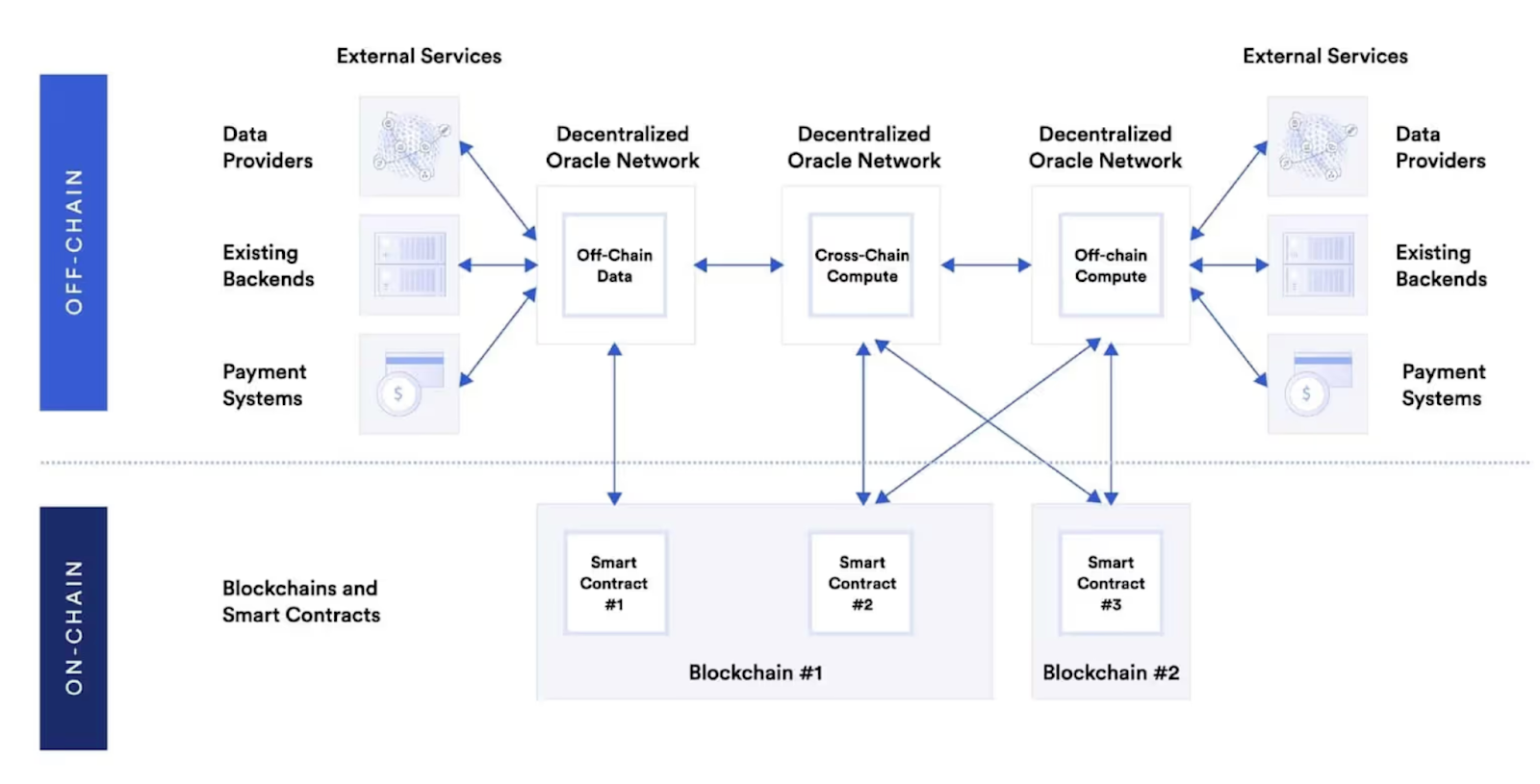
Oracle Platform
Chainlink is the only oracle solution that provides all the different types of oracles and oracle mechanisms within a single oracle platform. Instead of building in-house or relying on a complex patchwork of service providers, institutions, enterprises, and developers can leverage the Chainlink oracle platform to access all the key oracle services needed to build and execute the entire lifecycle of tokenized assets and sophisticated onchain applications. For a deeper understanding of the Chainlink platform, read The Chainlink Endgame: Integrating the World Into the Tokenized Asset Economy.
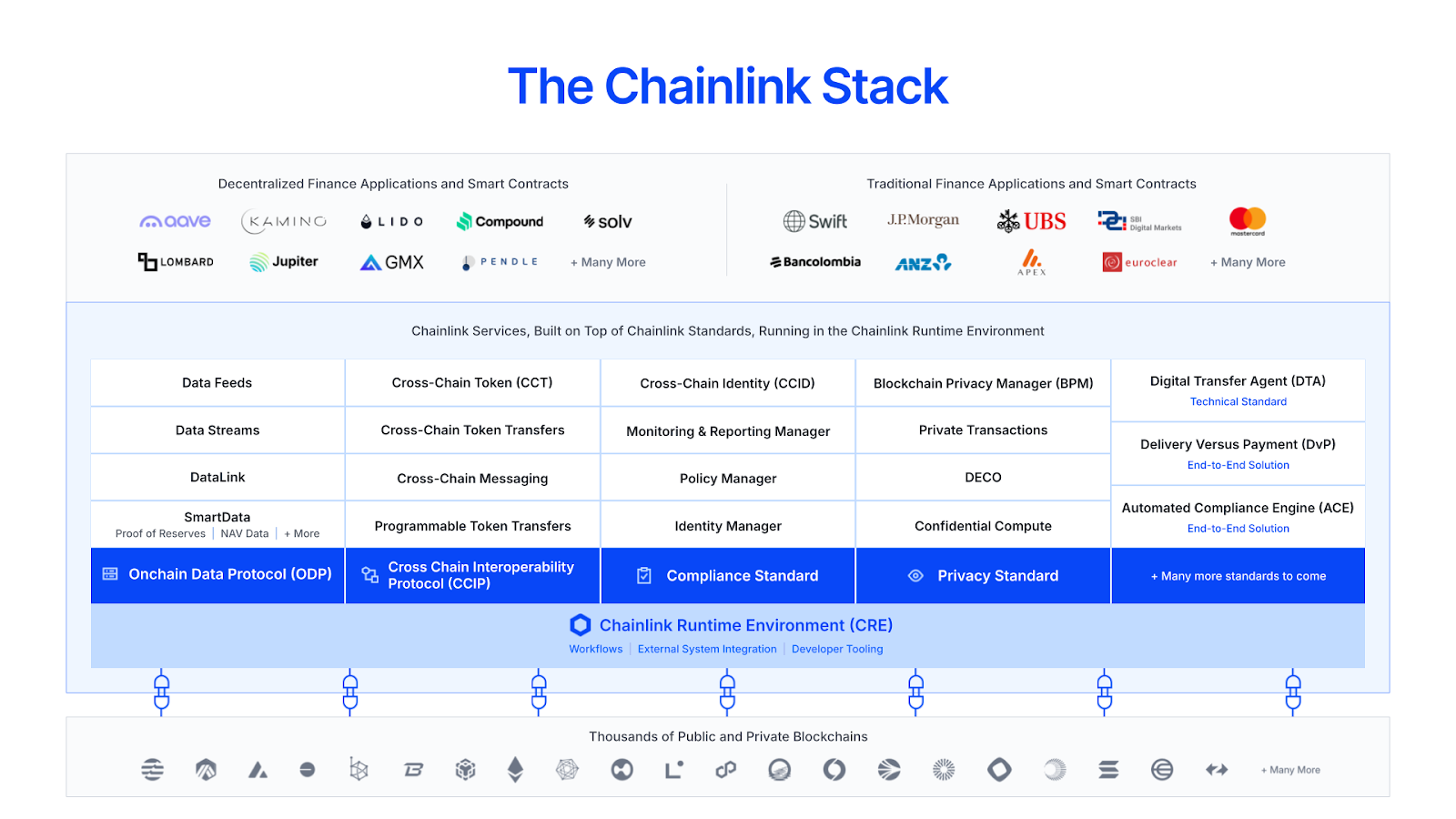
Blockchain Oracle Use Cases
Oracles unlock tokenized assets and advanced applications across a wider range of blockchain use cases. While there are potentially an infinite number of possibilities, below are some of the categories that have reached meaningful adoption.
Decentralized Finance (DeFi)
A large portion of DeFi relies on data oracles for access to financial data on assets and markets. For example, decentralized money markets use data oracles to determine asset prices when assessing users’ borrowing capacity and checking whether loans are undercollateralized. Similarly, synthetic asset platforms leverage data oracles to peg the value of tokens to real-world assets, while derivatives platforms reference data oracles when opening and closing positions.
Capital Markets and Tokenized Assets
In institutional finance, a wide range of oracles are used to support the full lifecycle of tokenized funds, bonds, and other real-world assets (RWAs). Oracle networks not only provide key market data for servicing tokenized assets, but they also automate compliance policy enforcement, protect the privacy of sensitive data and business logic, enable seamless value exchange between private and public blockchains, and connect existing banking and payment systems onchain. Learn more about oracle-powered capital market use cases.
Supply Chain
Supply chains automated by smart contracts leverage data oracles for exchange rates and to verify events, such as whether a package arrived on time. Cross-chain and compute oracles are also critical in facilitating compliance, ensuring privacy of sensitive trading details, and enabling settlement across different onchain and offchain systems.
Insurance
Insurance smart contracts use data oracles to verify the occurrence of insurable events during claims processing, giving them access to physical sensors, web APIs, satellite imagery, and legal data. Oracles also provide insurance smart contracts with a mechanism for making payouts on claims using other blockchains or traditional payment networks.
NFTs and Onchain Gaming
Oracles enable non-financial use cases for smart contracts too, such as dynamic NFTs—non-fungible tokens that can change in appearance, value, or distribution based on external events like the time of day or the weather. Additionally, oracles generate verifiable randomness to fairly select lucky winners in high-demand NFT drops or to create more unpredictable onchain gaming experiences, like randomized matchmaking.
AI
Artificial intelligence (AI) is utilizing oracles across several dimensions, including to:
- Aggregate responses from multiple LLMs to obtain a single trusted answer, helping protect against hallucinations.
- Train LLM models with private data while still preserving the privacy of such data.
- Provide verifiable compute for AI agents so users can verify that they ran exactly as programmed.
Oracles: The Missing Link
Oracles are the missing link to tokenization and smart contracts at scale. They provide all the critical services that blockchains can’t, including data connectivity, cross-chain interoperability, integration with existing systems, compliance, privacy, and automation.
With the onchain economy seeking to support more advanced applications and institutional use cases, oracle networks are now critical infrastructure. Similar to how the Internet brought forth a significant change in the way information is exchanged, oracle-powered smart contracts are redefining the way society exchanges value and enforces contractual agreements.


