Privacy-Preserving Identity Verification
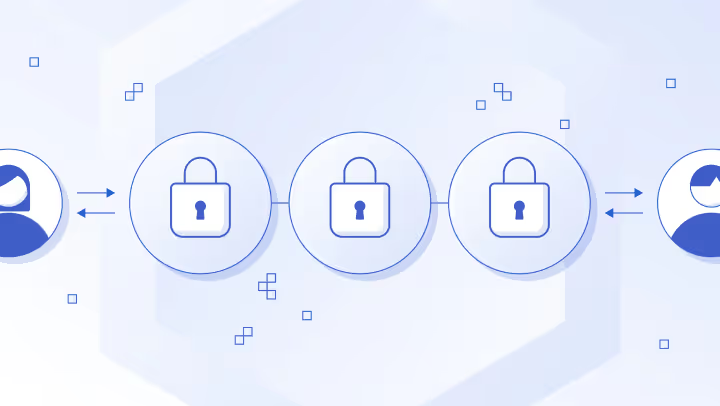
Privacy-preserving identity verification allows users to prove specific attributes (like age or accreditation) to a verifier without revealing the underlying sensitive data. By using cryptographic techniques like Zero-Knowledge Proofs (ZKPs), this approach resolves the conflict between blockchain transparency and data privacy laws.
The fundamental transparency of public blockchains creates a distinct conflict for the financial industry. While an immutable, public ledger offers trust and auditability, strict data privacy laws and the competitive necessity to keep trading strategies or client identities confidential often clash with it.
This paradox has historically limited institutional adoption of decentralized technologies. Banks and asset managers cannot broadcast client names on a public network, yet they must verify identities to meet Anti-Money Laundering (AML) and Counter-Terrorism Financing (CFT) regulations. The solution lies in privacy-preserving identity verification. This architectural shift decouples data verification from data storage, allowing institutions and protocols to verify who a user is—or what their qualifications are—without ever exposing their private information onchain. By using advanced cryptography, privacy-preserving verification enables a compliant market where regulatory requirements are met without compromising user privacy or institutional trade secrets.
The Core of Privacy-Preserving Identity
Traditional identity verification relies heavily on a "share-and-store" model. In this system, proving an attribute usually requires handing over the entire source document. To prove you are over 18, you might hand a bouncer your driver’s license, which reveals your exact birthdate, home address, and full legal name—far more data than is required for the specific check. In the digital realm, this results in centralized databases accumulating vast amounts of personal identifiable information (PII), creating honeypots that are attractive targets for hackers.
Privacy-preserving identity shifts this paradigm to a "verify-and-flag" model. Instead of sharing the raw document, the user generates a cryptographic proof that attests to a specific fact. The verifier receives a simple "True" or "False" confirmation without ever seeing the underlying data. For instance, a user can prove they are an accredited investor to a decentralized finance (DeFi) protocol without uploading their bank statements or tax returns to the blockchain. The protocol’s smart contract receives a verified flag—"Accredited: Yes"—allowing the transaction to proceed while the sensitive data remains offchain and in the user's control.
Key Enabling Technologies (ZKPs & MPC)
The transition to privacy-preserving verification is powered by specific cryptographic technologies that allow for computation and verification without data exposure.
Zero-Knowledge Proofs (ZKPs)
Zero-Knowledge Proofs allow a "prover" to demonstrate to a "verifier" that a specific statement is true without revealing the information used to prove it. In the context of identity, ZKPs can verify range proofs or set memberships. For example, a user can prove their assets exceed a certain threshold to qualify for an investment product without revealing their exact account balance. This ensures that onchain records contain only validity proofs, maintaining the integrity of the ledger while keeping raw PII completely offchain.
Multi-Party Computation (MPC) & TEEs
While ZKPs focus on the proof, Multi-Party Computation (MPC) and Trusted Execution Environments (TEEs) address the processing of sensitive data. MPC allows multiple parties to jointly compute a result—such as a credit score check across multiple banks—without any single party seeing the others' raw input data. TEEs provide hardware-level isolation, ensuring that even the node operator processing the verification cannot access the data inside the secure enclave. These technologies collectively enable a trusted verification layer that sits between private data sources and public blockchains.
The Role of Chainlink
Chainlink provides the essential infrastructure for connecting these privacy technologies to the onchain economy. Through the Chainlink Runtime Environment (CRE), developers can orchestrate privacy-preserving workflows that satisfy institutional compliance requirements while maintaining the benefits of blockchain technology.
Chainlink Privacy Standard: Confidential Compute
The Chainlink privacy standard enables high-integrity verification of sensitive data. Chainlink DECO is a privacy-preserving oracle protocol that utilizes ZKPs and TLS to verify data from any web server—such as a bank or government portal—without revealing the user’s login credentials or the raw data to the oracle. This allows users to attest to offchain facts using existing data sources. Furthermore, Chainlink Confidential Compute allows smart contracts to execute sensitive logic within a secure environment. An institution can run a proprietary risk model against private user data within CRE, generating an onchain result without ever exposing the model’s logic or the user’s inputs to the public ledger.
Chainlink Compliance Standard: ACE
The Chainlink compliance standard powers the Automated Compliance Engine (ACE), which allows institutions to enforce strict policy controls. ACE acts as a gatekeeper, checking transactions against allow lists or identity providers before they settle. By integrating with partners like GLEIF for Verifiable Legal Entity Identifiers, Chainlink allows protocols to verify institutional identity credentials instantly and securely.
Major Use Cases & Applications
Privacy-preserving identity is unlocking new categories of onchain finance by removing the barrier of data exposure.
Undercollateralized Lending
In the current DeFi landscape, most lending is overcollateralized because protocols cannot assess borrower risk without invasive data collection. Privacy-preserving identity allows borrowers to prove their creditworthiness or reputation score from offchain sources without doxxing their financial history. This enables more capital-efficient private lending markets where credit can be extended based on proven history rather than just collateral locked in a contract.
Institutional Proof of Reserve
Financial institutions can use Chainlink Proof of Reserve to prove they hold sufficient reserves to back a stablecoin or tokenized asset without revealing their exact wallet balances or the identities of their counterparties. This provides market confidence and transparency without sacrificing the commercial privacy required by large-scale asset managers.
Age Gating and Access Control
Digital platforms can restrict access to age-appropriate content or compliant jurisdictions without storing user data. A user can prove they reside in a permitted country or are above a legal age limit without revealing their physical address or birthdate. This reduces the compliance burden on the platform, as they do not have to secure and manage a database of sensitive user information.
The Future of Identity Verification
The transition to privacy-preserving verification is not merely about regulatory compliance; it is a fundamental upgrade to digital security. By eliminating centralized databases of user data, the Web3 space reduces the attack surface for massive data breaches and identity theft. As major institutions like Swift and Euroclear continue to collaborate with Chainlink to bring capital markets onchain, this privacy-first architecture will become the default standard for digital interaction, enabling a financial system that is both transparent in its integrity and private in its operation.