What Are Institutional Smart Contracts?
Institutional smart contracts use decentralized oracle networks to securely connect onchain logic with offchain data, systems, and computation. They are engineered to support global financial markets onchain by enabling access to trusted market data, embedded privacy and compliance, interoperability across blockchains and existing financial infrastructure, and integration with foundational emerging technologies like AI.
The migration of global capital markets to blockchain technology is accelerating. Early smart contracts powered the rise of decentralized finance (DeFi), but they were largely designed for open, single-chain environments, lacking the privacy, connectivity, and compliance tooling required by the world’s largest financial institutions. This gap has led to the necessity of a new type of institutional smart contract.
Institutional smart contracts are designed to operate within regulated financial systems. They connect to the world’s data and APIs, interface with existing financial infrastructure, enforce identity and compliance requirements, preserve data confidentiality and business logic, and coordinate workflows across multiple systems and blockchains from a single orchestration layer. As trillions of dollars in financial assets begin moving onchain—from an estimated $867 trillion global financial asset base that can be impacted by tokenization—these institutional contracts are foundational infrastructure for the next iteration of capital markets.
By using Chainlink, the industry-standard oracle platform bringing capital markets onchain, institutions can automate the full lifecycle of tokenized assets while remaining aligned with existing regulatory and operational requirements. This enables onchain finance at an institutional scale, where hundreds of trillions of dollars in onchain transaction value flows across markets globally.
Defining Institutional Smart Contracts
At their core, institutional smart contracts are just like traditional smart contracts: programmable agreements that execute automatically when predefined conditions are met. However, what distinguishes them from earlier versions is the greatly expanded scope of what a “smart contract” can do, particularly by combining onchain code with offchain resources via oracle networks.
Originally, a smart contract operated on a single blockchain. Its entire functionality was limited to that blockchain, including the data it has access to and its operational capacity. This limitation is acceptable for niche, isolated applications, but it’s incompatible with institutional finance.
Institutional smart contracts overcome this limitation by using oracle networks to support more advanced workflows, spanning multiple blockchains, external systems, and a wide range of services for data, compliance, privacy, AI, and more. They effectively translate complex financial processes—which often involve dozens of vendors and point integrations—into a single, coordinated workflow.
These institutional contracts serve as a single source of truth, verifiable by all transaction participants. In traditional finance, reconciliation between siloed ledgers can take days and introduce operational risk. Institutional smart contracts replace this fragmented coordination with a shared, programmable workflow and ledger state, enabling use cases such as Delivery-versus-Payment (DvP) settlement, in which assets and payments across blockchain and existing financial systems settle atomically, based on predefined conditions. If one leg fails, neither executes—eliminating counterparty risk.
Institutional smart contracts don’t replace existing financial systems—they integrate them with blockchains to streamline adoption. They leverage blockchains for immutable recordkeeping and settlement while using decentralized oracle networks (DONs) for all the services that blockchains can’t provide. This architecture allows institutions to preserve existing business logic and governance models while gaining the verifiability and automation of onchain execution.
Why Institutional Smart Contracts Are Needed Now
Banks, asset managers, and market infrastructures operate in a world of multi-system coordination. Financial workflows depend on market data, reference data, identity verification, compliance checks, payment systems, custodians, and clearing infrastructure, all of which exist outside any one blockchain.
The opportunity is massive, but so is the complexity. Institutional adoption has been held back not by a lack of blockchains, but by the challenge of orchestrating many different systems and services into a single workflow.
Core Components: The Institutional Smart Contract Stack
Institutional smart contracts need a robust and standardized infrastructure stack.
Data and Asset Intelligence
With the Chainlink data standard, institutions can bring high-fidelity financial data onchain through services such as:
- Chainlink Data Feeds for highly reliable pricing and market data
- Data Streams for high-frequency and low-latency data needs
- Chainlink SmartData, for enriching tokenized assets with institutional data, such as Net Asset Value (NAV) and Assets Under Management (AUM)
This ensures tokenized assets rely on the same trusted inputs used in traditional markets.
Cross-Chain Interoperability
The Chainlink interoperability standard, powered by the Cross-Chain Interoperability Protocol (CCIP), enables secure messaging and asset movement across blockchains. CCIP enables private bank chains, public networks, and tokenized asset platforms to interoperate without imposing unnecessary trust assumptions or requiring custom integrations.
Compliance, Identity, and Privacy by Design
Institutional smart contracts must be compliant by default.
The Chainlink compliance standard, supported by the Automated Compliance Engine (ACE), enables identity management and policy enforcement across blockchains and jurisdictions. Contracts can enforce allowlists, verify credentials, and automatically reject transactions that fail compliance checks—embedding regulatory logic directly into asset lifecycles, both within tokens and applications.
Privacy is equally critical. Institutions cannot expose proprietary strategies or client data on public ledgers. The Chainlink privacy standard enables confidential computing and private cross-chain transactions. For instance, Chainlink Confidential Compute enables smart contracts to execute sensitive workflows in secure environments where inputs, business logic, external system interactions, and computations remain fully confidential—all while providing verifiability that the workflows were executed exactly as intended.
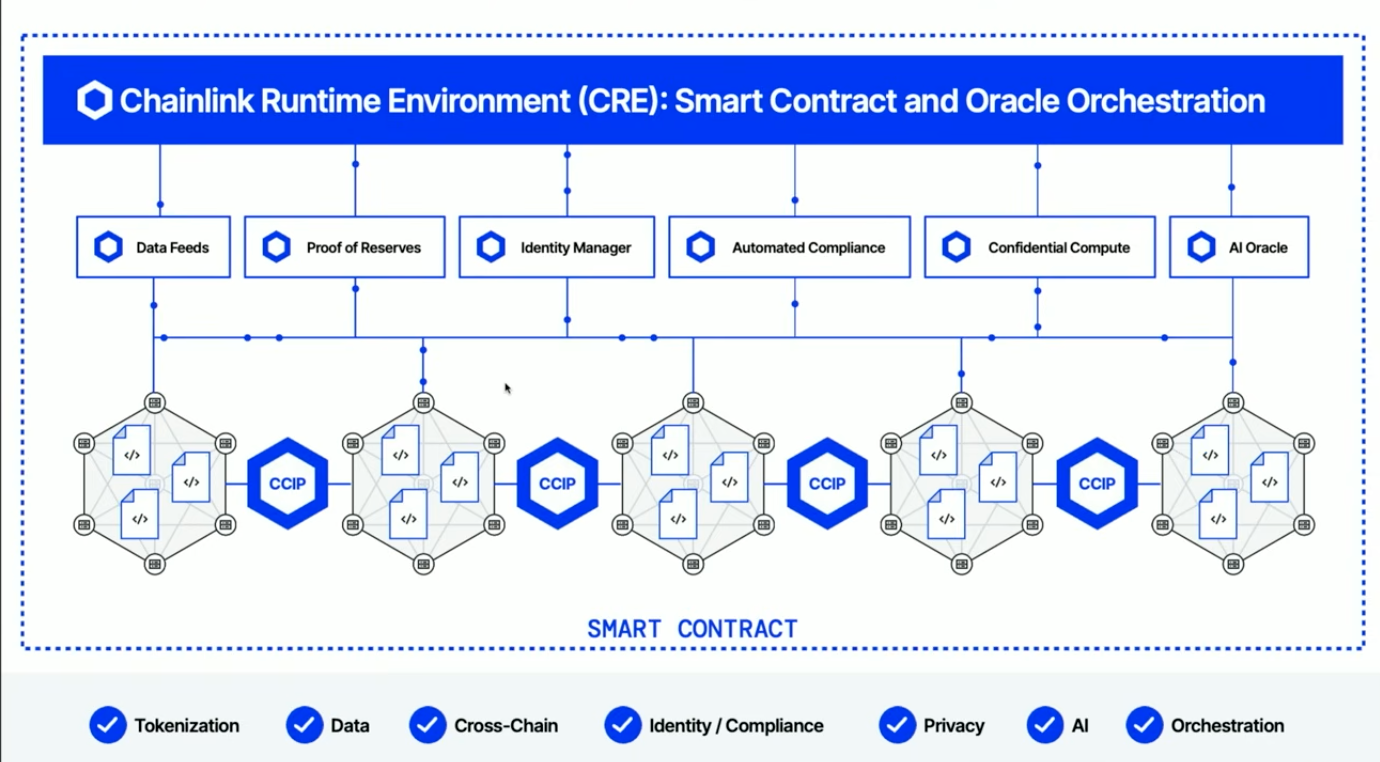
Orchestration via the Chainlink Runtime Environment (CRE)
As institutional workflows grow more complex, the number of required oracle services increases—data oracles, interoperability oracles, identity oracles, compliance oracles, and increasingly, AI-related oracles. Managing these components independently creates operational risk and slows adoption.
The Chainlink Runtime Environment (CRE) addresses this orchestration problem. CRE is the environment where developers run code that coordinates all required systems—across chains, oracle networks, compliance frameworks, and enterprise infrastructure—into a single executable workflow referred to as an institutional smart contract. It allows institutions to deploy multi-chain, multi-system applications without disrupting traditional enterprise system configurations, reducing integration time from months to days.
How an Institutional Smart Contract Operates
An institutional smart contract lifecycle can include:
- Translation: Legal agreements and term sheets are translated into programmable logic.
- Orchestration: Developers use CRE to coordinate data feeds, compliance checks, cross-chain messaging, and communication with existing systems, while embedding privacy where needed.
- Monitoring: The contract continuously monitors external conditions relevant to the contract, such as NAV updates or eligibility changes.
- Automated Execution: When predefined conditions are met, actions execute automatically in the exact order they are coded.
- Atomic Settlement: Assets and payments settle simultaneously via CCIP or existing financial rails, eliminating manual clearing and reconciliation.
Institutional Smart Contracts in Practice
Chainlink is already enabling institutions to leverage these institutional smart contract applications in production.
UBS: First End-to-End Tokenized Fund Operations with Chainlink CRE & DTA
In 2025, UBS completed the world’s first live in-production, end-to-end tokenized fund workflow leveraging the Chainlink Digital Transfer Agent (DTA) technical standard. In this live deployment, UBS executed an onchain subscription and redemption request of the UBS USD Money Market Investment Fund Token (uMINT) built on Ethereum.
DigiFT served as the onchain fund distributor, leveraging the DTA standard to request and process a subscription and redemption order. The workflow covered the full fund lifecycle—including order taking, execution, settlement, and synchronization across onchain and offchain systems.
This implementation demonstrates how institutional smart contracts extend beyond issuance into operational automation, replacing manual reconciliation with programmable, auditable workflows.
Atomic Settlement and Interoperability
Kinexys by J.P. Morgan and Ondo Finance successfully executed a cross-chain Delivery versus Payment transaction between Kinexys Digital Payments’ permissioned blockchain network and Ondo Chain testnet, with the CRE orchestrating end-to-end settlement.
The transaction involved the exchange of Ondo Chain’s Short-Term U.S. Government Treasuries Fund (OUSG) as the asset leg with Kinexys Digital Payments serving as the payment leg. CRE facilitated a seamless settlement between Kinexys Digital Payments and Ondo Chain’s testnet environment, while preserving enterprise-grade security, compliance, and scalability standards.
Global Connectivity and Standards
Chainlink has collaborated with Swift, DTCC, Euroclear, UBS, Wellington Management, and 20+ other leading financial organizations to modernize corporate actions processing workflows. CRE orchestrated the validation of multiple AI model outputs about a corporate actions event to arrive at a single trusted answer, which was then transformed into ISO 20022-compliant messages and transmitted to the Swift Network. In parallel, Chainlink CCIP distributed these same confirmed records across DTCC’s blockchain ecosystem and additional public and private blockchain environments, enabling simultaneous access across traditional infrastructure and blockchain-based platforms.
By standardizing how corporate actions data is extracted, validated, and delivered, the initiative creates a shared foundation for asset servicing across both blockchain networks and traditional financial infrastructure.
Security, Risk Management, and Observability
Institutional smart contracts use a defense-in-depth security model. Beyond audited code, they rely on decentralized oracle networks that provide Byzantine Fault Tolerant consensus, eliminating single points of failure.
These systems are reinforced by Chainlink’s industry-leading security standards, including several SOC 2 Type II and ISO 27001 certifications, reflecting the rigorous operational, data security, and risk controls required by regulated financial institutions.
Risk controls, such as circuit breakers and emergency pauses, can be triggered automatically if anomalies are detected—for example, if Proof of Reserve indicates undercollateralization or if price feeds exceed defined thresholds. CRE provides observability and access controls that align with institutional risk management practices.
The Future: AI-Enhanced Institutional Smart Contracts
The next evolution of institutional smart contracts involves using AI to enhance their capabilities. While traditional contracts are rigid, AI-driven agents can interpret nuanced terms, optimize collateral management, and dynamically rebalance portfolios.
The Chainlink platform serves as a gateway for both connecting to AI agents and providing verifiable computing for AI models and reporting the results back onchain. These AI-driven workflows will be orchestrated through CRE, ensuring transparency, auditability, and policy compliance.
The Next Stage of Financial Infrastructure
Institutional smart contracts represent the next stage of financial infrastructure. They transform onchain finance from a purely recordkeeping tool into a verifiable execution and coordination layer for global markets.
By providing standardized data, interoperability, compliance, privacy, and orchestration through CRE, the Chainlink platform enables institutions to move beyond experimentation and into production. As tokenization scales, institutional smart contracts will become the foundational building blocks of the global onchain economy.


