What is MiCA? EU’s Markets in Crypto-Assets Regulation Explained
MiCA (Markets in Crypto-Assets) is an EU regulation that sets out clear rules for crypto-assets, including stablecoins, utility tokens, and the platforms that support them.
MiCA—short for Markets in Crypto-Assets—is a major regulatory shift from the European Union. It’s the first attempt to create a single legal framework for crypto-assets across all 27 EU countries.
This guide explains what MiCA is, how it works, and why it matters—not just in Europe, but globally.
Key Takeaways
- MiCA gives crypto firms regulatory clarity across all 27 EU countries. This makes it easier to launch tokens and operate platforms in the region.
- MiCA compliance will take work, especially for smaller firms, but it could mean a more trusted and institution-friendly crypto market.
- Chainlink infrastructure supports MiCA-aligned operations, with tools for transparency, automation, and secure data handling.
What Is MiCA?
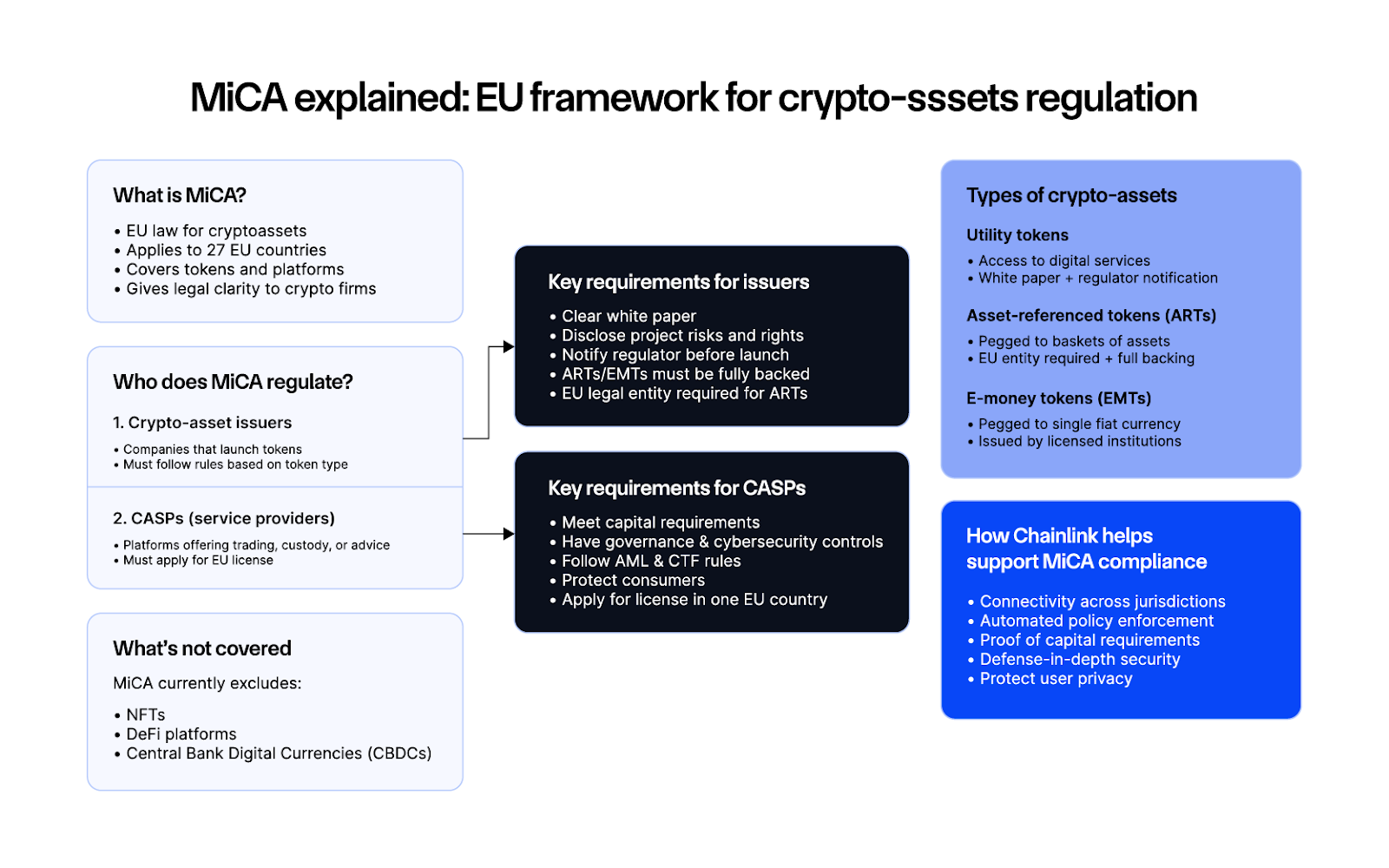
MiCA brings crypto into the EU’s existing financial regulatory structure. It defines the types of crypto-assets in scope—including stablecoins, tokenized assets, and utility tokens—and how they can be issued and traded. The framework also outlines who is responsible for enforcing its rules. By creating one harmonized rulebook, MiCA reduces regulatory fragmentation and gives crypto platforms legal certainty across the EU.
Before MiCA, crypto regulation was inconsistent across Europe. That made it difficult for companies to launch crypto-related products or services and scale across the EU. MiCA officially became EU law in June 2023, with the full regulation coming into force on December 30, 2024.
Key Objectives of MiCA
MiCA is designed to make crypto markets safer and more transparent. It provides investor protection and gives businesses a consistent set of rules to operate across the EU. If a firm is MiCA-licensed in one EU country, it can offer services across the entire bloc.
Who Does MiCA Regulate?
MiCA regulates two main groups:
- Crypto-asset issuers—companies that launch or manage tokens, including stablecoins.
- Crypto-asset service providers (CASPs)—platforms that offer crypto-asset trading, custody, portfolio management, or advisory services.
How MiCA Regulates Crypto-Asset Issuers
If a company wants to issue a crypto-asset to the public in the EU, it must follow a clear set of rules under MiCA. The process and obligations depend on the type of token issued. MiCA defines three main categories:
- Asset-referenced tokens (ARTs) link their value to an asset or basket of assets, such as currencies, commodities, crypto-assets, or other financial instruments. The idea is to provide more predictable value than a typical utility token. ARTs issuers must incorporate as a legal entity in the EU. Before launching a token, they need to submit a clear whitepaper to their National Competent Authority (NCA) for approval. They also need to hold sufficient reserves to back the tokens fully, so investors can redeem them at market value. If an ART meets certain size criteria—for example, more than 10 million holders—it may be classified as “significant”. Significant ARTs are directly supervised by the European Banking Authority (EBA) with stricter oversight and compliance requirements.
- E-money tokens (EMTs) are stablecoins pegged to a single fiat currency, like the euro. These must be issued by licensed credit or e-money institutions and supervised by NCAs. As with ARTs, EMTs should be fully backed by funds. It could be classified as significant if an EMT has over 2.5 million daily transactions or meets other key thresholds. In that case, the EBA supervises the EMT.
- Other crypto-assets like utility tokens don’t require full authorization under MiCA. However, issuers must still prepare a whitepaper and notify the national regulator before offering them to European investors. The white paper should include key information about the project, the rights attached to the token, and the risks. Additional requirements may apply if the token is listed on a trading platform or marketed to a broad audience, for example, more than 150 people per EU country.
Across all categories, issuers must provide clear disclosures, act in good faith, and put safeguards in place to protect users and market stability.
How MiCA Works for Crypto-Asset Service Providers (CASPs)
Any firm that offers crypto services in the EU must be licensed as a CASP. These services include:
- Custody and administration of crypto-assets.
- Operating a trading platform or crypto wallet.
- Executing orders and placing trades.
- Providing investment advice.
- Offering portfolio management or crypto transfer services.
To operate legally, CASPs must be registered in an EU member state and meet a set of baseline requirements. These include minimum capital requirements, governance and cybersecurity controls, and consumer protection policies.
CASPs must also follow anti-money laundering (AML) and counter-terrorism financing (CTF) rules. Once authorized, a CASP can operate in any EU country.
Significant CASPs (sCASPS) are firms that meet certain size and activity thresholds under MiCA. For example, a trading platform with over 15 million active users could be classified as significant. sCASPs are supervised by NCAs, and face additional oversight and compliance obligations. NCAs must also follow guidance from the European Securities and Markets Authority (ESMA) and the European Banking Authority (EBA) when supervising sCASPs. Non-significant CASPs remain under standard NCA oversight.
What’s Not Covered By MiCA?
MiCA regulations are still evolving, with some areas currently out of scope at this stage:
- Non-fungible tokens (NFTs): Tokens meant to represent unique digital or physical assets. MiCA generally excludes NFTs unless they are issued in large collections or marketed in ways that make them effectively fungible or financial in nature.
- Decentralized finance (DeFi): Financial service applications that operate on public blockchains don’t fall neatly into specific jurisdictions like the EU.
- Central bank digital currencies (CBDCs): Digital currencies issued by central banks might fall under separate regulations in the future.
How Chainlink Can Support MiCA Compliance
To be MiCA compliant, firms need infrastructure that supports transparency, automation, and secure data handling. Chainlink provides tools across all three areas:
Chainlink Data Feeds: Data Feeds bring offchain data—including price, FX rates, and NAVs—onchain in a secure and verifiable way. This helps issuers show that the token prices and redemption logic are based on real, up-to-date information. This added layer of onchain transparency builds trust with users, regulators, and counterparties.
Chainlink Proof of Reserve: Proof of Reserve lets firms provide verifications that stablecoins or tokenized assets are fully backed. It enables automated asset verification using onchain data, providing transparency for market participants.
Chainlink Automation: MiCA introduces rules that apply in specific situations, such as redemption windows, transaction limits, or investor restrictions. Chainlink Automation allows smart contracts to trigger actions automatically when those conditions are met. This reduces manual overhead and operational risk. Automating rule enforcement also helps firms support MiCA-aligned compliance by making controls more consistent, scalable, and easier to audit.
Chainink Cross-Chain Interoperability Protocol (CCIP): CCIP provides a secure way to move data and tokens between blockchains. This is especially useful when regulated activity spans multiple networks.
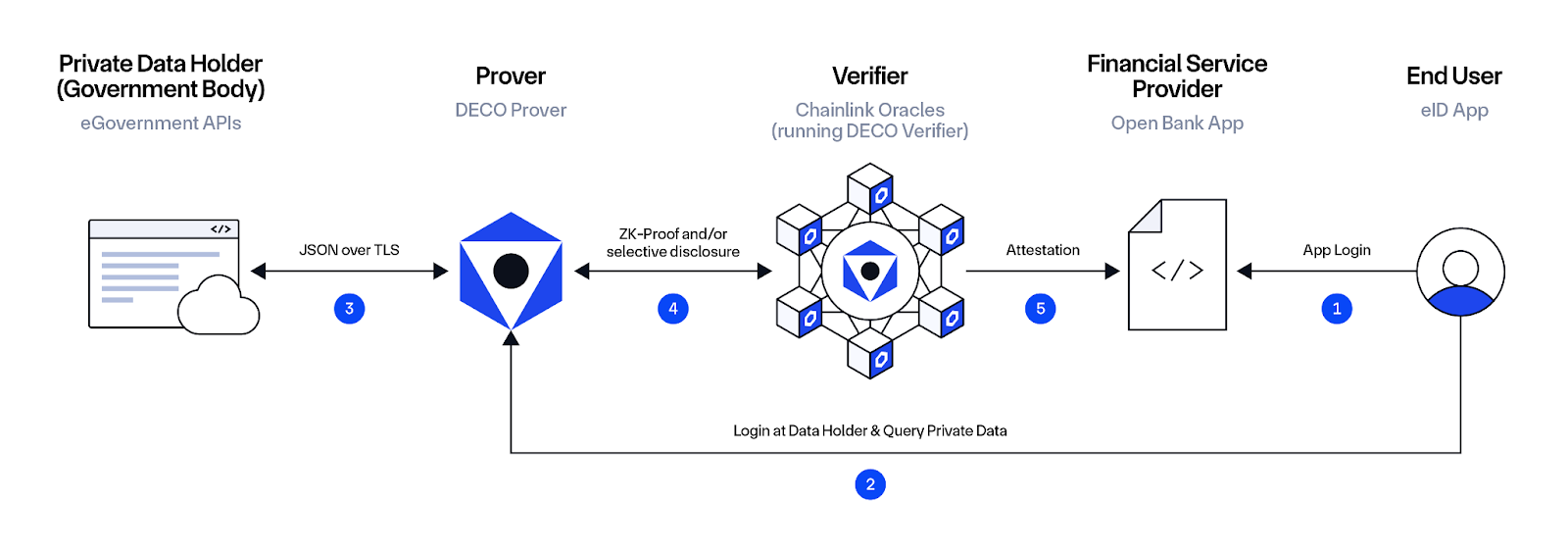
Chainlink DECO: MiCA requires Crypto-asset service providers (CASPs) to manage identity and sensitive data, generally in line with the EU’s General Data Protection Regulation (GDPR). DECO enables firms to verify information, like user identity, without exposing the underlying data or Personal Identifiable Information (PII). This helps support GDPR-aligned privacy practices while still meeting MiCA-related verification needs.
Chainlink Compliance Services: A set of smart contract tools that help firms define and enforce compliance rules onchain. Firms can set conditions around who can transact, when, and under which jurisdictions. They can then automate those controls across public and private blockchains. This helps support MiCA-aligned operations by bringing transparency, automation, and data controls into one programmable system—all with auditability built in.
While these tools don’t guarantee MiCA compliance, they provide the infrastructure needed to meet regulatory requirements more effectively.
Conclusion: MiCA and The Crypto Industry
MiCA is a turning point for crypto-assets in Europe. It gives the industry a clear rulebook, covering everything from issuing tokens to managing digital asset platforms. That means fewer gray areas, and a more reliable path for companies to build across the EU.
With clearer rules and better investor protections, the overall result is a more trusted and mature crypto market. MiCA could help bring in the next wave of institutional adoption, as long as firms have the right infrastructure in place.
Dive into more articles on the government and policy landscape for the blockchain industry.
____
Disclaimer: This post is intended for informational purposes only and does not constitute legal, financial, or regulatory advice. It discusses current and anticipated regulatory frameworks based on publicly available information as of the date first published. Regulatory requirements are subject to change and vary by jurisdiction. Readers should independently verify and seek professional advice regarding their specific legal and/or regulatory obligations. Chainlink Labs does not accept responsibility for compliance outcomes or legal and/or regulatory actions resulting from the use of its technologies or reliance on this information. Please review the Chainlink Terms of Service for more information.