Enterprise Data Privacy: Powering Institutional Finance Onchain
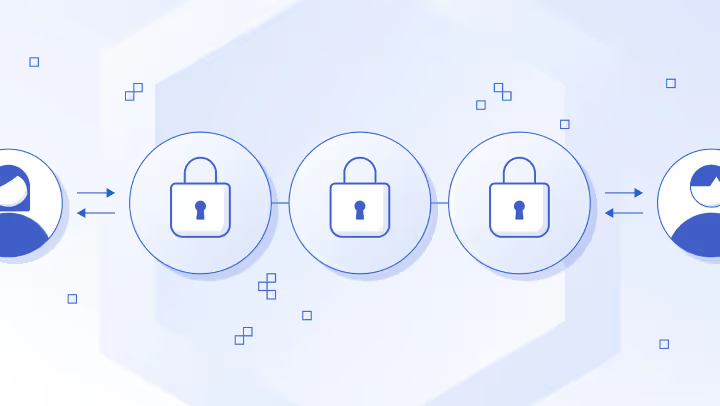
Enterprise data privacy onchain refers to the ability to protect sensitive data while maintaining the transparency and integrity of decentralized systems.
Institutional onchain finance reached a critical inflection point. While the transparency of public blockchains was once viewed as a barrier to entry, the maturation of the enterprise data privacy blockchain stack turned this challenge into a competitive advantage. Today, global financial institutions like Swift, ANZ, and Fidelity International are deploying production-grade systems that balance the trustless nature of decentralized ledgers with the need-to-know requirements of regulated capital markets.
The fundamental problem: how can an organization prove a transaction is valid without exposing proprietary trade secrets, client identities, or other sensitive information? The solution lies in the Chainlink platform, powering complex workflows across fragmented global networks without compromising privacy.
The State of Enterprise Data Privacy
Enterprise data privacy has evolved from a simple encryption task into a sophisticated strategic pillar. The industry moved beyond basic pseudonymity toward robust architectures that support selective disclosure. This shift is driven by the rise of application-specific blockchains (appchains) and modular architectures. These systems separate the execution of a transaction from the storage of its data, which helps enterprises maintain high performance and strict privacy.
Regulatory milestones, such as the 2025 passage of the U.S. GENIUS Act and expanded EU data oversight frameworks, mandate that blockchain systems must be compliant by design. Enterprises no longer choose between public and private chains. Instead, they adopt hybrid models where private subnets settle on public liquidity layers like Ethereum or a layer-2 solution, secured by Chainlink. These ecosystems rely on the Chainlink Privacy Standard to maintain data sovereignty while interacting with global liquidity.
Privacy-First Architectures: How It Works
Modern enterprise privacy relies on keeping sensitive business logic offchain while posting only cryptographic proofs to the ledger. This zero-knowledge approach allows a network to verify that a statement is true—for instance, that a borrower has sufficient collateral—without ever seeing the borrower's bank balance.
- Onchain vs. offchain data. Sensitive information remains in secure, private databases. Only the block hash or a unique digital fingerprint is stored onchain to ensure data integrity.
- Private data collections. Using Chainlink's Blockchain Privacy Manager, institutions define granular access control. This ensures only authorized parties see specific transaction details.
- Self-sovereign identity. Using decentralized identifiers, institutions verify the credentials of a counterparty—such as KYC/AML status—without storing identity documents on a shared ledger. This enables privacy-preserving identity compliance.
The orchestration of these moving parts is handled by The Chainlink Runtime Environment (CRE). CRE serves as the connective tissue between existing identity systems and onchain privacy protocols.
Smart Contracts and Confidentiality
Smart contracts are the engine of onchain finance, but they traditionally require all input data to be visible to the nodes executing the code. By using Chainlink Confidential Compute, smart contracts now execute within Trusted Execution Environments (TEEs)—secure hardware enclaves that protect data even from the node operator.
This technology enables private smart contracts that can process proprietary trading algorithms or sensitive cross-border payments. For example, a global bank can use Chainlink to trigger a payment once an offchain shipment reaches its destination. The system proves the condition was met without revealing the specific contents or value of the cargo to the public. This hybrid architecture provides the speed of centralized systems with the tamper-proof guarantees of the blockchain.
Overcoming the Right To Be Forgotten
One of the greatest hurdles for enterprise blockchain was the conflict between the immutability of the ledger and the right to be forgotten under GDPR. Instead of attempting to delete data from an immutable chain, organizations encrypt the data and store it offchain. When a deletion request occurs, the decryption keys are destroyed. This renders the onchain reference useless and ensures regulatory compliance.
Data minimization is the second pillar of this strategy. By using the Chainlink Privacy Standard, institutions prove facts about web-based data to a smart contract without the data ever leaving the original secure source. This ensures the blockchain never sees the sensitive data in the first place, which drastically reduces the compliance footprint for institutional stakeholders.
Enterprise Use Cases: Data Privacy in Action
The practical application of these technologies is most evident in the tokenization of real-world assets (RWAs). Institutions now move beyond simple T-bills into complex instruments like private credit and insurance.
- Institutional DeFi. Market makers can execute trades without being subject to frontrunning by bots scanning public transaction pools. This helps mitigate MEV (Maximal Extractable Value).
- Cross-chain settlement. Banks like ANZ use CCIP Private Transactions to move value across different blockchain networks while keeping transaction amounts and counterparty details hidden.
Security Challenges and Mitigation
Despite these advancements, the privacy landscape faces new challenges. Smart contract vulnerabilities remain a risk, as logic errors in privacy-preserving code can be harder to audit than transparent code. To mitigate this, institutional adopters use the Chainlink Compliance Standard and Chainlink's Automated Compliance Engine (ACE) to run real-time policy enforcement.
Furthermore, the management of private keys has shifted away from single points of failure toward multisig setups and multi-party computation (MPC). By splitting a key into multiple shares distributed across different nodes, enterprises ensure no single entity can ever access the full key. This provides a robust defense against internal and external breaches. All of these security layers are orchestrated through CRE, providing a unified management layer for the entire privacy stack.
Conclusion
Enterprise data privacy is essential for the global financial system to move onchain. By combining decentralized ledgers with the confidentiality of the Chainlink Privacy Standard, institutions reap the benefits of onchain efficiency without sacrificing the privacy required by law.